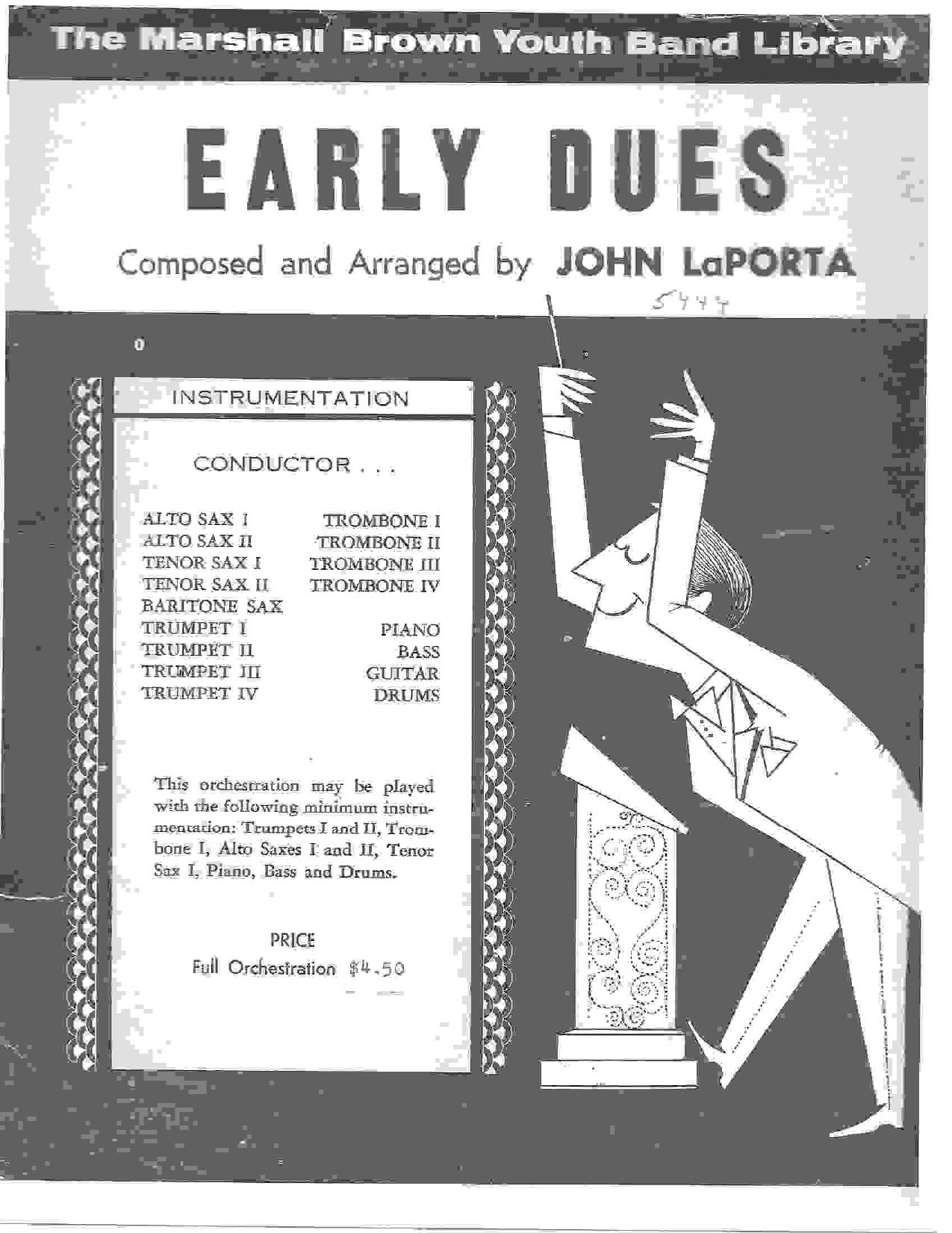
Early Dues (J.LaPorta) sheet music preview

Early Dues (J.LaPorta)

Composed by John LaPorta

Arranged by J.LaPorta

  • Ensemble: Big Band
  • Pages: 46
  • Instruments (18): Conductor, Alto Sax I, Alto Sax II, Tenor Sax I, Tenor Sax II, Baritone Sax, Trumpet I, Trumpet II, Trumpet III, Trumpet IV, Trombone I, Trombone II, Trombone III, Trombone IV, Piano, Guitar, Bass, Drums
  • Difficulty: medium
  • Content: Individual Parts
  • Format: PDF Download (Instant)
  • Price: $24.99

Rooted in the mid-century modern jazz ethos of New York’s creative underground, "Early Dues" captures the sophisticated, intellectual pulse of post-bop and progressive big band writing. Originally crafted within the circle of visionary multi-instrumentalist and educator John LaPorta—frequently associated with groundbreaking workshop recordings alongside luminaries like Charlie Mingus and Mal Waldron—this composition represents a fascinating bridge between traditional swinging big band instrumentation and the adventurous harmonic explorations characteristic of the 1950s and 1960s modernists. LaPorta’s writing reflects a deep commitment to ensemble polyphony, linear counterpoint, and rhythm section interactivity, elevating standard sectional arranging into an adventurous chamber-jazz experience for larger forces. Driven by a compelling medium-up swing feel in 4/4 time, the musical character balances an urbane, cool-school aesthetic with bursts of fiery, blues-infused modernism. The thematic material unfolds with linear agility, moving through clever chromatic descents, angular interval leaps, and sophisticated chord extensions that evoke the smoky ambiance of an intimate New York jazz club. The mood shifts dynamically between tense, anticipatory coolness and exuberant, full-ensemble swinging. Harmonically, LaPorta avoids predictable clichés, favoring altered dominants, modal colorings, and unexpected voicings that require the ensemble to listen closely across sections to maintain intonation and stylistic cohesion. The arranger’s treatment showcases a masterclass in texture and color distribution. Rather than relying on standard block-chord tutti writing throughout, LaPorta frequently splits the ensemble into conversational units, pitting crisp sax solis against muted brass counter-lines. The rhythm section functions as an equal partner rather than a mere time-keeping engine, with specific comping figures designed to push the soloists and drive the underlying groove. The melodic burden is shared democratically; woodwinds handle intricate linear statements while the brass interject with pointed staccato punches. A robust, harmonically rich shout chorus builds naturally out of the developmental section, providing a satisfying climax before resolving cleanly into the head-out. Advanced high school, collegiate, and professional big bands will find this chart an invigorating challenge that rewards meticulous rehearsal. While the technical demands require clean articulation, agile fingerwork in the woodwinds, and dependable range control in the upper brass, the primary hurdle lies in stylistic interpretation and swing subdivision. Performers must master the delicate balance between aggressive modern jazz phrasing and relaxed, laid-back placement. It stands as an exceptional repertoire choice for ensembles seeking to stretch their harmonic palettes and showcase sectional independence beyond standard swing-era arrangements. Navigating "Early Dues" successfully requires meticulous attention to articulation consistency and stylistic unity across the entire ensemble. The tempo should be anchored by a steady, driving medium-up swing feel where the underlying quarter note remains relaxed yet authoritative. Avoid rushing the syncopated figures; encourage the rhythm section to lean slightly into the backbeat to maintain the authentic mid-century jazz groove. Key technical hurdles involve navigating the angular intervallic leaps found in the saxophone and trumpet lines. Conductors should isolate these passages during sectional rehearsals, ensuring that eighth-note lines are articulated with traditional jazz phrasing—swinging the eighth notes lightly while accentuating the upbeat, off-beat syncopations. Brass players should utilize appropriate mutes (such as straight or cup mutes where indicated) to achieve the dry, focused timbres characteristic of the era, paying careful attention to dynamic shading so that background figures never obscure the primary melodic voice. Rehearsals should initially focus on achieving a unified dynamic contour, especially during passages where the melodic line is handed off rapidly between the saxophones and trombones. Ensure the rhythm section—particularly the piano and guitar—uses sparse, modal-friendly voicings that complement rather than clutter the rich harmonic structure embedded in the full score. Q: What instruments and parts are included in this arrangement? A: This 46-page big band publication includes a full conductor score alongside 17 individual instrumental parts: Alto Saxophone I, Alto Saxophone II, Tenor Saxophone I, Tenor Saxophone II, Baritone Saxophone, four trumpets, four trombones, piano, guitar, bass, and drums. Q: What is the appropriate difficulty level for this chart? A: This arrangement is best suited for advanced high school, collegiate, and professional jazz ensembles due to its sophisticated harmonies, angular lines, and required stylistic maturity. Q: What is the historical background and musical style of this piece? A: Composed in the post-bop and progressive jazz idiom of the 1950s and 1960s, it reflects the modern, forward-thinking writing style associated with John LaPorta and his contemporary New York jazz workshop circles. Q: What makes this specific arrangement unique? A: It stands out for its sophisticated linear counterpoint, conversational scoring between sections rather than constant tutti writing, and an equal emphasis on rhythm section interactivity and modern harmonic color. Q: What is the recommended tempo and performance duration? A: The arrangement is set to a driving, medium-up swing feel in 4/4 time, typically resulting in a performance duration of approximately 4 to 5 minutes depending on the length of improvised solo spaces.

Questions and answers

What is included in the Early Dues (J.LaPorta) PDF?
The verified current file contains a conductor score and individual parts across 46 pages.
How many instruments or parts are listed for Early Dues (J.LaPorta)?
The verified instrumentation list contains 18 entries for this Big Band arrangement.
Who is credited for Early Dues (J.LaPorta)?
Composer: John LaPorta. Arranger: J.LaPorta.
What difficulty is listed for Early Dues (J.LaPorta)?
The verified difficulty level is medium.
Can I preview Early Dues (J.LaPorta) before buying?
Yes. The product page provides a preview generated from the current PDF file.
How is Early Dues (J.LaPorta) delivered?
After successful payment, the digital PDF is made available for download. The displayed price is $24.99.

Musicians Also Search For

Early Dues J.LaPorta PDFEarly Dues J.LaPorta sheet musicEarly Dues arranged by J.LaPortaJ.LaPorta big band chartsJ.LaPorta jazz arrangements PDFEarly Dues John LaPorta sheet musicEarly Dues John LaPorta big band arrangementsJohn LaPorta big band chartsEarly Dues big band arrangementsEarly Dues big band PDF downloadEarly Dues jazz sheet musicbig band sheet music downloadEarly Dues conductor score PDFEarly Dues individual parts downloadEarly Dues sheet music PDFbuy Early Dues sheet musicdownload Early Dues PDFEarly Dues jazz chartsbest J.LaPorta big band arrangementsJohn LaPorta arranged by J.LaPortaEarly Dues printable sheet musicbig band repertoire PDF

All arrangements by J.LaPorta All John LaPorta sheet music