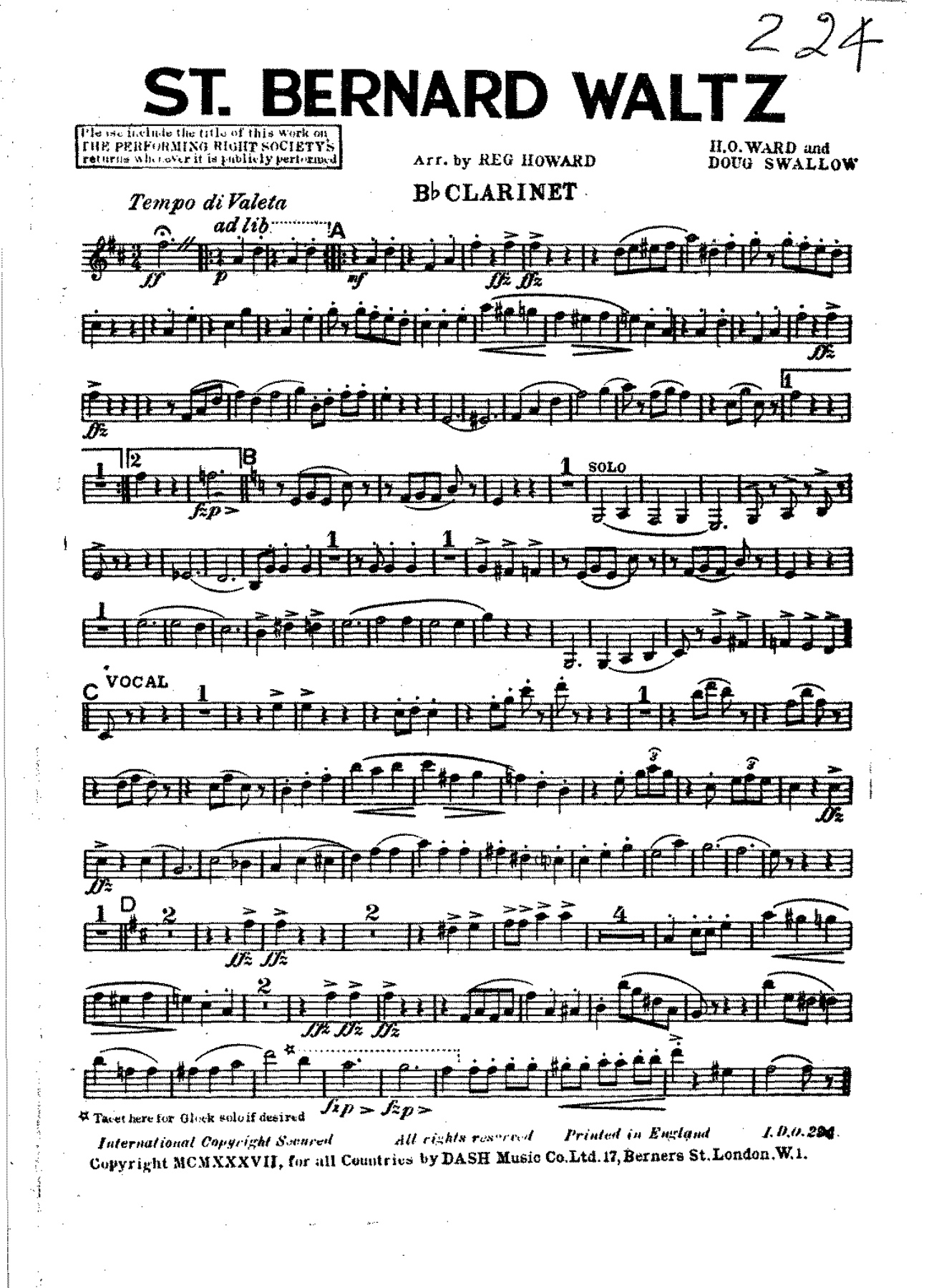
St.Bernard Waltz (R.Howard)
Composed by W.F. Higgins
Arranged by R. Howard
- Ensemble: Big Band Dance
- Style: Waltz
- Pages: 8
- Instruments (6): Bb Clarinet, 1st Eb Alto Saxophone, 2nd Eb Alto Saxophone, 1st Bb Tenor Saxophone, 2nd Bb Tenor Saxophone, Eb Baritone Saxophone
- Difficulty: easy
- Content: Individual Parts
- Format: PDF Download (Instant)
- Price: $24.99
The "St. Bernard Waltz," originally penned by W.F. Higgins, stands as a beloved classic in the repertoire of social dance music. While not a jazz standard in the conventional sense, its enduring popularity and charming melodic structure have made it a frequent subject for various instrumental treatments. This particular arrangement by R. Howard reimagines the traditional 3/4 waltz, infusing it with big band dance band sensibilities that harken back to the mid-20th century, an era when dance orchestras reigned supreme. It evokes the elegance and structured joy of ballroom dancing, offering a nostalgic yet vibrant take on a familiar tune. Howard's approach transforms the simple folk melody into a sophisticated big band chart, perfect for ensembles aiming to explore the dance band tradition. R. Howard's distinctive arrangement of "St. Bernard Waltz" is crafted for a full 17-piece big band, emphasizing rich, layered voicings and a smooth, flowing character. The musical character is a medium waltz, maintaining a consistent 3/4 feel throughout, set in a comfortable key that allows the brass to sing without strain. Howard demonstrates a keen understanding of big band orchestration, utilizing the full dynamic range of the ensemble. The melody is initially carried by the saxophones in a warm, blended soli, later transitioning to the brass for a more declarative statement. There are no improvised solo sections in this chart; instead, the focus is on the ensemble's precision and blend, with carefully crafted soli passages for each section. The arrangement features a beautiful modulation that lifts the energy before returning to the original key, showcasing Howard's ability to develop the piece harmonically while retaining its danceable quality. Performance of this arrangement requires a strong sense of ensemble cohesion and rhythmic accuracy, particularly in maintaining the consistent waltz feel across all sections. The technical challenges lie primarily in achieving a unified sound, precise articulation, and seamless transitions between dynamics. The brass sections will need to articulate clearly without overpowering the woodwinds, while the saxophones must blend impeccably in their soli passages. The rhythm section is crucial for establishing and maintaining the danceable pulse, with the bass and drums providing a steady, lilting foundation. What makes this piece rewarding to perform is its inherent charm and the opportunity for the band to showcase its collective precision and musicality in a style that is both classic and engaging. The arrangement is ideally suited for college and advanced high school jazz ensembles, as well as community big bands, that possess a solid grasp of ensemble playing and a desire to explore the dance band tradition. This arrangement of "St. Bernard Waltz" thrives on a consistent, flowing medium waltz tempo. Conductors should emphasize a clear, strong 3/4 pulse from the rhythm section, ensuring that all ensemble members feel and articulate within this established groove. Key technical challenges include precise ensemble articulation, especially in the saxophone and brass soli sections, and maintaining balanced dynamics to allow the melodic lines to project clearly. Pay close attention to the indicated articulations; they are vital for achieving the intended dance band character. There are no special techniques like plunger mutes or falls required, focusing instead on traditional big band phrasing. Rehearsal tips include isolating sax and brass soli passages to refine blend and intonation, and working with the rhythm section to establish a rock-solid, yet flexible, waltz feel that supports the entire band without being rigid. Encourage musicians to listen across sections to ensure a unified and elegant performance. Q: What instruments and parts are included in this arrangement? A: This arrangement is scored for a 17-piece big band, including Alto Saxophone 1 & 2, Tenor Saxophone 1 & 2, Baritone Saxophone, Trumpet 1-4, Trombone 1-4, Piano, Bass, Drums, and Guitar. Q: What is the difficulty level of R. Howard's "St. Bernard Waltz" arrangement? A: This arrangement is rated as medium difficulty, suitable for college, advanced high school, and community big bands. It demands strong ensemble playing, precise articulation, and a solid understanding of big band dynamics. Q: What is the musical style and historical context of this arrangement? A: This is a big band dance arrangement of the traditional "St. Bernard Waltz" by W.F. Higgins. It evokes the classic mid-20th century dance band era, featuring a smooth, elegant waltz feel rather than modern jazz improvisation. Q: What makes this particular arrangement unique compared to other versions of "St. Bernard Waltz"? A: R. Howard's arrangement stands out for its sophisticated big band orchestration, rich voicings, and the absence of improvised solos, focusing instead on ensemble precision, dynamic contrast, and a charming melodic development with a key modulation. Q: What is the typical performance duration and tempo for this piece? A: The performance duration typically ranges from 2:30 to 3:30 minutes, depending on the chosen medium waltz tempo, which should be consistent and danceable throughout.
Questions and answers
- What is included in the St.Bernard Waltz (R.Howard) PDF?
- The verified current file contains individual parts across 8 pages.
- How many instruments or parts are listed for St.Bernard Waltz (R.Howard)?
- The verified instrumentation list contains 6 entries for this Big Band Dance arrangement.
- Who is credited for St.Bernard Waltz (R.Howard)?
- Composer: W.F. Higgins. Arranger: R. Howard.
- What difficulty is listed for St.Bernard Waltz (R.Howard)?
- The verified difficulty level is easy.
- What style is listed for St.Bernard Waltz (R.Howard)?
- The catalog lists the style as Waltz.
- Can I preview St.Bernard Waltz (R.Howard) before buying?
- Yes. The product page provides a preview generated from the current PDF file.
- How is St.Bernard Waltz (R.Howard) delivered?
- After successful payment, the digital PDF is made available for download. The displayed price is $24.99.
Musicians Also Search For
St.Bernard Waltz R. Howard PDF • St.Bernard Waltz R. Howard sheet music • St.Bernard Waltz arranged by R. Howard • R. Howard big band dance charts • R. Howard jazz arrangements PDF • St.Bernard Waltz W.F. Higgins sheet music • St.Bernard Waltz W.F. Higgins big band dance arrangements • W.F. Higgins big band dance charts • St.Bernard Waltz big band dance arrangements • St.Bernard Waltz big band dance PDF download • St.Bernard Waltz jazz sheet music • big band dance sheet music download • St.Bernard Waltz individual parts download • St.Bernard Waltz sheet music PDF • St.Bernard Waltz Waltz charts • Waltz big band dance arrangements • buy St.Bernard Waltz sheet music • download St.Bernard Waltz PDF • St.Bernard Waltz jazz charts • best R. Howard big band dance arrangements • W.F. Higgins arranged by R. Howard • St.Bernard Waltz printable sheet music • big band dance repertoire PDF