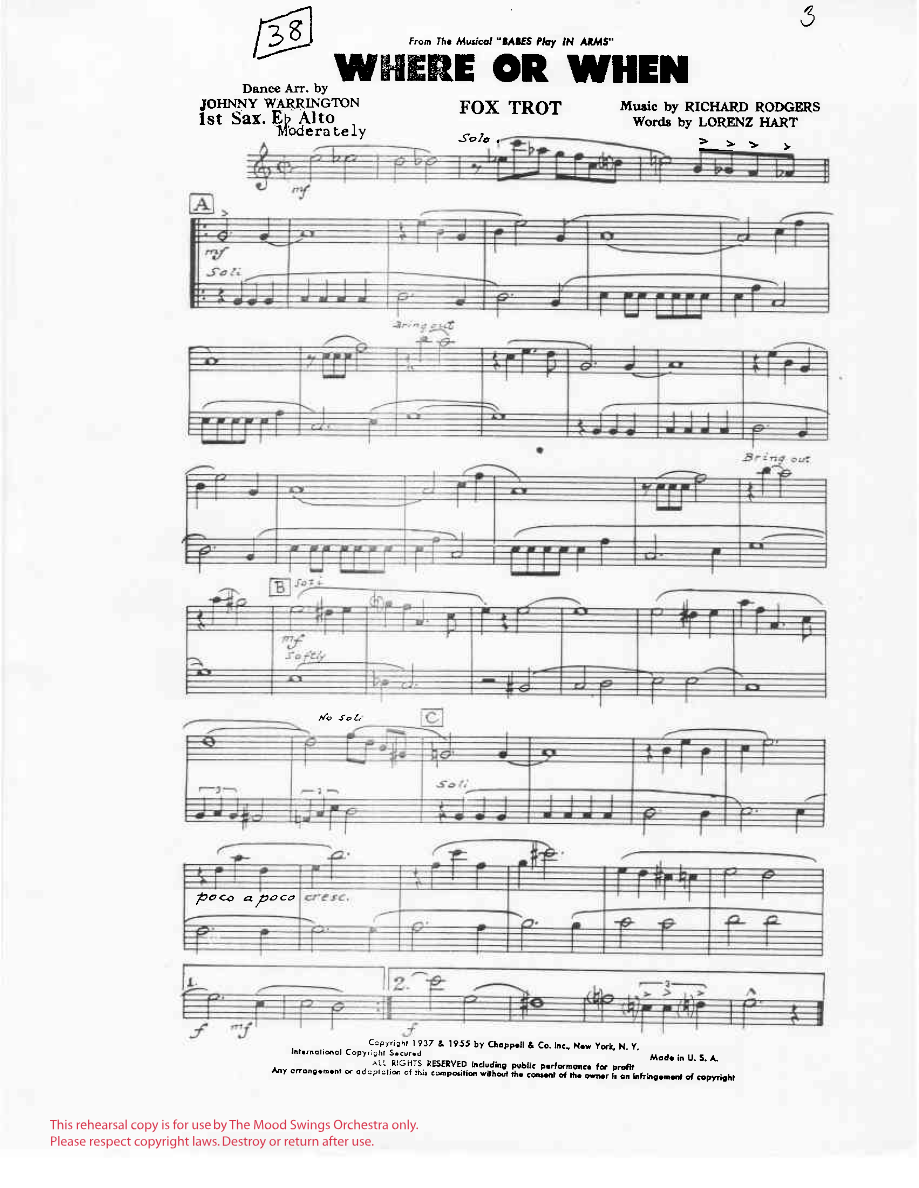
Where Or When (J.Warrington)
Composed by Richard Rodgers
Arranged by Johnny Warrington
- Ensemble: Big Band Dance
- Style: Waltz
- Pages: 17
- Instruments (17): Alto Saxophone 1, Alto Saxophone 2, Tenor Saxophone 1, Tenor Saxophone 2, Baritone Saxophone, Trumpet 1, Trumpet 2, Trumpet 3, Trumpet 4, Trombone 1, Trombone 2, Trombone 3, Bass Trombone, Piano, Bass, Drums, Guitar
- Difficulty: easy
- Content: Individual Parts
- Format: PDF Download (Instant)
- Price: $18.99
## SECTION 1: Description Richard Rodgers and Lorenz Hart's timeless ballad "Where Or When" premiered in the 1937 musical *Babes in Arms*, quickly establishing itself as a cornerstone of the Great American Songbook. This poignant tune, with its introspective lyrics and soaring melody, became a favorite of jazz vocalists and instrumentalists alike, embodying the sophisticated romanticism of the pre-World War II era. Its harmonic richness and memorable melodic contours have ensured its enduring appeal as a jazz standard, frequently explored for its improvisational potential and emotional depth. The song's enduring popularity is a testament to Rodgers' melodic genius and Hart's lyrical artistry, making it a staple in both Broadway and jazz repertoires. This Johnny Warrington arrangement reimagines "Where Or When" not as a ballad, but as a charming, medium-tempo jazz waltz. Set in the key of F Major, Warrington masterfully transforms the original's reflective nature into an elegant, danceable groove, while retaining its inherent beauty. The overall mood is sophisticated and buoyant, evoking the classic big band dance era. Warrington's signature style shines through with his characteristic full-bodied voicings and smooth transitions. The arrangement opens with a lush, harmonized statement of the melody, immediately setting the waltz feel. Warrington's treatment features a compelling interplay between sections. The melody is initially carried by the saxophones, often doubled or harmonized, before being passed to the brass for contrasting statements. Expect classic Warrington soli sections, where the saxophones or brass play intricate, harmonized lines together, showcasing the ensemble's blend and precision. While there isn't an extended open solo section, Warrington subtly integrates improvised fills and short melodic embellishments, allowing individual players to add their personal touch within the ensemble context. The technical challenges lie primarily in maintaining the precise waltz feel, achieving excellent balance within the thick voicings, and executing the clean articulation required for a dance band chart. The arrangement culminates in a satisfying, full-ensemble statement, bringing the piece to a polished close. This arrangement is ideally suited for college, community, and advanced high school jazz ensembles looking to broaden their repertoire beyond traditional swing and Latin charts. Its medium waltz tempo offers a refreshing rhythmic challenge and provides an excellent opportunity to develop ensemble precision, blend, and dynamic control. Performing this chart is rewarding for its elegant musicality and the chance to present a familiar standard in a distinctive, engaging style that honors the big band dance tradition. ## SECTION 2: Performance Notes Conductors should emphasize a consistent, flowing medium waltz feel (quarter note around 144-152 BPM), avoiding any tendency to rush or drag. The primary technical challenge lies in achieving precise ensemble blend and intonation within Warrington's rich, often dense voicings, particularly in the saxophone and brass soli sections. Encourage a warm, sustained tone from all sections. Articulation should be clean and light, especially on eighth-note passages, to maintain the danceable character. Dynamics are crucial; ensure clear contrast between piano and forte sections to highlight melodic lines and create musical shape. No special mutes or extended techniques are required, but a unified approach to phrasing and cutoffs will elevate the performance. Rehearsal should focus on sectionals to perfect intonation and balance, followed by full ensemble run-throughs to integrate the waltz feel and dynamic shaping. ## SECTION 3: FAQ Q: What instruments are included in this arrangement? A: This arrangement is scored for a standard 17-instrument big band: Alto Saxophone 1 & 2, Tenor Saxophone 1 & 2, Baritone Saxophone, Trumpet 1-4, Trombone 1-4, Piano, Bass, Drums, and Guitar. Q: What is the difficulty level of "Where Or When (J.Warrington)"? A: This arrangement is rated as Medium-Advanced. It requires solid instrumental technique, good ensemble blend, and an understanding of big band waltz phrasing, making it suitable for college, community, and advanced high school jazz ensembles. Q: What is the musical style and historical context of this arrangement? A: This is a classic big band dance arrangement of the Richard Rodgers standard "Where Or When," originally from the 1937 musical *Babes in Arms*. Johnny Warrington's treatment transforms the ballad into an elegant, medium-tempo jazz waltz, characteristic of the mid-20th century big band era. Q: What makes Johnny Warrington's arrangement of "Where Or When" unique? A: Warrington's signature style is evident in his lush, full-bodied voicings, smooth transitions, and transformation of the original ballad into a sophisticated jazz waltz. The arrangement features classic big band soli sections and a focus on ensemble precision and blend. Q: What is the approximate performance duration and recommended tempo for this piece? A: The approximate performance duration is 3-4 minutes, depending on the chosen tempo. A medium waltz tempo of around 144-152 beats per minute (quarter note) is recommended to capture the intended danceable feel.