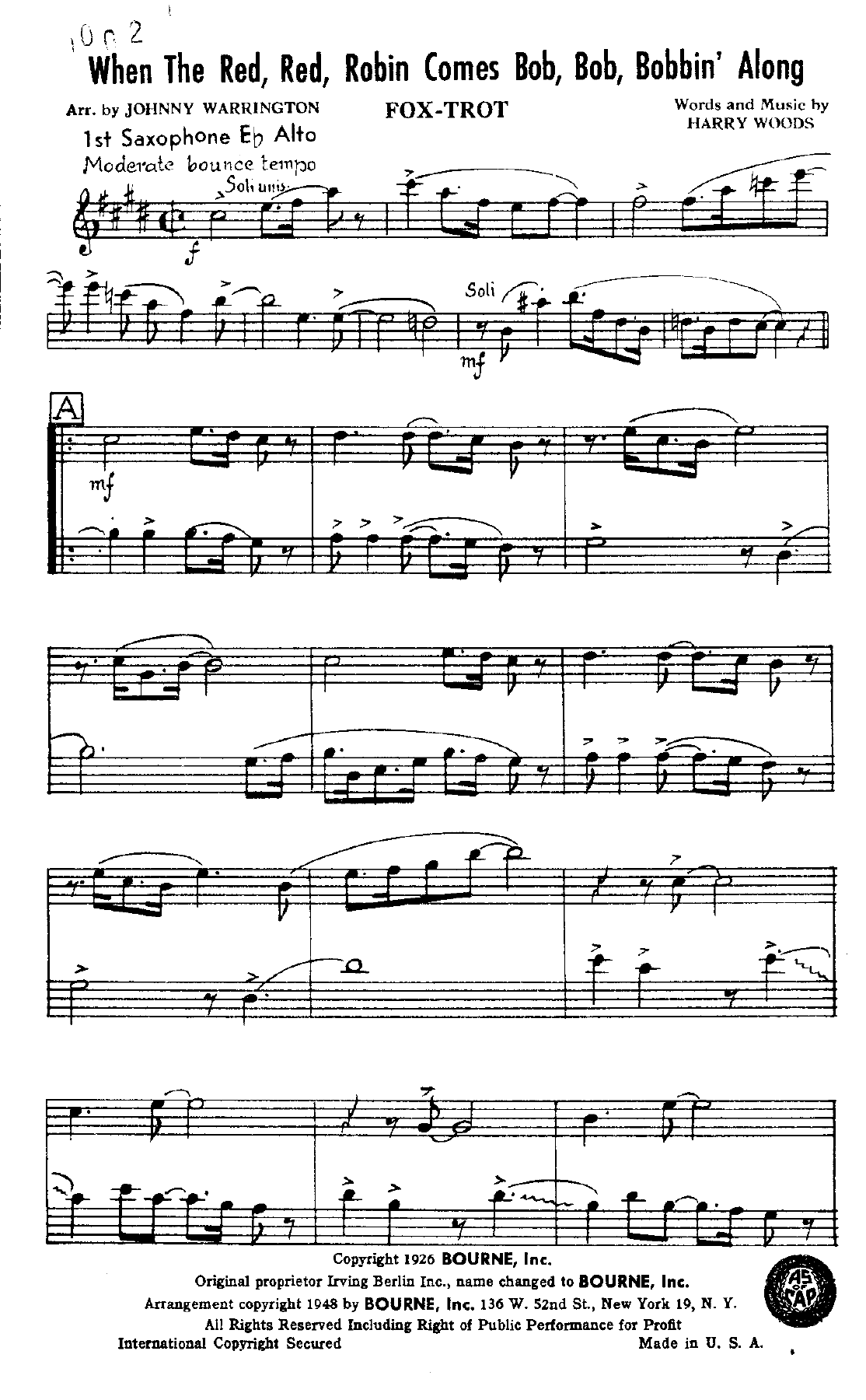
When The Red Red Robbin Bobbin (J.Warrington)
Composed by Harry Woods
Arranged by Johnny Warrington
- Ensemble: Big Band Dance
- Style: Waltz
- Pages: 44
- Instruments (15): 1st Saxophone Eb Alto, 2nd Saxophone Bb Tenor, 3rd Saxophone Eb Alto, 4th Saxophone Bb Tenor, Eb Baritone Saxophone, 1st Trumpet in Bb, 2nd Trumpet in Bb, 3rd Trumpet in Bb, 1st Trombone, 2nd Trombone, 3rd Trombone, Piano, Bass, Guitar, Drums
- Difficulty: medium
- Content: Individual Parts
- Format: PDF Download (Instant)
- Price: $24.99
Harry Woods' timeless classic, "When the Red, Red Robin (Comes Bob, Bob, Bobbin' Along)," first charmed audiences in 1926, quickly becoming a quintessential tune of the Roaring Twenties. This enduring melody, famously popularized by Al Jolson and later embraced by countless jazz and pop artists, embodies the optimistic spirit and melodic accessibility characteristic of the Tin Pan Alley era. It's a piece that evokes springtime, joy, and a nostalgic innocence, maintaining its status as a beloved standard due to its catchy, singable theme and harmonic simplicity, which lends itself beautifully to diverse interpretations across genres. Its enduring appeal lies in its straightforward, uplifting message and memorable melodic contours, making it instantly recognizable and perennially popular. Johnny Warrington’s arrangement of "When the Red, Red Robin" transforms this beloved standard into a delightful big band waltz, a less common but highly effective rhythmic setting for the tune. Warrington, renowned for his meticulous and often sophisticated charts for dance bands, approaches this piece with a refined touch, maintaining the original's bright, cheerful disposition while infusing it with a smooth, flowing 3/4 feel. The arrangement is set in the key of C major, offering a bright and accessible harmonic landscape. The overall mood is one of elegant cheerfulness, a sophisticated yet lighthearted dance number perfect for a concert program or a social event. Warrington's signature can be heard in the clean voicings and the tasteful interplay between sections, ensuring clarity and balance throughout. This particular arrangement is a masterclass in big band writing for the waltz idiom. The melody is skillfully passed between the saxophone section, often in unison or tight harmonies, and the brass, creating a rich textural variety. While there are no extended improvised solos, the arrangement features brief, melodic fills and counter-melodies that allow individual players to shine within the ensemble context. Warrington employs well-crafted soli sections, particularly for the saxophones, which require precise articulation and blend to achieve their full effect. The technical demands are moderate, focusing on rhythmic accuracy in 3/4 time, dynamic control, and ensemble precision rather than extreme ranges or virtuosic improvisation. The rewarding aspect of performing this piece lies in achieving its seamless flow and capturing its inherent charm, making it an excellent choice for developing bands looking to expand their repertoire beyond typical swing charts, or for more experienced ensembles seeking a refreshing and elegant addition to their program. This arrangement is ideally suited for high school and college jazz ensembles seeking to explore the waltz style within a big band setting. Its approachable key and moderate technical requirements make it manageable, while the emphasis on ensemble blend, rhythmic precision in 3/4, and dynamic shaping provides valuable educational opportunities. Community bands will also find it a charming and accessible piece, offering a pleasant change of pace from standard swing repertoire. Professional ensembles can use it as a delightful, polished feature, showcasing their versatility and ability to infuse classic tunes with fresh arrangements. Conductors should emphasize a consistent, flowing 3/4 pulse, avoiding any tendency for the waltz to feel rushed or stiff. A tempo around quarter note = 120-130 will allow the melodic lines to breathe while maintaining a danceable feel. Key technical challenges include precise articulation in the saxophone soli passages and achieving a unified sound across the ensemble, particularly in the sustained brass chords. Encourage a light, legato approach where appropriate, contrasting with crisp, detached figures. Dynamic contrast is crucial to highlight the melodic interplay; ensure crescendos and diminuendos are executed smoothly. There are no special techniques like mutes or falls indicated, focusing instead on fundamental big band execution. Rehearsal time should be dedicated to balancing the inner voices within the saxophone and brass sections, ensuring the melodic lines are always prominent and supported. Q: What instruments are included in this arrangement? A: This arrangement is scored for a standard 17-piece big band dance ensemble, including Alto Saxophone 1, Alto Saxophone 2, Tenor Saxophone 1, Tenor Saxophone 2, Baritone Saxophone, Trumpet 1-4, Trombone 1-4, Piano, Bass, and Drums. Q: What is the difficulty level of "When The Red Red Robbin Bobbin (J.Warrington)"? A: This arrangement is of moderate difficulty, suitable for high school, college, and community jazz ensembles. It emphasizes ensemble precision and rhythmic accuracy in a waltz feel rather than demanding extreme ranges or complex improvisation. Q: What is the musical style and historical context of this arrangement? A: This is a big band waltz arrangement of Harry Woods' classic "When the Red, Red Robin (Comes Bob, Bob, Bobbin' Along)" from 1926. It represents a sophisticated dance band interpretation of a Tin Pan Alley standard. Q: What makes Johnny Warrington's arrangement of "When The Red Red Robbin Bobbin" unique? A: Warrington's distinctive approach lies in transforming this well-known tune into a flowing big band waltz, a less common but elegant rhythmic setting. His signature clean voicings, tasteful soli sections, and emphasis on ensemble blend give it a refined character. Q: What is the typical performance duration or tempo for this piece? A: The arrangement is intended for a medium waltz tempo, around quarter note = 120-130. A typical performance duration would be approximately 2.5 to 3 minutes, depending on the chosen tempo and any optional repeats.
Questions and answers
- What is included in the When The Red Red Robbin Bobbin (J.Warrington) PDF?
- The verified current file contains individual parts across 44 pages.
- How many instruments or parts are listed for When The Red Red Robbin Bobbin (J.Warrington)?
- The verified instrumentation list contains 15 entries for this Big Band Dance arrangement.
- Who is credited for When The Red Red Robbin Bobbin (J.Warrington)?
- Composer: Harry Woods. Arranger: Johnny Warrington.
- What difficulty is listed for When The Red Red Robbin Bobbin (J.Warrington)?
- The verified difficulty level is medium.
- What style is listed for When The Red Red Robbin Bobbin (J.Warrington)?
- The catalog lists the style as Waltz.
- Can I preview When The Red Red Robbin Bobbin (J.Warrington) before buying?
- Yes. The product page provides a preview generated from the current PDF file.
- How is When The Red Red Robbin Bobbin (J.Warrington) delivered?
- After successful payment, the digital PDF is made available for download. The displayed price is $24.99.
Musicians Also Search For
When The Red Red Robbin Bobbin Johnny Warrington PDF • When The Red Red Robbin Bobbin Johnny Warrington sheet music • When The Red Red Robbin Bobbin arranged by Johnny Warrington • Johnny Warrington big band dance charts • Johnny Warrington jazz arrangements PDF • When The Red Red Robbin Bobbin Harry Woods sheet music • When The Red Red Robbin Bobbin Harry Woods big band dance arrangements • Harry Woods big band dance charts • When The Red Red Robbin Bobbin big band dance arrangements • When The Red Red Robbin Bobbin big band dance PDF download • When The Red Red Robbin Bobbin jazz sheet music • big band dance sheet music download • When The Red Red Robbin Bobbin individual parts download • When The Red Red Robbin Bobbin sheet music PDF • When The Red Red Robbin Bobbin Waltz charts • Waltz big band dance arrangements • buy When The Red Red Robbin Bobbin sheet music • download When The Red Red Robbin Bobbin PDF • When The Red Red Robbin Bobbin jazz charts • best Johnny Warrington big band dance arrangements • Harry Woods arranged by Johnny Warrington • When The Red Red Robbin Bobbin printable sheet music • big band dance repertoire PDF