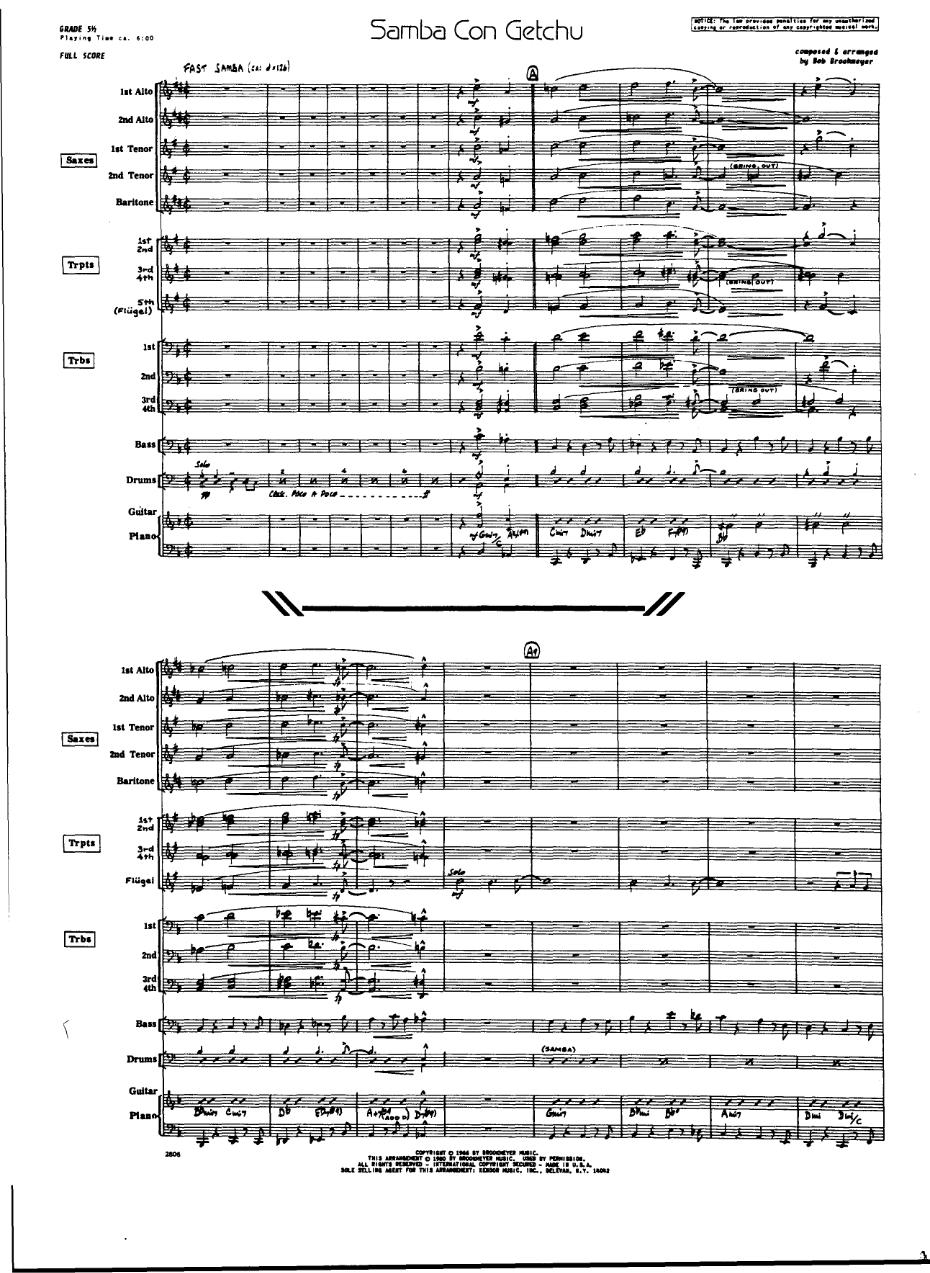
Samba Con Getchu (B.Brookmeyer)
Composed by Bob Brookmeyer
Arranged by Bob Brookmeyer
- Ensemble: Big Band
- Style: Jazz Standard
- Pages: 65
- Instruments (17): 1st Eb Alto Sax, 2nd Eb Alto Sax, 1st Bb Tenor Sax, 2nd Bb Tenor Sax, Eb Baritone Sax, 1st Trumpet, 2nd Trumpet, 3rd Trumpet, 4th Trumpet, 5th Trumpet/Flügelhorn, 1st Trombone, 2nd Trombone, 3rd Trombone, 4th Trombone, Piano/Guitar, Bass, Drums
- Difficulty: advanced
- Content: Individual Parts
- Format: PDF Download (Instant)
- Price: $24.99
"Samba Con Getchu," composed and arranged by the visionary Bob Brookmeyer, stands as a quintessential big band chart from the fertile period of the late 1960s, specifically 1967. This era saw Brookmeyer deeply involved with the groundbreaking Thad Jones/Mel Lewis Jazz Orchestra, for which he penned several of his "stone classics," including this vibrant samba. Brookmeyer, a celebrated valve trombonist, pianist, composer, and arranger, was a pivotal figure in cool jazz and West Coast jazz, later evolving his compositional style to incorporate elements of 20th-century classical music, drawing inspiration from composers like Stravinsky and Bartók. His work with the Gerry Mulligan Concert Jazz Band and later the Thad Jones/Mel Lewis Orchestra cemented his reputation as a master of large ensemble writing, known for his ability to create music that felt both expansive and intimately detailed. The musical character of "Samba Con Getchu" is defined by its infectious Latin groove, specifically a driving samba feel that permeates the entire piece. While the exact key can vary in performance, the overall mood is one of joyous energy and sophisticated rhythmic interplay, characteristic of the Thad Jones/Mel Lewis sound. It evokes a sense of vibrant movement and intricate conversation between sections, making it a captivating experience for both performers and listeners. The piece showcases Brookmeyer's mastery of blending rhythmic propulsion with harmonic depth, creating a sound that is both accessible and intellectually stimulating. Brookmeyer's arranging approach in "Samba Con Getchu" is a testament to his unique voice in big band jazz. He masterfully employs his signature techniques, including dense, often angular voicings that create rich harmonic textures, and intricate counterpoint between sections. Unlike many big band charts that rely on repetitive riff-based structures, Brookmeyer's compositions, including this one, unfold organically, taking the listener on a journey through carefully constructed musical episodes. Expect sophisticated soli sections where different instrumental groups engage in complex melodic and rhythmic dialogues, demanding precision and blend from the ensemble. While specific shout choruses are present, they are often integrated into a larger, evolving musical narrative rather than serving as standalone climaxes. The piece features opportunities for improvised solos, typically over the samba form, allowing individual voices to shine within the larger ensemble context. Performing "Samba Con Getchu" is an immensely rewarding experience, though it presents significant technical challenges. The intricate rhythmic figures and precise ensemble playing require a high level of musicianship. The melody often shifts between sections—sometimes carried by the brass, other times by the saxophones, and occasionally in unison or octaves for maximum impact. The piece is most appropriate for advanced high school, college, community, and professional big bands. Its demands on rhythmic accuracy, harmonic understanding, and ensemble cohesion make it an excellent vehicle for developing sophisticated large ensemble skills, pushing musicians beyond conventional big band repertoire. Navigating "Samba Con Getchu" requires meticulous attention to rhythmic precision and dynamic contrast. The primary technical challenge lies in maintaining the authentic samba feel throughout, ensuring that the rhythmic figures are executed with crispness and a unified pulse, particularly in the intricate soli passages. Conductors should emphasize a light, buoyant articulation, avoiding a heavy or overly aggressive approach. The tempo should be vibrant, typically around quarter note = 180-200, to capture the danceable essence of the samba. Encourage sections to listen across the band, focusing on blend and balance, especially when melodic lines are passed between brass and woodwinds. There are no specific extended techniques like plunger mutes or falls indicated, but a keen sense of jazz articulation—ghost notes, breath accents, and dynamic shaping—is crucial. Rehearsal tips include isolating challenging rhythmic figures, practicing them slowly with a metronome, and gradually increasing tempo. Focus on the interplay between the rhythm section and the horns, ensuring the bass and drums provide a solid, yet flexible, foundation for the ensemble's intricate lines. Q: What instruments are included in this arrangement of "Samba Con Getchu"? A: This big band arrangement is scored for 18 instruments, including Alto Saxophone 1 & 2, Tenor Saxophone 1 & 2, Baritone Saxophone, Trumpet 1-4, Trombone 1-4, Guitar, Piano, Bass, and Drums. The full score is also included. Q: What is the difficulty level of "Samba Con Getchu (B.Brookmeyer)"? A: This arrangement is considered advanced, suitable for college, community, and professional big bands due to its complex rhythmic figures, sophisticated harmonies, and demanding ensemble passages. Q: What is the musical style and historical context of "Samba Con Getchu"? A: "Samba Con Getchu" is an original jazz standard composed in 1967 by Bob Brookmeyer, known for its vibrant Latin groove, specifically a samba feel, and represents Brookmeyer's innovative writing during his tenure with the Thad Jones/Mel Lewis Jazz Orchestra. Q: What makes Bob Brookmeyer's arrangement of "Samba Con Getchu" unique? A: Brookmeyer's distinct compositional style is evident in its intricate counterpoint, angular voicings, and the organic development of musical ideas, moving beyond typical big band structures to create a sophisticated and continuously evolving piece. Q: What is the typical performance duration or tempo for this piece? A: While performance duration can vary with improvised solos, the piece is typically performed at a vibrant samba tempo, around quarter note = 180-200 beats per minute.
Questions and answers
- What is included in the Samba Con Getchu (B.Brookmeyer) PDF?
- The verified current file contains a conductor score and individual parts across 65 pages.
- How many instruments or parts are listed for Samba Con Getchu (B.Brookmeyer)?
- The verified instrumentation list contains 17 entries for this Big Band arrangement.
- Who is credited for Samba Con Getchu (B.Brookmeyer)?
- Composer: Bob Brookmeyer. Arranger: Bob Brookmeyer.
- What difficulty is listed for Samba Con Getchu (B.Brookmeyer)?
- The verified difficulty level is advanced.
- What style is listed for Samba Con Getchu (B.Brookmeyer)?
- The catalog lists the style as Jazz Standard.
- Can I preview Samba Con Getchu (B.Brookmeyer) before buying?
- Yes. The product page provides a preview generated from the current PDF file.
- How is Samba Con Getchu (B.Brookmeyer) delivered?
- After successful payment, the digital PDF is made available for download. The displayed price is $24.99.
Musicians Also Search For
Samba Con Getchu Bob Brookmeyer PDF • Samba Con Getchu Bob Brookmeyer sheet music • Samba Con Getchu arranged by Bob Brookmeyer • Bob Brookmeyer big band charts • Bob Brookmeyer jazz arrangements PDF • Samba Con Getchu Bob Brookmeyer big band arrangements • Samba Con Getchu big band arrangements • Samba Con Getchu big band PDF download • Samba Con Getchu jazz sheet music • big band sheet music download • Samba Con Getchu conductor score PDF • Samba Con Getchu individual parts download • Samba Con Getchu sheet music PDF • Samba Con Getchu Jazz Standard charts • Jazz Standard big band arrangements • buy Samba Con Getchu sheet music • download Samba Con Getchu PDF • Samba Con Getchu jazz charts • best Bob Brookmeyer big band arrangements • Samba Con Getchu printable sheet music • big band repertoire PDF