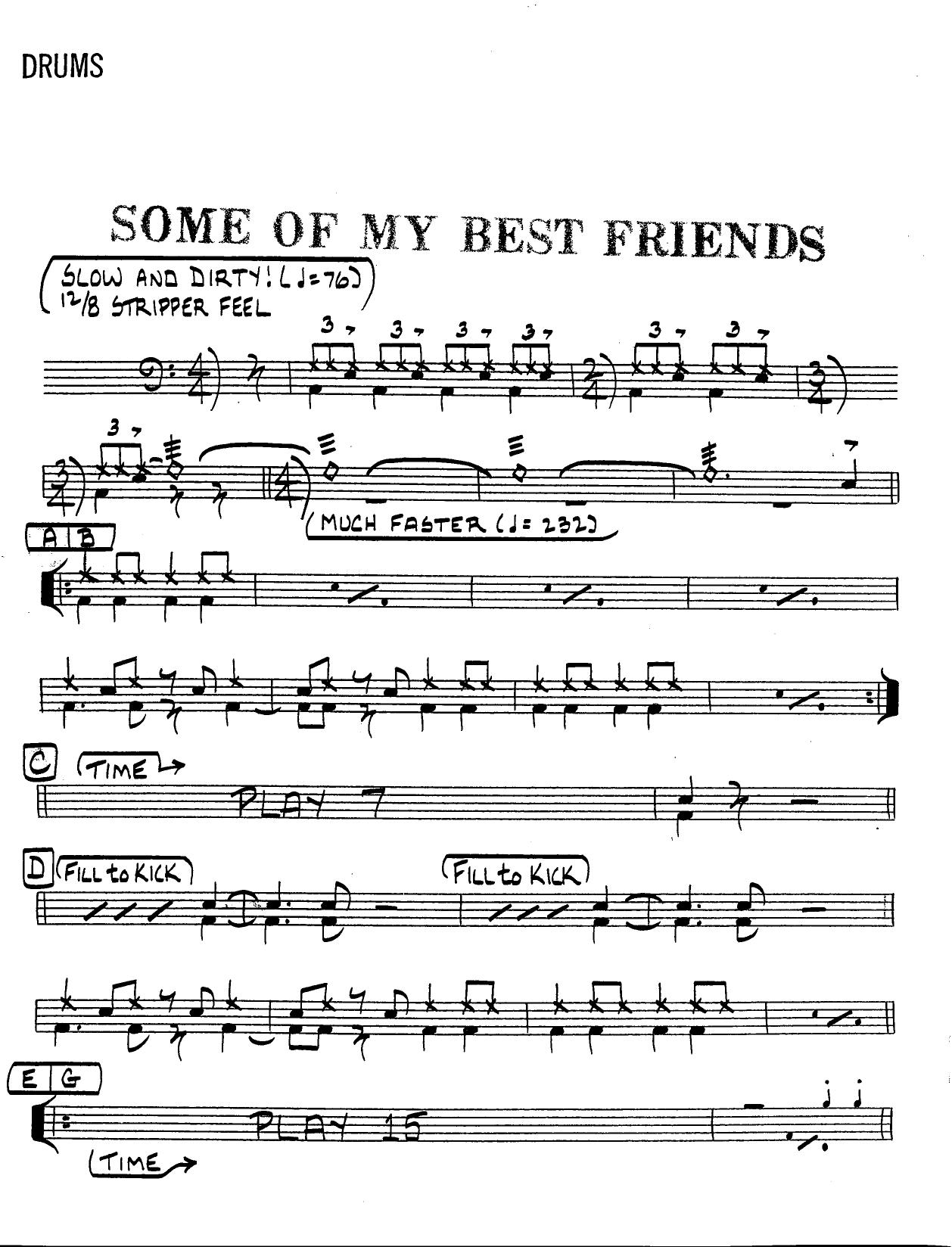
Some Of My Best Friends B.Brookmeyer (B.Brookmeyer) sheet music preview

Some Of My Best Friends B.Brookmeyer (B.Brookmeyer)

Composed by Bob Brookmeyer

Arranged by Bob Brookmeyer

  • Ensemble: Big Band
  • Pages: 79
  • Instruments (17): Drums, 1st Woodwind Alto Sax, 2nd Woodwind Alto Sax, 3rd Woodwind Tenor Sax, 4th Woodwind Tenor Sax, 5th Woodwind Baritone Sax, 1st Trumpet, 2nd Trumpet, 3rd Trumpet (Jazz), 4th Trumpet (Jazz), 1st Trombone, 2nd Trombone, 3rd Trombone (Solo), 4th Bass Trombone, Piano, Guitar, Bass
  • Difficulty: advanced
  • Content: Individual Parts
  • Format: PDF Download (Instant)
  • Price: $24.99

Masterminded by one of modern jazz’s most distinctive compositional voices, "Some Of My Best Friends" captures the sophisticated, witty, and harmonically rich aesthetic that defined Bob Brookmeyer's writing during his seminal mid-century era. Emerging from the vibrant post-bop and modern big band tradition, Brookmeyer’s writing bridges the gap between classic swing-era sectional warmth and advanced, contrapuntal modernism. Known for his work with Gerry Mulligan and the Thad Jones/Mel Lewis Orchestra, Brookmeyer approaches the ensemble not merely as a block-voicing machine, but as a flexible chamber jazz organism. This arrangement reflects a period when jazz composers were stretching functional harmony, incorporating clever counterpoint, and demanding a high level of linear independence from every section in the orchestra. Musically, the chart sits comfortably in a driving, medium-up 4/4 swing groove characterized by an infectious forward momentum and playful articulation. The mood shifts effortlessly between sophisticated urban cool and high-energy, brass-driven excitement. Brookmeyer utilizes unusual intervallic leaps, tight cluster voicings, and shifting tonal centers that evoke a sense of surprise and sophisticated urbanity. Rather than relying on predictable chord progressions, the harmonic landscape is peppered with altered dominants and chromatic mediants, creating an emotional depth that rewards repeated listening and close ensemble analysis. The arranger’s signature approach is immediately evident in the ingenious distribution of thematic material across non-traditional instrument pairings. Instead of standard tutti blocks, Brookmeyer frequently pits lighter woodwind textures against dark, murmuring trombone sub-mixes, showcasing his deep affinity for the lower-register palette. The chart features meticulously crafted soli sections where inner voices move with horizontal grace, requiring absolute precision in phrasing and intonation. Dynamic contrasts are sharp and deliberate, moving from whispered, sub-tone saxophone lines to roaring shout choruses that utilize wide-interval brass writing to maximize acoustic impact without sacrificing clarity. Performance-wise, the melody is passed organically through the saxophone and brass sections, demanding agile fingerwork and a mature concept of jazz articulation. Featured solo space allows improvisers to stretch out over sophisticated changes, while the rhythm section is given ample room to push the beat with an elastic, interactive feel. Technical demands include navigating rapid accidental-heavy lines, maintaining balance across extreme registers, and executing crisp swing eighth-note subdivisions at a brisk tempo. Advanced college ensembles, community jazz orchestras, and professional big bands will find this 79-page manuscript an exhilarating challenge that elevates the sophistication of any program. Navigating this chart successfully requires careful attention to balance and articulation, particularly within the inner voices. The tempo should be kept steady and buoyant; avoid rushing the medium-up swing feel, as Brookmeyer’s intricate counterpoint relies on a relaxed, conversational time-feel to speak clearly. Key technical challenges involve the execution of wide-interval leaps and chromatic lines embedded deep within the horn sections. Conductors should rehearse sectional passages independently, ensuring that dynamic swells match precisely across disparate instrument families. Mutes are generally kept standard, though players should emphasize a dry, articulate tone over excessive vibrato to match the modern post-bop ethos. Pay close attention to dynamic markings; the contrast between lightweight chamber-like interludes and explosive ensemble hits provides the piece with its structural drama. The rhythm section must approach the chart with an interactive, open mindset, anchoring the pulse while reacting dynamically to the shifting harmonic weights of the horn layers. Q: What instruments and parts are included in this publication? A: The arrangement is scored for an 8-instrument big band core, featuring parts for Alto Saxophone, Tenor Saxophone, Baritone Saxophone, Trumpet, Trombone, and a complete rhythm section framework spanning 79 total pages. Q: What is the difficulty level of this arrangement? A: This chart is best suited for advanced high school, collegiate, community, and professional big bands due to its complex harmonic language, intricate inner-voice counterpoint, and technical demands. Q: What musical style and historical era does this piece represent? A: It represents the sophisticated post-bop and modern big band jazz style of the 1960s, reflecting the compositional genius of valve trombonist and arranger Bob Brookmeyer. Q: What makes this specific arrangement unique? A: It features Brookmeyer’s signature compositional hallmarks, including unorthodox sectional voicings, linear counterpoint, shifting chromatic harmonies, and a clever distribution of melodic material across lower-register instruments. Q: What is the expected performance tempo and feel? A: The arrangement is set in a driving 4/4 meter with a medium-up swing feel that prioritizes forward momentum, buoyant articulation, and interactive rhythm section interplay.

Questions and answers

What is included in the Some Of My Best Friends B.Brookmeyer (B.Brookmeyer) PDF?
The verified current file contains a conductor score and individual parts across 79 pages.
How many instruments or parts are listed for Some Of My Best Friends B.Brookmeyer (B.Brookmeyer)?
The verified instrumentation list contains 17 entries for this Big Band arrangement.
Who is credited for Some Of My Best Friends B.Brookmeyer (B.Brookmeyer)?
Composer: Bob Brookmeyer. Arranger: Bob Brookmeyer.
What difficulty is listed for Some Of My Best Friends B.Brookmeyer (B.Brookmeyer)?
The verified difficulty level is advanced.
Can I preview Some Of My Best Friends B.Brookmeyer (B.Brookmeyer) before buying?
Yes. The product page provides a preview generated from the current PDF file.
How is Some Of My Best Friends B.Brookmeyer (B.Brookmeyer) delivered?
After successful payment, the digital PDF is made available for download. The displayed price is $24.99.

Musicians Also Search For

Some Of My Best Friends B.Brookmeyer Bob Brookmeyer PDFSome Of My Best Friends B.Brookmeyer Bob Brookmeyer sheet musicSome Of My Best Friends B.Brookmeyer arranged by Bob BrookmeyerBob Brookmeyer big band chartsBob Brookmeyer jazz arrangements PDFSome Of My Best Friends B.Brookmeyer Bob Brookmeyer big band arrangementsSome Of My Best Friends B.Brookmeyer big band arrangementsSome Of My Best Friends B.Brookmeyer big band PDF downloadSome Of My Best Friends B.Brookmeyer jazz sheet musicbig band sheet music downloadSome Of My Best Friends B.Brookmeyer conductor score PDFSome Of My Best Friends B.Brookmeyer individual parts downloadSome Of My Best Friends B.Brookmeyer sheet music PDFbuy Some Of My Best Friends B.Brookmeyer sheet musicdownload Some Of My Best Friends B.Brookmeyer PDFSome Of My Best Friends B.Brookmeyer jazz chartsbest Bob Brookmeyer big band arrangementsSome Of My Best Friends B.Brookmeyer printable sheet musicbig band repertoire PDF

All arrangements by Bob Brookmeyer All Bob Brookmeyer sheet music