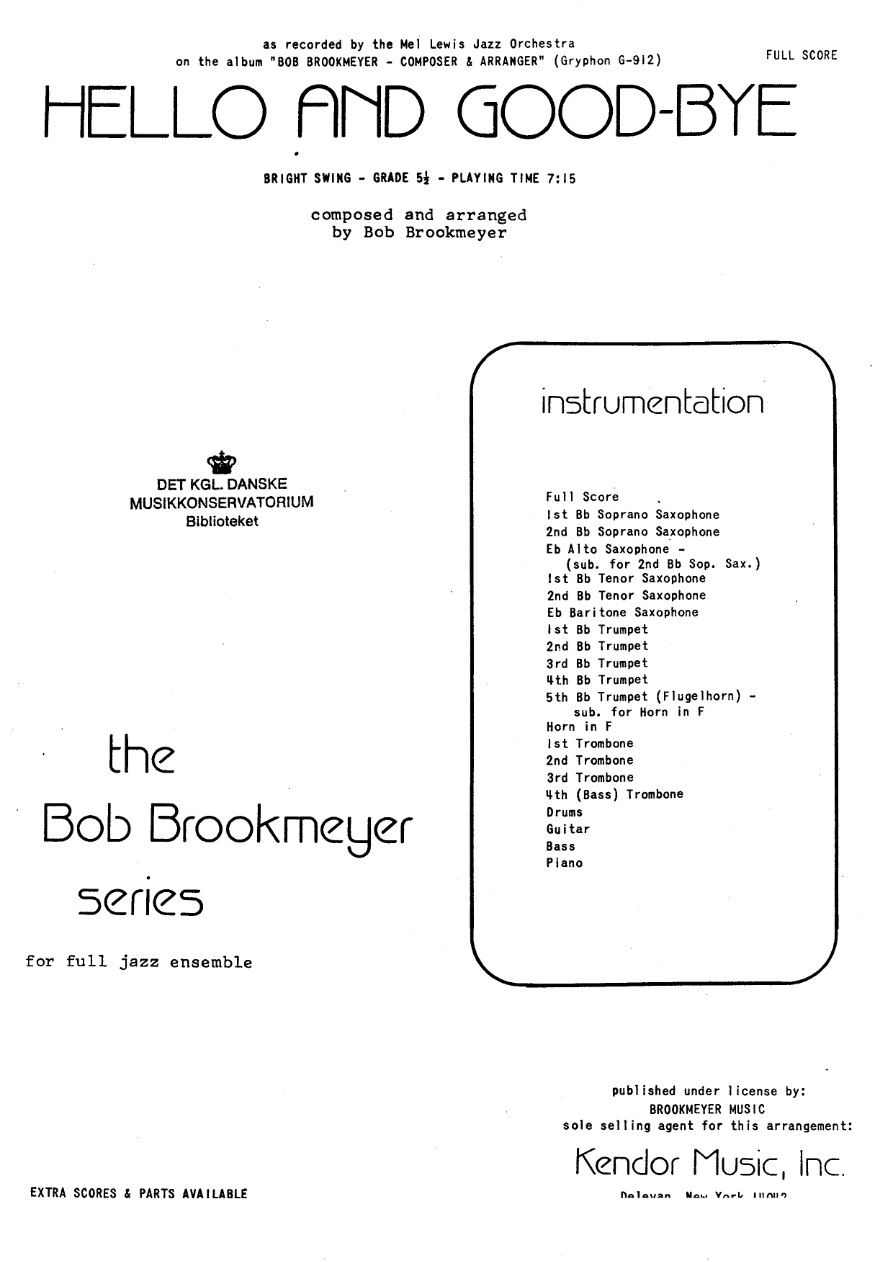
Hello And Good-Bye (B.Brookmeyer) sheet music preview

Hello And Good-Bye (B.Brookmeyer)

Composed by Bob Brookmeyer

Arranged by Bob Brookmeyer

  • Ensemble: Big Band
  • Pages: 105
  • Instruments (20): 1st Bb Soprano Saxophone, 2nd Bb Soprano Saxophone, Eb Alto Saxophone, 1st Bb Tenor Saxophone, 2nd Bb Tenor Saxophone, Eb Baritone Saxophone, 1st Bb Trumpet, 2nd Bb Trumpet, 3rd Bb Trumpet, 4th Bb Trumpet, 5th Bb Trumpet (Flugelhorn), Horn in F, 1st Trombone, 2nd Trombone, 3rd Trombone, 4th (Bass) Trombone, Piano, Bass, Guitar, Drums
  • Difficulty: advanced
  • Content: Individual Parts
  • Format: PDF Download (Instant)
  • Price: $24.99

Composed by legendary valve trombonist, pianist, and master orchestrator Bob Brookmeyer, "Hello And Good-Bye" stands as a monumental achievement in modern large ensemble jazz writing. Originally popularized through landmark recordings by Mel Lewis and The Jazz Orchestra—most notably featured on the pivotal album *Bob Brookmeyer: Composer/Arranger*—this composition captures the sophisticated, forward-thinking aesthetic of post-bop big band music from the late 1970s and 1980s. Brookmeyer’s writing redefined the parameters of jazz orchestration by shifting away from rigid sectional block-writing and moving toward fluid, counterpoint-driven textures that treat the big band as a flexible, chamber-like entity. Rooted in a driving medium-swing feel, the piece balances intricate harmonic sophistication with an infectious, organic groove. The musical landscape shifts fluidly between introspective, lushly voiced harmonic suspensions and explosive, high-energy ensemble statements. Brookmeyer constructs a distinct emotional narrative, alternating between welcoming, warm melodic contours ("hello") and sharper, more poignant harmonic resolutions ("good-bye"). The texture is characterized by unconventional voicings and cross-section pairings—frequently intertwining woodwinds and lower brass rather than maintaining traditional choir separations—creating a transparent, luminous soundscape that constantly surprises the listener's ear. Brookmeyer’s trademark structural approach relies on developing motives through subtle developmental variations and rich, extended tertian and quartal harmonies. The melody is distributed inventively across the ensemble, paving the way for substantial, emotionally charged improvised features for tenor saxophone and baritone saxophone. The background figures behind the soloists are masterclasses in composition-within-improvisation, reacting dynamically to the soloist rather than just providing static rhythmic punches. As the chart builds toward its dynamic climaxes, the ensemble weaves interlocking counterlines that demand absolute precision, excellent intonation, and a deep understanding of contemporary jazz phrasing. Given its advanced harmonic vocabulary, complex rhythmic interplays, and intricate ensemble demands, this 105-page arrangement is best suited for elite university jazz orchestras, professional repertory ensembles, and highly accomplished community big bands. Performing a masterwork of this caliber offers an immensely rewarding educational and artistic experience, pushing advanced players to master sophisticated blend, balance, and modern swing articulation. It remains an essential cornerstone for any serious big band looking to explore the pinnacle of post-Thad Jones era modern composition. Navigating "Hello And Good-Bye" requires meticulous attention to balance, blend, and stylistic nuance. The conductor must ensure that the ensemble maintains a relaxed yet driving medium-swing groove, avoiding any tendency to rush the tempo during dense ensemble passages. * **Technical Challenges:** The primary hurdle lies in the execution of Brookmeyer's interlocking counterpoint and wide-interval voicings. Sections must practice their lines independently with a metronome before integrating them, focusing on seamless voice-leading and uniform articulation. * **Dynamic Control:** Because Brookmeyer frequently utilizes unconventional instrumental pairings, players must constantly listen across sections to balance inner voices against the primary melodic line. Subtlety in dynamics—ranging from hushed, whisper-quiet sub-tones to blazing, full-ensemble shout choruses—is vital to executing the emotional arc of the chart. * **Soloing Approach:** The featured tenor and baritone saxophone soloists should anchor their improvisations in the rich harmonic framework of the changes while reflecting the conversational, spontaneous spirit of the writing. Rhythm section players, particularly the drummer and pianist, should lean into the interactive, open-ended style pioneered by Mel Lewis, utilizing conversational comping rather than heavy, prescriptive time-keeping. Q: What instruments and parts are included in this arrangement? A: This comprehensive 105-page arrangement includes full instrumentation for an expanded big band featuring reeds (with specific doubling requirements), trumpets, trombones, and a full rhythm section (piano, guitar, bass, and drums) directly re-engraved from Brookmeyer’s manuscript. Q: What is the difficulty level of this piece? A: This arrangement is graded as advanced, making it best suited for collegiate jazz ensembles, professional orchestras, and highly proficient advanced high school or community big bands. Q: What is the style and historical context of "Hello And Good-Bye"? A: Written by Bob Brookmeyer and famously recorded by Mel Lewis and The Jazz Orchestra, this piece is a cornerstone of late 20th-century modern big band jazz, blending post-bop harmony with chamber-ensemble transparency. Q: What makes this specific Bob Brookmeyer arrangement unique? A: Unlike traditional big band charts that rely on rigid sectional writing, Brookmeyer breaks conventional norms by mixing instrument families (such as pairing woodwinds with lower brass) and utilizing intricate, evolving counterpoint and extended harmonies. Q: What is the recommended tempo and performance feel? A: The piece is set in a driving, relaxed medium-swing feel, requiring precise time-keeping from the rhythm section and flexible, articulate phrasing from the horn sections to manage its shifting harmonic momentum.

Questions and answers

What is included in the Hello And Good-Bye (B.Brookmeyer) PDF?
The verified current file contains a conductor score and individual parts across 105 pages.
How many instruments or parts are listed for Hello And Good-Bye (B.Brookmeyer)?
The verified instrumentation list contains 20 entries for this Big Band arrangement.
Who is credited for Hello And Good-Bye (B.Brookmeyer)?
Composer: Bob Brookmeyer. Arranger: Bob Brookmeyer.
What difficulty is listed for Hello And Good-Bye (B.Brookmeyer)?
The verified difficulty level is advanced.
Can I preview Hello And Good-Bye (B.Brookmeyer) before buying?
Yes. The product page provides a preview generated from the current PDF file.
How is Hello And Good-Bye (B.Brookmeyer) delivered?
After successful payment, the digital PDF is made available for download. The displayed price is $24.99.

Musicians Also Search For

Hello And Good-Bye Bob Brookmeyer PDFHello And Good-Bye Bob Brookmeyer sheet musicHello And Good-Bye arranged by Bob BrookmeyerBob Brookmeyer big band chartsBob Brookmeyer jazz arrangements PDFHello And Good-Bye Bob Brookmeyer big band arrangementsHello And Good-Bye big band arrangementsHello And Good-Bye big band PDF downloadHello And Good-Bye jazz sheet musicbig band sheet music downloadHello And Good-Bye conductor score PDFHello And Good-Bye individual parts downloadHello And Good-Bye sheet music PDFbuy Hello And Good-Bye sheet musicdownload Hello And Good-Bye PDFHello And Good-Bye jazz chartsbest Bob Brookmeyer big band arrangementsHello And Good-Bye printable sheet musicbig band repertoire PDF

All arrangements by Bob Brookmeyer All Bob Brookmeyer sheet music