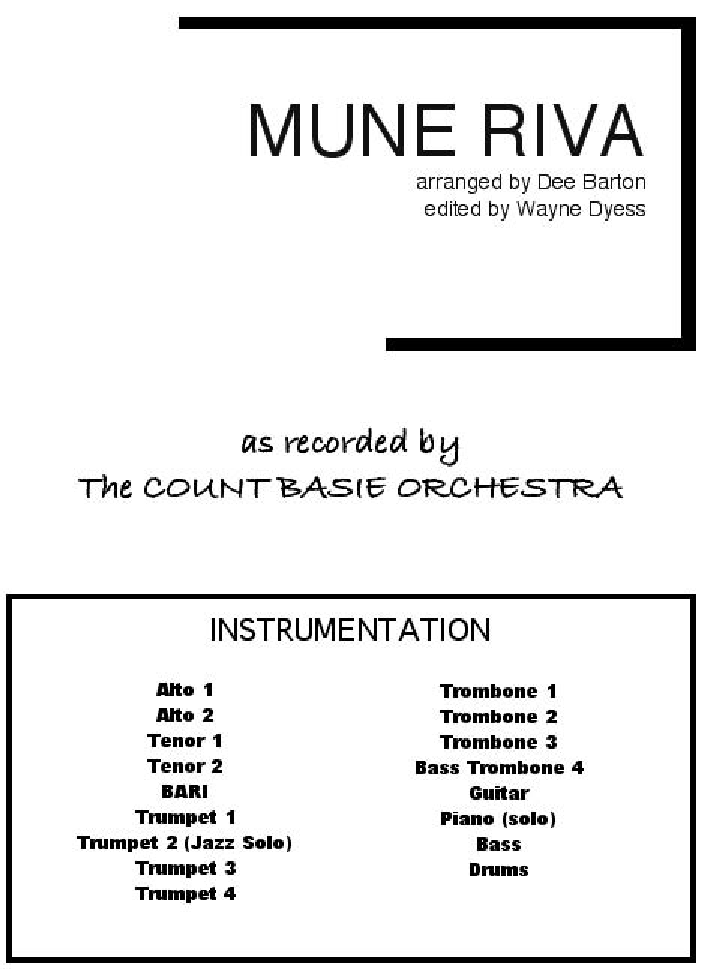
Mune Riva (D.Barton) sheet music preview

Mune Riva (D.Barton)

Composed by Dee Barton

Arranged by Dee Barton

  • Ensemble: Big Band
  • Style: Jazz Standard
  • Pages: 42
  • Instruments (17): Alto 1, Alto 2, Tenor 1, Tenor 2, Bari, Trumpet 1, Trumpet 2, Trumpet 3, Trumpet 4, Bone 1, Bone 2, Bone 3, Bone 4, Guitar, Piano, Bass, Drums
  • Difficulty: medium
  • Content: Individual Parts
  • Format: PDF Download (Instant)
  • Price: $24.99

Dee Barton’s masterful chart for "Mune Riva" captures the innovative spirit of West Coast modern big band jazz during an era when arrangers were actively expanding the harmonic and rhythmic boundaries of the idiom. Originally written and recorded by Barton—a brilliant drummer, trombonist, and composer renowned for his pivotal work with the Stan Kenton Orchestra—this composition showcases the muscular yet intricately voiced brass writing and sophisticated linear movement that defined Barton's signature style. Far from a conventional, predictable head-arrangement, "Mune Riva" operates as an expansive canvas of modern jazz composition, bridging the gap between lush post-bop harmonic textures and high-octane big band propulsion. Driven by an invigorating, assertive medium-up tempo swing groove, "Mune Riva" opens with a striking motivic statement that immediately establishes an atmosphere of tense, sophisticated urgency. The harmonic landscape is rich with extended and altered dominants, utilizing open-voiced chordal structures in the saxophones and punctuating brass stabs that create a sense of perpetual forward motion. Barton’s scoring treats the 17-piece big band as a unified, symphonic organism; the arrangement features dense, multi-layered counterpoint where inner voices maintain distinct melodic independence. A standout feature of the chart is its dynamic pacing, seamlessly shifting from spacious, rhythmically nuanced ensemble interplay to roaring, high-register shout choruses that demand absolute precision and stamina from both trumpet and trombone sections. Throughout the arrangement, the melodic weight is shared fluidly across the ensemble, though the reed section plays a pivotal role in delivering angular, bop-inflected solis that require immaculate articulation and breath support. Solo opportunities are strategically integrated to provide a narrative arc, offering designated blowing changes over harmonically stimulating modal and chromatic extensions. The rhythm section—particularly the drum chair, reflecting Barton’s own formidable percussion background—serves as the engine of the chart, utilizing driving ride cymbal patterns, crisp snare accents, and interactive comping that pushes the ensemble to swing with authority. The technical demands of the chart, from fast-moving unison lines to wide dynamic sweeps, make it a thrilling centerpiece for any serious performance. Advanced collegiate ensembles, top-tier high school bands with strong section leaders, and professional regional big bands will find "Mune Riva" to be an exceptionally rewarding addition to their repertoire. Because of its sophisticated harmonic vocabulary and intricate rhythmic unisons, the chart demands mature listening skills across all sections, challenging the band to balance aggressive projection with transparent, crystalline intonation. Conductor and players alike will appreciate how thoroughly the arrangement showcases the full sonic spectrum of a standard 17-piece jazz orchestra, leaving audiences captivated by its timeless, driving modern jazz aesthetic. Executing Dee Barton’s "Mune Riva" successfully requires meticulous attention to articulation, stylistic unity, and rhythmic precision across all 17 voices. The foundational tempo should be anchored by a driving, unhurried medium-up swing feel where the ride cymbal dictates the pulse rather than heavy-handed downbeats. A primary technical hurdle lies in the fast, chromatic unison lines shared between the saxophones and brass; conductors should isolate these passages during early rehearsals, practicing them slowly at first with a metronome to lock in clean articulation and uniform breath accents. The brass section must exercise extreme care with dynamic balance during high-register shout choruses, ensuring that lead trumpet lines project clearly without forcing tone quality. The rhythm section needs to lock in tightly, with the bass player walking strong, modal-informed quarter notes that support the altered harmonic structures above. Utilize subtle dynamic shading to make the ensemble's sudden shifts between aggressive staccato punches and lush, sustained chordal passages sound effortless and transparent. Q: What instruments and parts are included in this big band arrangement? A: This 42-page arrangement is scored for a standard 17-piece big band instrumentation, consisting of 5 saxophones (Alto 1, Alto 2, Tenor 1, Tenor 2, Bari), 4 trumpets, 4 trombones, and a standard 4-piece rhythm section (piano, bass, drums, guitar). Q: What is the difficulty level of "Mune Riva"? A: This arrangement is rated as advanced, making it best suited for college jazz ensembles, professional big bands, and elite high school groups with strong section players and mature technical facility. Q: What is the musical style and historical context of this piece? A: Composed and recorded by Dee Barton during the modern West Coast big band era, "Mune Riva" is a sophisticated jazz standard that blends post-bop harmonic density with the driving energy of the Stan Kenton school of arranging. Q: What makes this Dee Barton arrangement unique? A: It is defined by Barton's signature dense voicings, intricate linear counterpoint, and dynamic structural shifts that treat the 17-piece ensemble like a unified, harmonically adventurous modern jazz orchestra. Q: What is the recommended performance tempo and duration for this chart? A: The piece is designed to be performed at a driving, medium-up swing tempo that typically yields a performance duration of around 5 to 6 minutes, depending on the length of the open solo sections.

Questions and answers

What is included in the Mune Riva (D.Barton) PDF?
The verified current file contains individual parts across 42 pages.
How many instruments or parts are listed for Mune Riva (D.Barton)?
The verified instrumentation list contains 17 entries for this Big Band arrangement.
Who is credited for Mune Riva (D.Barton)?
Composer: Dee Barton. Arranger: Dee Barton.
What difficulty is listed for Mune Riva (D.Barton)?
The verified difficulty level is medium.
What style is listed for Mune Riva (D.Barton)?
The catalog lists the style as Jazz Standard.
Can I preview Mune Riva (D.Barton) before buying?
Yes. The product page provides a preview generated from the current PDF file.
How is Mune Riva (D.Barton) delivered?
After successful payment, the digital PDF is made available for download. The displayed price is $24.99.

Musicians Also Search For

Mune Riva Dee Barton PDFMune Riva Dee Barton sheet musicMune Riva arranged by Dee BartonDee Barton big band chartsDee Barton jazz arrangements PDFMune Riva Dee Barton big band arrangementsMune Riva big band arrangementsMune Riva big band PDF downloadMune Riva jazz sheet musicbig band sheet music downloadMune Riva individual parts downloadMune Riva sheet music PDFMune Riva Jazz Standard chartsJazz Standard big band arrangementsbuy Mune Riva sheet musicdownload Mune Riva PDFMune Riva jazz chartsbest Dee Barton big band arrangementsMune Riva printable sheet musicbig band repertoire PDF

All arrangements by Dee Barton All Dee Barton sheet music