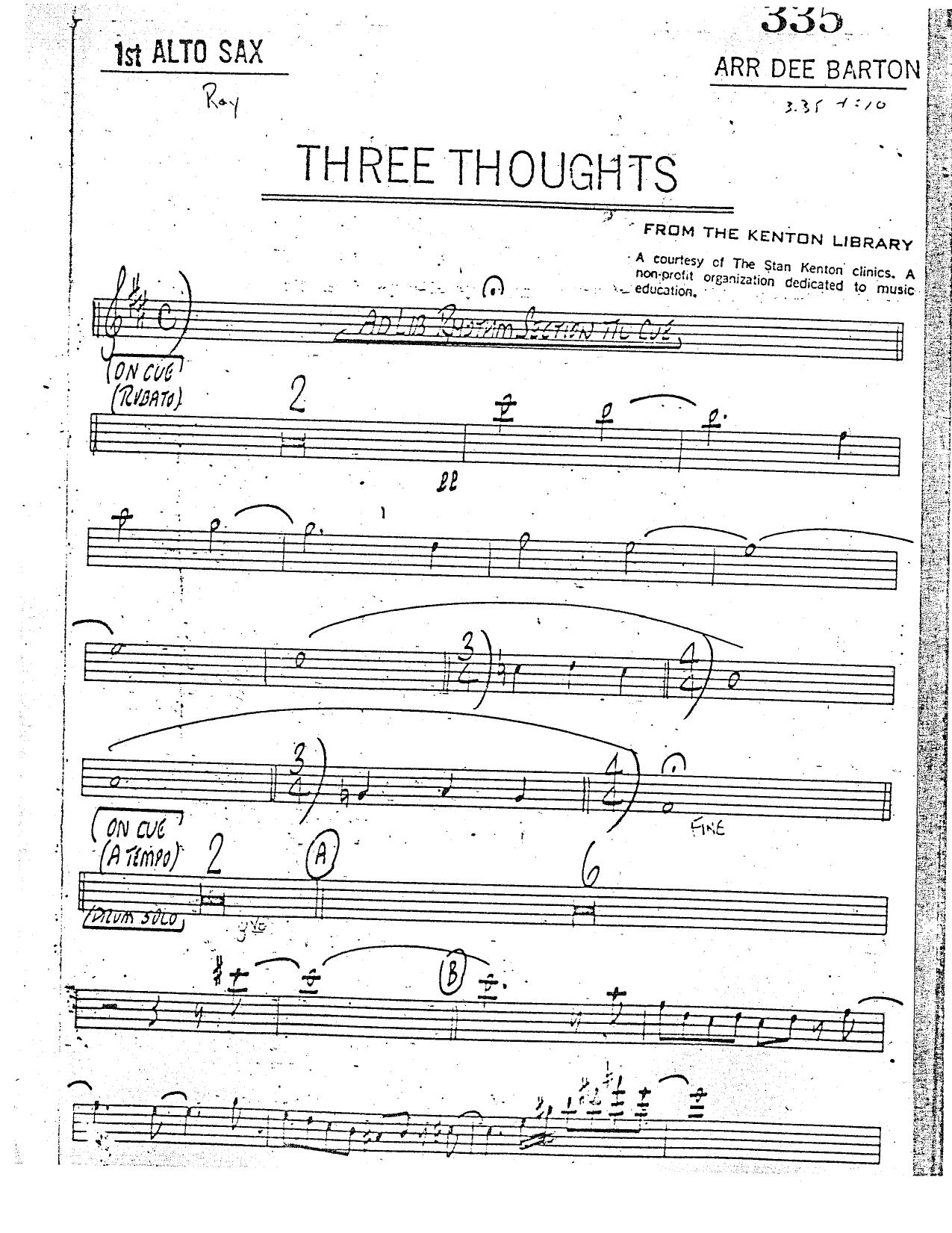
Three Thoughts (D.Barton) S.Kenton) sheet music preview

Three Thoughts (D.Barton) S.Kenton)

Composed by Dee Barton

Arranged by Dee Barton

  • Ensemble: Big Band
  • Pages: 79
  • Instruments (18): 1st Alto Sax, 2nd Tenor Sax, 3rd Tenor Sax, 4th Baritone Sax, 5th Baritone Sax, 1st Trumpet, 2nd Trumpet, 3rd Trumpet, 4th Trumpet, 5th Trumpet, 1st Trombone, 2nd Trombone, 3rd Trombone, 4th Trombone, Tuba, Piano, Bass, Drums
  • Difficulty: advanced
  • Content: Individual Parts
  • Format: PDF Download (Instant)
  • Price: $24.99

Originally recorded for the landmark 1968 Capitol Records release *Stan Kenton Conducts the Jazz Compositions of Dee Barton*, "Three Thoughts" stands as a brilliant showcase of the sophisticated, modern West Coast big band writing that defined the late-1960s Kenton Orchestra. Composed and arranged by multi-instrumentalist Dee Barton—who famously served as both trombonist and drummer for Kenton before embarking on a prolific Hollywood film-scoring career with director Clint Eastwood—this dynamic work bridges contemporary orchestral jazz textures with driving, muscular swing. The piece reflects an era of bold experimentation within the Kenton library, where traditional big band conventions were continually expanded through dense, forward-thinking harmonies and unconventional pacing. The musical character of the chart is defined by its striking structural contrast and dramatic tempo duality. "Three Thoughts" famously opens with a slow, atmospheric rubato ensemble setting that creates an immediate sense of suspense and mystery, juxtaposed against a brightly swinging rhythm section pulse underneath. This contemplative introduction quickly erupts into a high-energy, fast-paced modern jazz setting driven by intricate horn lines and relentless rhythmic momentum. The mood shifts fluidly between introspective, lushly voiced harmonic passages and explosive, brass-heavy climaxes, evoking a cinematic intensity that mirrors Barton's theatrical background. Barton’s arranging approach fully leverages the expanded color palette of the modern jazz orchestra, utilizing thick, contemporary voicings and dynamic sectional interplay. Rather than relying solely on standard block-chord writing, Barton fractures and weaves melodic fragments across the ensemble, giving individual sections distinct conversational voices. The orchestration requires exceptional rhythmic precision, featuring intricate counterpoint, demanding ensemble solis, and a powerful framing device that brings the composition full circle by ending precisely the way it began. Performance-wise, this expansive chart offers generous solo opportunities for the rhythm section—specifically showcasing the bass and drums—alongside prominent, soaring features for alto saxophone and trumpet. The technical challenges lie primarily in maintaining pristine intonation during the exposed rubato sections, executing rapid-fire articulated passages at high tempos, and locking in the complex rhythmic shifts. Advanced college, community, and professional big bands will find this piece deeply rewarding, as it provides a masterclass in tension, release, and sophisticated West Coast ensemble phrasing. Navigating "Three Thoughts" successfully requires rigorous attention to contrast, time-feel, and section balance. The opening rubato section demands absolute confidence from the brass and woodwinds; conductors should insist on unified phrasing and careful pitch-matching over dense, extended chords while the bass and drums maintain an independent, steady underlying pulse. When the chart transitions into its fast-paced main tempo, the rhythm section must anchor the groove with a driving, unhurried swing feel that prevents the frantic sections from rushing. Horn players should focus on clean, articulate articulation and agile fingerwork, particularly during fast unison and harmonized lines. Balance is paramount during the transition points—ensure the accompanying sections dynamically back off to give complete clarity to the featured alto saxophone, trumpet, bass, and drum solos. Rehearsals should isolate the rubato opening and closing segments first to establish the moody, dramatic character before tackling the physical stamina required for the up-tempo middle choruses. Q: What instruments and parts are included in this arrangement? A: This arrangement is scored for a standard big band expanded to 8 core instrumental frontline parts (Alto Saxophone, Tenor Saxophones, Baritone Saxophones, Trumpets, and Trombones), accompanied by a full rhythm section and a condensed score totaling 79 pages. Q: What is the difficulty level of this piece? A: This arrangement is rated Grade 5 to 6, making it suitable for advanced college, conservatory, professional, and elite high school big bands with highly proficient soloists and section players. Q: What is the historical style and context of the composition? A: Composed by Dee Barton and famously recorded by the Stan Kenton Orchestra in 1967 for the Capitol Records album *The Jazz Compositions of Dee Barton*, it represents the cutting-edge West Coast modern big band style of the late 1960s. Q: What makes this specific Dee Barton arrangement unique? A: It is uniquely structured around a dramatic juxtaposition, opening and closing with slow, atmospheric rubato ensemble writing while the rhythm section swings freely underneath, framing a high-speed, contemporary middle section. Q: What is the performance duration and tempo framework of the piece? A: The work runs approximately 5 minutes and 30 seconds, traversing a dynamic tempo map that moves from an unmeasured, slow rubato opening into a brisk, fast-paced swing groove.

Questions and answers

What is included in the Three Thoughts (D.Barton) S.Kenton) PDF?
The verified current file contains individual parts across 79 pages.
How many instruments or parts are listed for Three Thoughts (D.Barton) S.Kenton)?
The verified instrumentation list contains 18 entries for this Big Band arrangement.
Who is credited for Three Thoughts (D.Barton) S.Kenton)?
Composer: Dee Barton. Arranger: Dee Barton.
What difficulty is listed for Three Thoughts (D.Barton) S.Kenton)?
The verified difficulty level is advanced.
Can I preview Three Thoughts (D.Barton) S.Kenton) before buying?
Yes. The product page provides a preview generated from the current PDF file.
How is Three Thoughts (D.Barton) S.Kenton) delivered?
After successful payment, the digital PDF is made available for download. The displayed price is $24.99.

Musicians Also Search For

Three Thoughts Dee Barton PDFThree Thoughts Dee Barton sheet musicThree Thoughts arranged by Dee BartonDee Barton big band chartsDee Barton jazz arrangements PDFThree Thoughts Dee Barton big band arrangementsThree Thoughts big band arrangementsThree Thoughts big band PDF downloadThree Thoughts jazz sheet musicbig band sheet music downloadThree Thoughts individual parts downloadThree Thoughts sheet music PDFbuy Three Thoughts sheet musicdownload Three Thoughts PDFThree Thoughts jazz chartsbest Dee Barton big band arrangementsThree Thoughts printable sheet musicbig band repertoire PDF

All arrangements by Dee Barton All Dee Barton sheet music