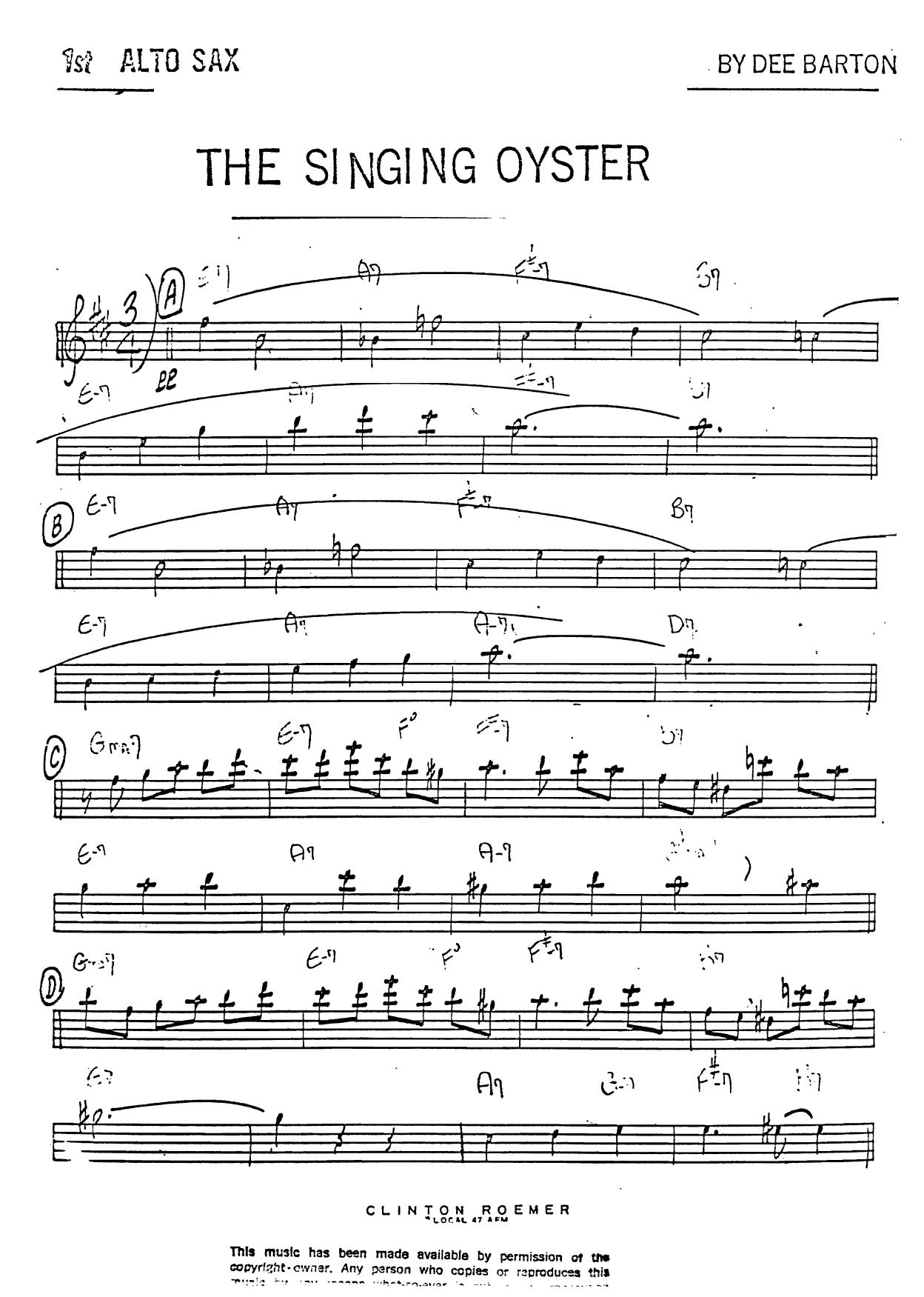
The Singing Oyster (D.Barton) sheet music preview

The Singing Oyster (D.Barton)

Composed by Dee Barton

Arranged by Dee Barton

  • Ensemble: Big Band
  • Pages: 98
  • Instruments (18): 1st Alto Sax, 2nd Tenor Sax, 3rd Tenor Sax, 4th Baritone Sax, 5th Baritone Sax, 1st Trumpet, 2nd Trumpet, 3rd Trumpet, 4th Trumpet, 5th Trumpet, 1st Trombone, 2nd Trombone, 3rd Trombone, 4th Trombone, Tuba, Piano, Bass, Drums
  • Difficulty: advanced
  • Content: Individual Parts
  • Format: PDF Download (Instant)
  • Price: $24.99

Originally composed and recorded for the landmark 1968 Capitol album *Stan Kenton Conducts the Jazz Compositions of Dee Barton*, "The Singing Oyster" stands as one of the definitive benchmarks of late-1960s modern big band writing. Dee Barton—who famously served as both a trombonist and powerhouse drummer for Stan Kenton before launching a prolific career as a Hollywood film composer for Clint Eastwood—infused the Kenton library with advanced harmonic concepts, asymmetrical rhythmic frameworks, and razor-sharp ensemble textures. This composition captures the adventurous spirit of the era, bridging the gap between sophisticated progressive jazz and high-energy swinging performance. The musical character is defined by a bright, lilting, and driving 3/4 swing feel that constantly plays with listener expectations through shifting textural densities. Opening with a deceptively light, delicate presentation of the thematic material carried entirely in unison by the saxophone section, the piece quickly expands as brass backgrounds enter to weave complex counter-melodies. The mood shifts dynamically from playful and breezy to intense and driving, creating a sense of perpetual motion. Barton’s signature approach relies heavily on lean, exposed unison lines across the entire ensemble, demanding absolute rhythmic precision and intonation before opening up into expansive, roaring shout choruses that effortlessly lift an audience out of their seats. Featured prominent features include a soaring trumpet solo that serves as the emotional and improvisational focal point, backed by crisp, modernistic rhythmic punctuations from the lower brass and woodwinds. Technical challenges abound, particularly in the demanding unison soli sections and the agile fingerwork required across all horn parts, making it an exhilarating exercise in sectional unity. The arrangement oscillates masterfully between delicate, transparent ensemble passages and massive, brass-heavy climaxes, concluding with a witty, understated piano finish. Advanced high school, collegiate, and professional big bands will find this chart to be an exceptionally rewarding centerpiece for festival performances and advanced concerts. Because it stretches traditional big band styling with clever metric phrasing and transparent writing, it provides an ideal vehicle for developing collegiate-level sectional discipline and mature ensemble phrasing. Conductors should approach the tempo with a buoyant, forward-moving 3/4 jazz feel, ensuring that the triple meter never bogs down into a heavy waltz. The primary technical hurdle lies in the exposed unison saxophone and brass lines; clean articulation and unified breath support are mandatory to keep these passages from sounding brittle or uneven. Rehearsals should initially isolate the intricate ensemble passages at a reduced tempo, gradually building up to performance speed while locking in the syncopated background figures. Pay careful attention to the dynamic contrast between the subdued, lighter thematic statements and the explosive shout choruses. The drummer plays a pivotal role in driving the 3/4 groove without overplaying, maintaining a crisp cymbal pulse that anchors the ensemble's metric shifts. Ensure that the featured trumpet soloist has ample freedom within the chordal framework to build a dynamic, narrative-driven solo that matches the escalating intensity of the surrounding ensemble writing. Q: What instruments and parts are included in this big band arrangement? A: The arrangement is scored for a standard contemporary big band instrumentation comprising 8 core instrumental tracks—including Alto Saxophone, Tenor Saxophone, Baritone Saxophone, Trumpets, and Trombones—spanning a comprehensive 98-page master score and part set. Q: What is the designated difficulty level for this chart? A: This arrangement is graded as advanced, making it best suited for accomplished collegiate, community, and professional big bands equipped with strong readers and technically secure soloists. Q: What is the historical style and musical context of "The Singing Oyster"? A: Composed by Dee Barton, it is a quintessential example of progressive late-1960s modern big band jazz made famous by the Stan Kenton Orchestra on their acclaimed Capitol Records releases. Q: What makes this Dee Barton arrangement unique compared to standard swing charts? A: It is uniquely characterized by its bright, swinging 3/4 time signature, highly exposed unison woodwind and brass lines, and a clever juxtaposition of delicate transparency with roaring, high-intensity shout choruses. Q: What is the performance tempo and overall feel of the piece? A: The arrangement features a bright, lilting, and driving 3/4 swing feel that demands exceptional metric control and rhythmic agility from the entire ensemble.

Questions and answers

What is included in the The Singing Oyster (D.Barton) PDF?
The verified current file contains individual parts across 98 pages.
How many instruments or parts are listed for The Singing Oyster (D.Barton)?
The verified instrumentation list contains 18 entries for this Big Band arrangement.
Who is credited for The Singing Oyster (D.Barton)?
Composer: Dee Barton. Arranger: Dee Barton.
What difficulty is listed for The Singing Oyster (D.Barton)?
The verified difficulty level is advanced.
Can I preview The Singing Oyster (D.Barton) before buying?
Yes. The product page provides a preview generated from the current PDF file.
How is The Singing Oyster (D.Barton) delivered?
After successful payment, the digital PDF is made available for download. The displayed price is $24.99.

Musicians Also Search For

The Singing Oyster Dee Barton PDFThe Singing Oyster Dee Barton sheet musicThe Singing Oyster arranged by Dee BartonDee Barton big band chartsDee Barton jazz arrangements PDFThe Singing Oyster Dee Barton big band arrangementsThe Singing Oyster big band arrangementsThe Singing Oyster big band PDF downloadThe Singing Oyster jazz sheet musicbig band sheet music downloadThe Singing Oyster individual parts downloadThe Singing Oyster sheet music PDFbuy The Singing Oyster sheet musicdownload The Singing Oyster PDFThe Singing Oyster jazz chartsbest Dee Barton big band arrangementsThe Singing Oyster printable sheet musicbig band repertoire PDF

All arrangements by Dee Barton All Dee Barton sheet music