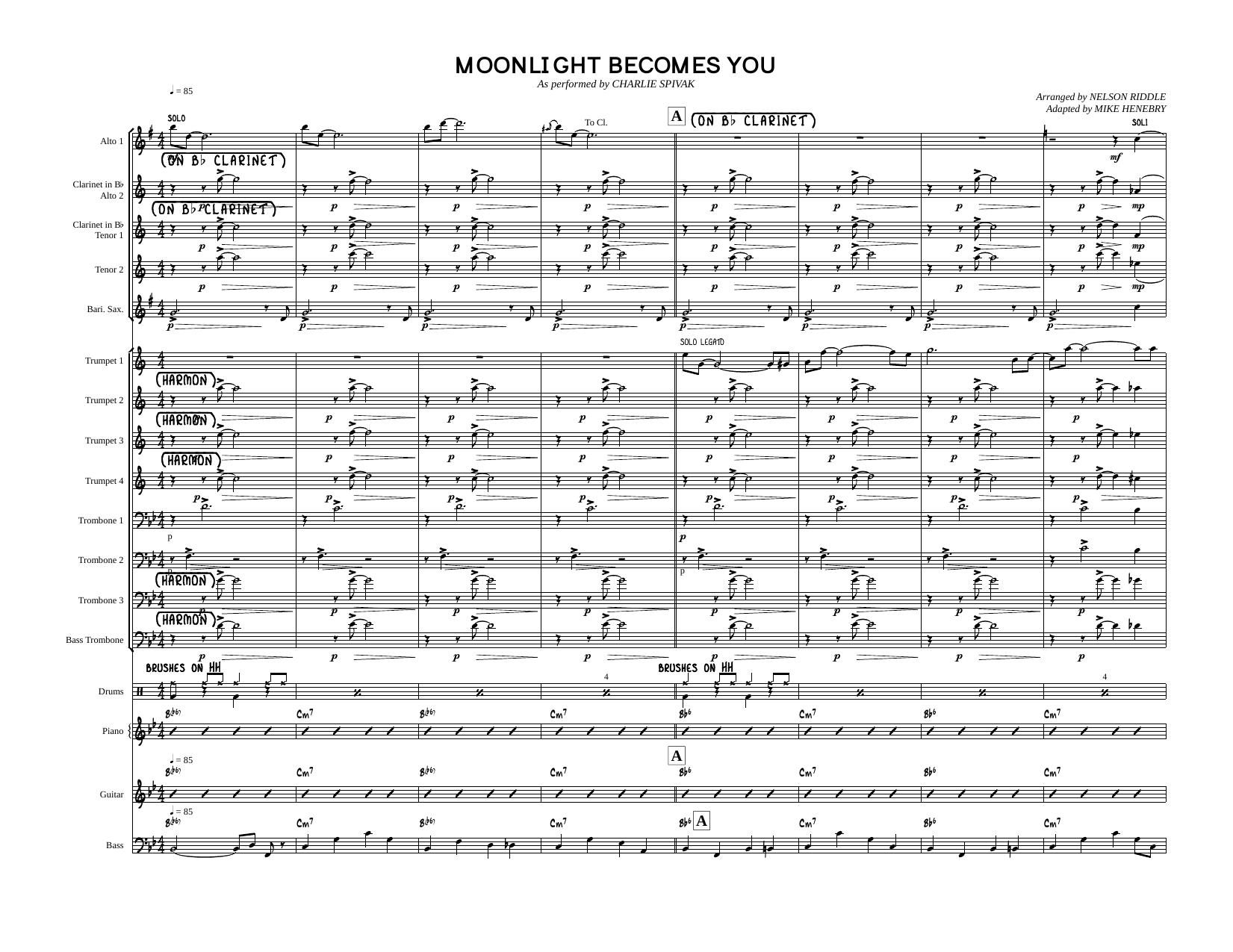
Moonlight Becomes You (N. Riddle-M. Henebry)
Composed by Nelson Riddle
Arranged by Frank Sinatra & Nelson Riddle
- Ensemble: Big Band
- Pages: 40
- Instruments (17): Alto 1, Clarinet in Bb Alto 2, Clarinet in Bb Tenor 1, Tenor 2, Bari. Sax., Trumpet 1, Trumpet 2, Trumpet 3, Trumpet 4, Trombone 1, Trombone 2, Trombone 3, Bass Trombone, Guitar, Piano, Bass, Drums
- Difficulty: medium
- Content: Individual Parts
- Format: PDF Download (Instant)
- Price: $24.99
The timeless partnership of vocalist Frank Sinatra and arranger Nelson Riddle defined the pinnacle of mid-century Capitol Records studio jazz, producing sophisticated orchestrations that remain the gold standard for big band writing. "Moonlight Becomes You"—originally penned by Johnny Burke and Jimmy Van Heusen—receives the definitive Riddle treatment in this classic iteration, capturing the lush, cinematic romanticism of the 1950s golden era of vocal jazz. This arrangement distills the sophisticated harmonic palette and airy, floating textures that Riddle perfected, bridging the gap between intimate saloon balladry and sweeping orchestral swing. Musically, the chart unfolds as a relaxed, flowing medium ballad in 4/4 time, anchored by a warm, swinging pulse that prioritizes breath, space, and rubato phrasing. The mood is nocturnal, elegant, and deeply nostalgic, evoking candlelit supper clubs and late-night studio sessions. Riddle’s signature approach is immediately evident in the exquisite voicing of the reed section—often utilizing flute doubles or tightly packed clarinet-led saxes—which floats effortlessly above a muted, cushion-like brass backdrop. The arrangement avoids heavy-handedness, instead relying on cascading string-like lines transferred to the horns, subtle chromatic passing tones, and masterfully paced dynamic swells that build emotional resonance without ever rushing the tempo. Carrying the melodic weight is the lead vocal line (or featured instrumental soloist), supported closely by conversational counter-melodies in the trombones and delicate bell-like figures in the upper woodwinds and muted trumpets. While rhythmically accessible, the technical challenge lies in the micro-nuance: maintaining a gossamer-light swing feel, achieving pristine blend within section solis, and executing precise dynamic control during transitional modulations. The reward for the ensemble is immense, as the chart offers a masterclass in phrasing, breath support, and textural contrast. Specific high-value moments include the lush harmonic turnaround leading into the vocal bridge and a subtly dramatic re-entry of the full ensemble just before the final cadence. Advanced high school, collegiate, community, and professional jazz ensembles will find this arrangement an exceptional vehicle for developing stylistic maturity and ballad-playing sensitivity. Because it relies heavily on listening, dynamic restraint, and subtle stylistic execution rather than sheer velocity, it serves as an invaluable pedagogical tool for teaching students how to swing quietly and with sophisticated tonal color, while offering professional groups a guaranteed crowd-pleasing classic. Achieving the authentic Nelson Riddle sound requires strict attention to dynamic discipline and articulation. The tempo should remain flexible yet steady, maintaining a relaxed medium swing feel where the underlying eighth notes are gently rounded rather than sharply accented. Brass players must master their mutes—utilizing cup and harmon mutes where indicated—to blend seamlessly into the velvety background textures without piercing the acoustic space. Rehearsal should begin with the rhythm section; the piano and guitar must lock into a sparse, supportive comping style reminiscent of Bill Miller's work with Sinatra, utilizing chord voicings that emphasize extensions (9ths, 13ths) while leaving plenty of sonic room. Horn sections should practice their sustained lines with a continuous, warm vibrato and meticulous intonation, paying close attention to the breath-marks inherent in the phrasing. Directors should rehearse the dynamic swells independently, ensuring that the crescendos peak precisely where Riddle intended to maximize the emotional impact of the harmonic shifts. Q: What instruments and parts are included in this 40-page arrangement? A: This chart is scored for a standard 16-instrument big band instrumentation, featuring four trumpets, four trombones, five saxophones, and a full three-piece or four-piece rhythm section (piano, bass, drums, and optional guitar), complete with fully realized conductor and instrumental parts. Q: What is the overall difficulty level of this arrangement? A: This arrangement is rated at an intermediate-to-advanced difficulty level (Grade 4), primarily due to the demands placed on intonation, balance, endurance in muted brass, and the stylistic maturity required to swing at a slower ballad tempo. Q: What is the historical style and context of this chart? A: It represents the quintessential 1950s Capitol Records "saloon song" style pioneered by Frank Sinatra and arranger Nelson Riddle, capturing the sophisticated, string-inflected big band jazz aesthetic of the post-swing era. Q: What makes this specific Nelson Riddle arrangement unique? A: Its uniqueness lies in Riddle's signature transparent scoring, which utilizes clever woodwind doublings, muted brass textures, and lush harmonic extensions to create a cinematic, floating atmosphere behind the melody. Q: What is the performance duration and tempo guideline for this piece? A: The arrangement runs approximately 3 to 4 minutes and is designed to be performed at a relaxed, flowing medium-ballad swing tempo that emphasizes lyrical phrasing over rhythmic drive.
Questions and answers
- What is included in the Moonlight Becomes You (N. Riddle-M. Henebry) PDF?
- The verified current file contains a conductor score and individual parts across 40 pages.
- How many instruments or parts are listed for Moonlight Becomes You (N. Riddle-M. Henebry)?
- The verified instrumentation list contains 17 entries for this Big Band arrangement.
- Who is credited for Moonlight Becomes You (N. Riddle-M. Henebry)?
- Composer: Nelson Riddle. Arranger: Frank Sinatra & Nelson Riddle.
- What difficulty is listed for Moonlight Becomes You (N. Riddle-M. Henebry)?
- The verified difficulty level is medium.
- Can I preview Moonlight Becomes You (N. Riddle-M. Henebry) before buying?
- Yes. The product page provides a preview generated from the current PDF file.
- How is Moonlight Becomes You (N. Riddle-M. Henebry) delivered?
- After successful payment, the digital PDF is made available for download. The displayed price is $24.99.
Musicians Also Search For
Moonlight Becomes You Frank Sinatra & Nelson Riddle PDF • Moonlight Becomes You Frank Sinatra & Nelson Riddle sheet music • Moonlight Becomes You arranged by Frank Sinatra & Nelson Riddle • Frank Sinatra & Nelson Riddle big band charts • Frank Sinatra & Nelson Riddle jazz arrangements PDF • Moonlight Becomes You Nelson Riddle sheet music • Moonlight Becomes You Nelson Riddle big band arrangements • Nelson Riddle big band charts • Moonlight Becomes You big band arrangements • Moonlight Becomes You big band PDF download • Moonlight Becomes You jazz sheet music • big band sheet music download • Moonlight Becomes You conductor score PDF • Moonlight Becomes You individual parts download • Moonlight Becomes You sheet music PDF • buy Moonlight Becomes You sheet music • download Moonlight Becomes You PDF • Moonlight Becomes You jazz charts • best Frank Sinatra & Nelson Riddle big band arrangements • Nelson Riddle arranged by Frank Sinatra & Nelson Riddle • Moonlight Becomes You printable sheet music • big band repertoire PDF