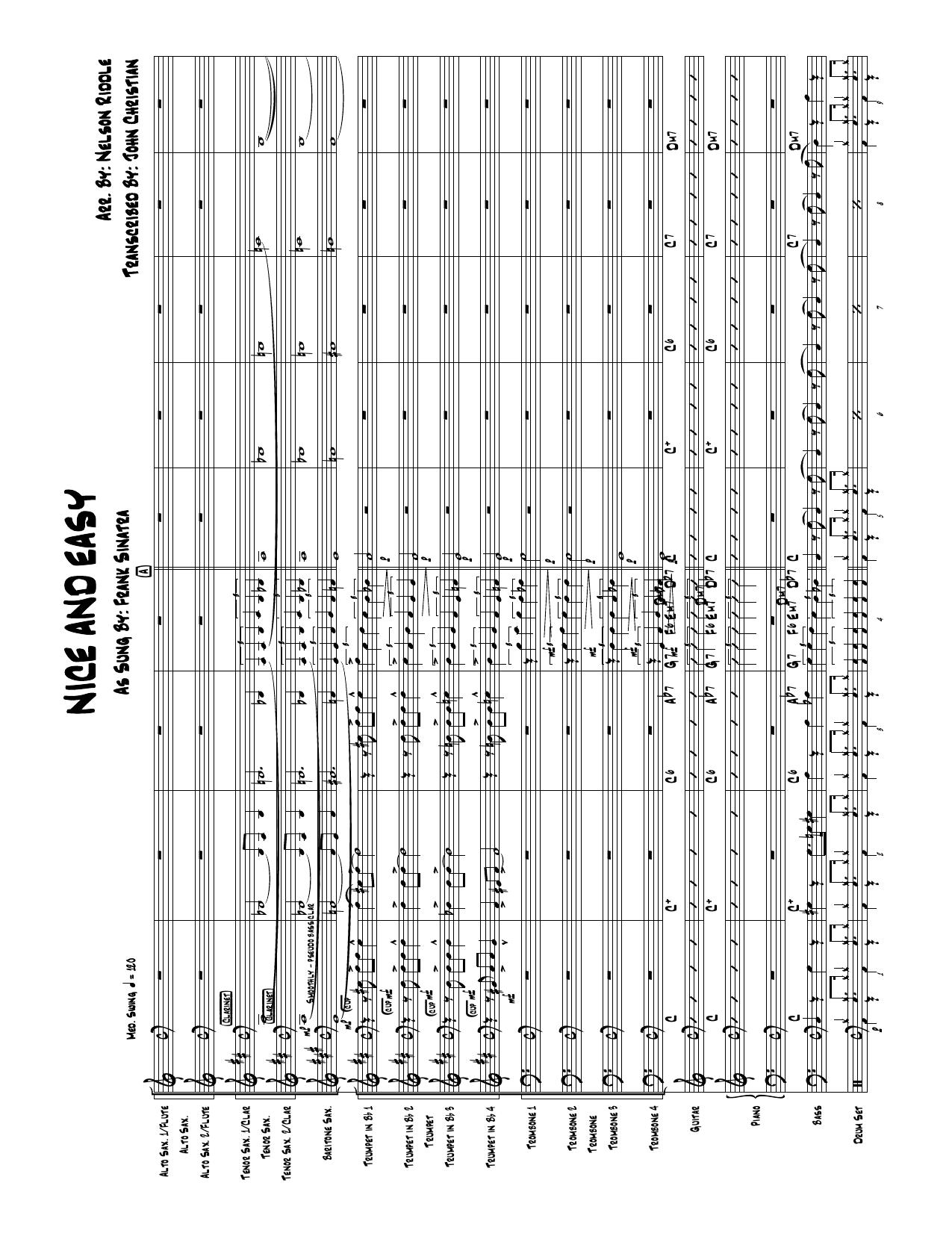
Nice 'N Easy (N.Riddle -J.Christian) sheet music preview

Nice 'N Easy (N.Riddle -J.Christian)

Composed by Nelson Riddle

Arranged by Nelson Riddle

  • Ensemble: Big Band
  • Pages: 28
  • Instruments (17): 1st Alto Saxophone/Flute, 2nd Alto Saxophone/Flute, 1st Tenor Saxophone/Clarinet, 2nd Tenor Saxophone/Clarinet, Baritone Saxophone, 1st Trumpet, 2nd Trumpet, 3rd Trumpet, 4th Trumpet, 1st Trombone, 2nd Trombone, 3rd Trombone, 4th Trombone, Guitar, Piano, Bass, Drum Set
  • Difficulty: medium
  • Content: Individual Parts
  • Format: PDF Download (Instant)
  • Price: $24.99

"Nice 'N Easy," the quintessential mid-century vocal and instrumental standard, encapsulates the relaxed, effortlessly sophisticated cool of the late 1950s and early 1960s pop-jazz crossover era. Immortalized most famously by Frank Sinatra in 1960 on his landmark album of the same name, the tune was co-written by legendary arranger Nelson Riddle alongside M. Keith and B. Spence. Riddle’s signature arranging style—characterized by lush, cinematic string-inspired brass voicings, floating woodwind countermelodies, and an impeccable sense of rhythmic bounce—elevates the composition from a standard popular song into a masterclass in big band arranging. This professional 17-instrument big band adaptation preserves that iconic, tailored Hollywood sound, translating Riddle’s sophisticated orchestral palette directly into the jazz ensemble idiom. Musically, the arrangement is anchored in a relaxed, confident medium swing feel that prioritizes an ultra-laid-back groove over frantic pyrotechnics. Set in a comfortable, warm concert key, the mood is one of urbane self-assurance and effortless cool. The harmonic landscape relies on rich major-seventh voicings, subtle chromatic descents, and signature Riddle-esque suspended chords that create a sense of shimmering warmth in the brass sections. The ensemble writing demands absolute precision in dynamic control; the background figures must glide underneath featured melodic statements with feather-light articulation, maintaining a buoyant pulse without ever heavy-handed rushing. Riddle’s structural genius shines through the distribution of thematic material across the 17-piece instrumentation. The 28-page score features sophisticated reed-and-brass interplay, where the saxophone section (two altos, two tenors, and baritone) often carries the primary melodic weight, underscored by feather-light, muted brass stabs. Dynamic contrast is the primary vehicle for expression, moving seamlessly from intimate, chamber-jazz textures to a brilliantly voiced, brass-heavy shout chorus that opens up the harmonic space before dropping back into the sultry, whispered main theme. While individual technical demands are moderate in terms of range, the overarching challenge lies in stylistic authenticity—achieving the exact placement of the swing eighth notes and matching the sophisticated, cinematic phrasing demanded by Riddle's manuscript. Advanced high school ensembles with strong section players, collegiate jazz orchestras, and professional big bands will find this chart an invaluable addition to their repertoire. It offers a masterclass in dynamic restraint, ensemble blend, and stylistic nuance. Performing this arrangement forces a band to listen horizontally rather than vertically, making it an exceptional vehicle for teaching time feel, tonal balance, and the subtle art of accompanying a soloist or driving a sophisticated swing groove without resorting to brute volume. Executing this arrangement successfully requires a deep commitment to the relaxed, behind-the-beat medium swing feel characteristic of Nelson Riddle’s mid-century writing. Conductors must guard against the tendency of modern rhythm sections to rush the tempo; the groove must feel utterly unhurried yet persistently driving. The primary technical challenge lies in the dynamic balance between the muted brass and the open saxophone solis. Muted sections (utilizing cup or harmon mutes where indicated) must project clarity without pinching their tone, while the saxophones need a homogeneous, velvety blend during their scalar passages. Articulation is paramount: quarter notes should be given full value with a warm breath release, and eighth notes must swing naturally without heavy accentuation on the upbeat. Rehearsal should begin by isolating the rhythm section to lock in the foundational pocket before layering in the horns section by section. Pay close attention to the dynamic swells leading into the shout chorus; ensure the ensemble transitions smoothly from a whisper to a robust, room-filling roar without distorting the overall intonation. Q: What instruments and parts are included in this 17-instrument arrangement? A: The chart is scored for a standard 17-piece big band configuration comprising 5 saxophones (2 altos, 2 tenors, 1 baritone), 4 trumpets, 4 trombones, and a standard 4-piece rhythm section (piano, bass, drums, and guitar). Q: What is the difficulty level of this Nelson Riddle arrangement? A: This arrangement is rated as medium-advanced, primarily due to the high degree of ensemble precision, stylistic maturity, and dynamic control required rather than extreme technical range demands. Q: What is the historical and musical style of "Nice 'N Easy"? A: Composed during the golden age of Capitol Records vocal jazz and popularized by Frank Sinatra, this piece represents the sophisticated, cinematic swing style that bridged traditional pop and modern big band jazz. Q: What makes this specific arrangement by Nelson Riddle unique? A: It features Riddle’s signature lush harmonic voicings, cinematic countermelodies, and clever dynamic contrasts that emulate a full string orchestra within a traditional 17-piece jazz ensemble framework. Q: What is the suggested performance tempo and duration? A: The chart is designed to be played at a relaxed medium swing tempo (approximately 112-120 BPM), resulting in a total performance duration of roughly 3 to 4 minutes depending on solo extensions.

Questions and answers

What is included in the Nice 'N Easy (N.Riddle -J.Christian) PDF?
The verified current file contains a conductor score and individual parts across 28 pages.
How many instruments or parts are listed for Nice 'N Easy (N.Riddle -J.Christian)?
The verified instrumentation list contains 17 entries for this Big Band arrangement.
Who is credited for Nice 'N Easy (N.Riddle -J.Christian)?
Composer: Nelson Riddle. Arranger: Nelson Riddle.
What difficulty is listed for Nice 'N Easy (N.Riddle -J.Christian)?
The verified difficulty level is medium.
Can I preview Nice 'N Easy (N.Riddle -J.Christian) before buying?
Yes. The product page provides a preview generated from the current PDF file.
How is Nice 'N Easy (N.Riddle -J.Christian) delivered?
After successful payment, the digital PDF is made available for download. The displayed price is $24.99.

Musicians Also Search For

Nice 'N Easy Nelson Riddle PDFNice 'N Easy Nelson Riddle sheet musicNice 'N Easy arranged by Nelson RiddleNelson Riddle big band chartsNelson Riddle jazz arrangements PDFNice 'N Easy Nelson Riddle big band arrangementsNice 'N Easy big band arrangementsNice 'N Easy big band PDF downloadNice 'N Easy jazz sheet musicbig band sheet music downloadNice 'N Easy conductor score PDFNice 'N Easy individual parts downloadNice 'N Easy sheet music PDFbuy Nice 'N Easy sheet musicdownload Nice 'N Easy PDFNice 'N Easy jazz chartsbest Nelson Riddle big band arrangementsNice 'N Easy printable sheet musicbig band repertoire PDF

All arrangements by Nelson Riddle All Nelson Riddle sheet music