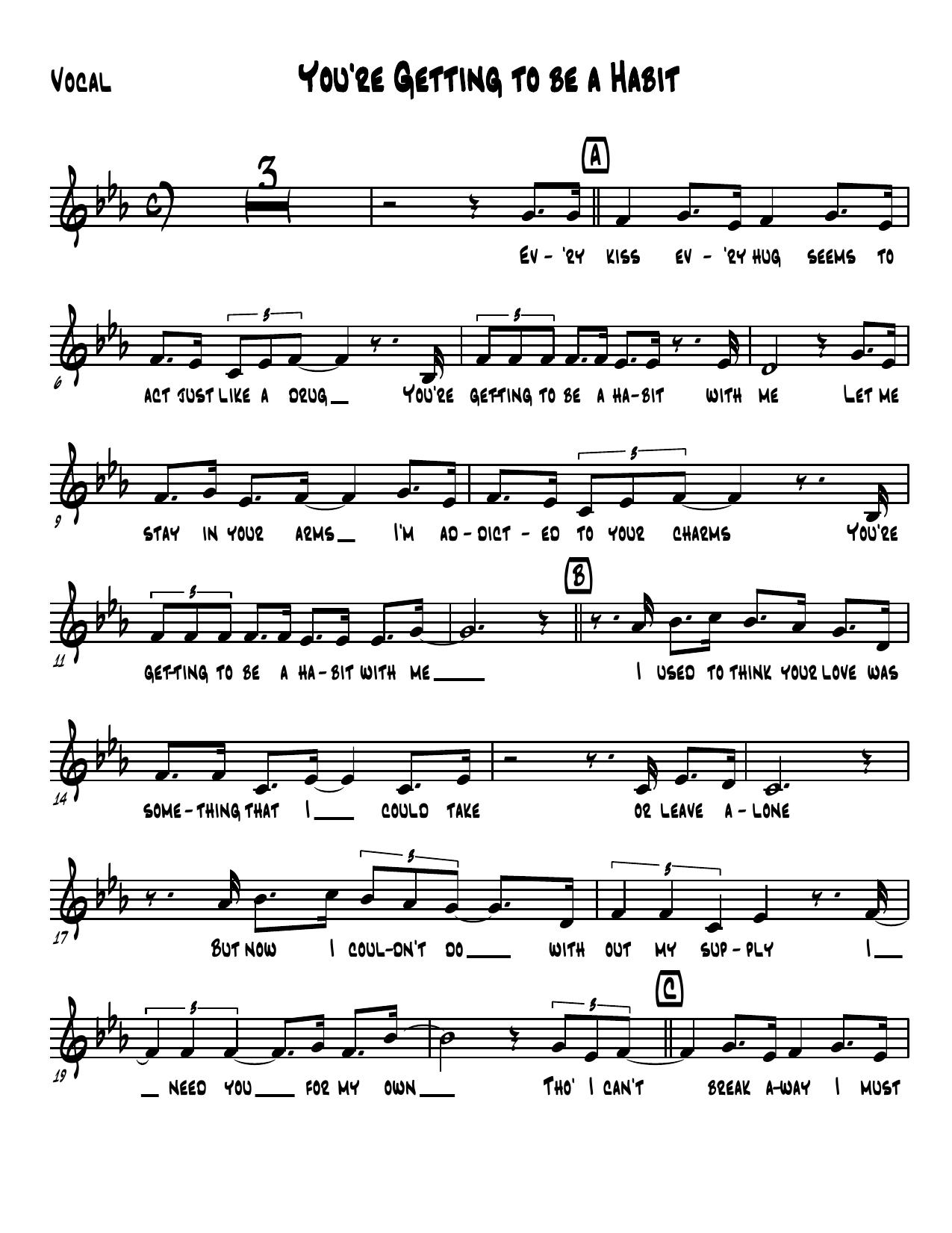
You're Getting To Be A Habit (N.Riddle) sheet music preview

You're Getting To Be A Habit (N.Riddle)

Composed by Nelson Riddle

Arranged by Frank Sinatra & Nelson Riddle

  • Ensemble: Big Band
  • Pages: 19
  • Instruments (17): Vocal, Alto Sax 1, Alto Sax 2, Tenor Sax 1, Tenor Sax 2, Baritone Sax, Trumpet 1, Trumpet 2, Trumpet 3, Trumpet 4, Trombone 1, Trombone 2, Trombone 3, Trombone 4, Bass, Piano/Guitar, Drums
  • Difficulty: easy
  • Content: Individual Parts
  • Format: PDF Download (Instant)
  • Price: $24.99

Harry Warren and Al Dubin’s timeless 1932 standard "You're Getting To Be A Habit With Me" received its definitive mid-century jazz vocal treatment when Nelson Riddle adapted it for Frank Sinatra’s landmark 1956 Capitol Records session, *Songs for Swingin' Lovers!*. This era represents the absolute zenith of the classic American pop-vocal and big band collaboration, where Riddle perfected a lush, cinematic, yet fiercely swinging orchestral language that redefined how interpreters approached the Great American Songbook. Rather than treating the rhythm section as a mere background pulse, Riddle wove sophisticated counter-melodies, cascading string-like brass lines, and ingenious harmonic turnarounds that elevated swinging dance music into high art. Driven by an infectious, buoyant medium-up swing groove in 4/4 time, this arrangement radiates sophisticated optimism and high-octane charm. The chart opens with an unmistakable, bright brass-and-reed hook that immediately establishes a forward-leaning momentum, propelled by an aggressive, walking bassline and crisp hi-hat persistence. Riddle’s harmonic palette relies on sparkling extended dominant chords, clever chromatic descents, and sudden dynamic shifts that create a sparkling, energetic texture. The mood is effortlessly suave, balancing driving, foot-tapping rhythmic intensity with the relaxed, conversational phrasing characteristic of Sinatra's prime Capitol years. Riddle’s signature scoring brilliance shines through the ingenious interplay between the woodwinds and brass, utilizing tight, cool-school saxophone voicings contrasted against biting muted trumpet stabs. The 10-instrument scoring cleverly maximizes every voice, deploying the alto, tenor, and baritone saxophones as a unified harmonic engine while utilizing the trombone and trumpet to punch through with sharp syncopated accents. The arrangement features brilliantly crafted ensemble solis that mimic vocal counterlines, punctuated by dynamic build-ups leading into a triumphant shout chorus. The melody is carried primarily by the lead vocal role (or a featured lead instrument in instrumental adaptations), supported by clever background figures that never obscure the narrative text. Technical challenges lie primarily in maintaining an immaculate, light-articulation swing feel at a brisk tempo, requiring absolute precision in the horn section's execution of dynamic swells and crisp syncopated phrasing. Advanced high school, collegiate, and professional jazz ensembles will find this chart an exceptionally rewarding addition to their repertoire. Because the 10-instrument configuration strips away padding to expose individual section accountability, players must possess strong stylistic awareness and impeccable intonation. Performing this arrangement offers musicians a masterclass in mid-century West Coast arranging sensibilities, demanding a blend of aggressive swing drive and feather-light harmonic balance that will captivate sophisticated jazz audiences. Nailing the authentic Nelson Riddle sound requires strict attention to dynamic contrast and articulation discipline. The tempo should sit comfortably around a brisk medium-swing (approx. 144–152 BPM), ensuring the rhythm section drives relentlessly without rushing. Horn players must treat all quarter notes with a sustained, jazz-weighted length, while eighth notes require an even, triplet-based swing subdivision with emphasized accents on the upbeat. Pay close attention to the dynamic markings; Riddle's arrangements thrive on sudden sub-ito pianos and sweeping crescendos that mimic a cinematic soundscape. Mute usage should be crisp and uniform where indicated in the brass parts, avoiding a congested tone. Rehearsal should begin by isolating the rhythm section to lock in the foundational swing feel before layering the compact 10-piece horn section, ensuring the inner-voice harmony lines blend cohesively beneath the lead melody. Q: What specific instruments and parts are included in this 19-page arrangement? A: This chart is scored for a compact 10-instrument ensemble comprising Alto Saxophone, Tenor Saxophone, Baritone Saxophone, Trumpet, and Trombone, alongside a full rhythm section (piano, guitar, bass, drums) and vocal/lead line parts. Q: What is the difficulty level of this Nelson Riddle arrangement? A: This arrangement is rated at an advanced level, best suited for collegiate, professional, or high-level high school jazz bands due to its demanding rhythmic precision, tight 10-player voicing exposure, and rapid swing articulation requirements. Q: What is the historical style and background of this specific version? A: It captures the quintessential 1956 Capitol Records style popularized by Frank Sinatra and arranger Nelson Riddle, representing the golden age of sophisticated, swinging West Coast big band jazz. Q: What makes this particular arrangement unique compared to standard big band charts? A: Riddle's signature scoring genius is evident in the clever harmonic turnarounds, cinematic counter-melodies, and specialized 10-instrument voicings that deliver the massive sound of a full studio orchestra within a streamlined, transparent ensemble format. Q: What is the recommended performance duration and tempo feel? A: The piece runs approximately 2.5 to 3 minutes in length and is anchored by a bright, driving medium-swing feel in 4/4 time.

Questions and answers

What is included in the You're Getting To Be A Habit (N.Riddle) PDF?
The verified current file contains individual parts across 19 pages.
How many instruments or parts are listed for You're Getting To Be A Habit (N.Riddle)?
The verified instrumentation list contains 17 entries for this Big Band arrangement.
Who is credited for You're Getting To Be A Habit (N.Riddle)?
Composer: Nelson Riddle. Arranger: Frank Sinatra & Nelson Riddle.
What difficulty is listed for You're Getting To Be A Habit (N.Riddle)?
The verified difficulty level is easy.
Can I preview You're Getting To Be A Habit (N.Riddle) before buying?
Yes. The product page provides a preview generated from the current PDF file.
How is You're Getting To Be A Habit (N.Riddle) delivered?
After successful payment, the digital PDF is made available for download. The displayed price is $24.99.

Musicians Also Search For

You're Getting To Be A Habit Frank Sinatra & Nelson Riddle PDFYou're Getting To Be A Habit Frank Sinatra & Nelson Riddle sheet musicYou're Getting To Be A Habit arranged by Frank Sinatra & Nelson RiddleFrank Sinatra & Nelson Riddle big band chartsFrank Sinatra & Nelson Riddle jazz arrangements PDFYou're Getting To Be A Habit Nelson Riddle sheet musicYou're Getting To Be A Habit Nelson Riddle big band arrangementsNelson Riddle big band chartsYou're Getting To Be A Habit big band arrangementsYou're Getting To Be A Habit big band PDF downloadYou're Getting To Be A Habit jazz sheet musicbig band sheet music downloadYou're Getting To Be A Habit individual parts downloadYou're Getting To Be A Habit sheet music PDFbuy You're Getting To Be A Habit sheet musicdownload You're Getting To Be A Habit PDFYou're Getting To Be A Habit jazz chartsbest Frank Sinatra & Nelson Riddle big band arrangementsNelson Riddle arranged by Frank Sinatra & Nelson RiddleYou're Getting To Be A Habit printable sheet musicbig band repertoire PDF

All arrangements by Frank Sinatra & Nelson Riddle All Nelson Riddle sheet music