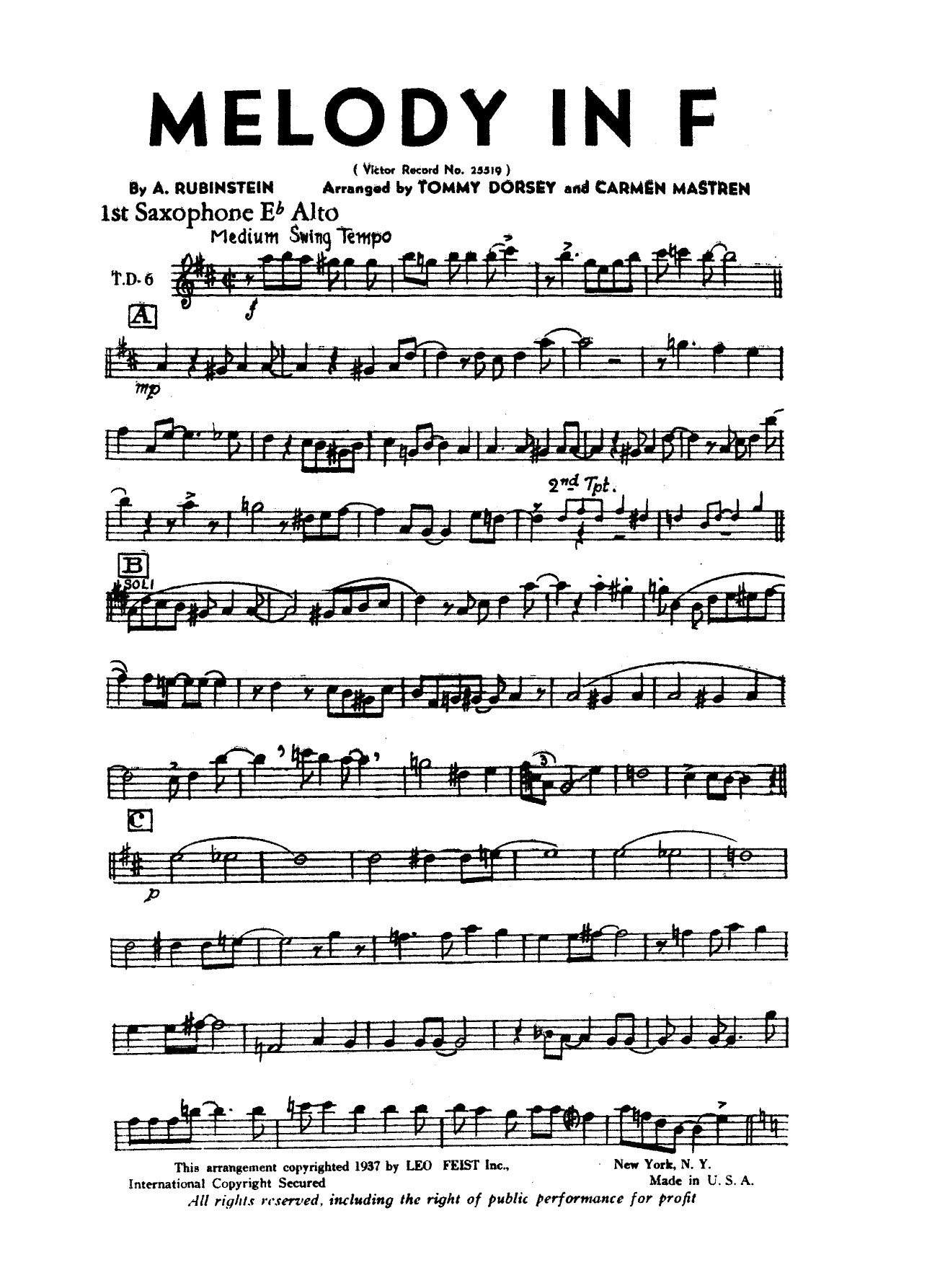
Melody In F (T.Dorsey)
Composed by Anton Rubinstein
Arranged by Tommy Dorsey-Jimmy Dorsey
- Ensemble: Big Band
- Pages: 32
- Instruments (15): 1st Saxophone Eb Alto, 2nd Saxophone Bb Tenor, 3rd Saxophone Eb Alto, 4th Saxophone Bb Tenor, 4th Saxophone Eb Baritone (Substitute for 4th Sax. Bb Tenor), 1st Trumpet in Bb, 2nd Trumpet in Bb, 3rd Trumpet in Bb, 1st Trombone, 2nd Trombone, Guitar, Piano, Bass, Drums, 1st Violins
- Difficulty: medium
- Content: Individual Parts
- Format: PDF Download (Instant)
- Price: $24.99
Anton Rubinstein’s romantic piano staple "Melody in F" underwent a remarkable transformation when filtered through the brilliant minds of the Dorsey brothers during the height of the big band era. Originally published in 1852 as part of Rubinstein's *Soirées musicales* (Op. 3, No. 1), the timeless melody was famously adapted into the swing idiom by Tommy and Jimmy Dorsey, merging 19th-century classical lyricism with the driving pulse of 1930s and 40s jazz orchestration. This sophisticated crossover represents a fascinating intersection where salon music meets the grand tradition of swing, capturing the elegance of sweet bands while retaining the rhythmic vitality of hot jazz. Operating at a fluid, expressive medium tempo, the arrangement opens with a lush, harmonically rich introduction that honors Rubinstein's original melodic contour before settling into a supple, flowing swing feel. The mood shifts seamlessly between nostalgic warmth and driving, upbeat optimism. The Dorsey brothers' signature approach is stamped all over the charts: smooth, highly polished reed-and-brass interplay, seamless modulation between lyrical rubato passages and strict rhythm sections, and exquisitely voiced chordal structures that demand impeccable intonation. The arrangement avoids heavy-handed pastiche, instead treating the classical theme with genuine reverence while injecting it with clever syncopation and sophisticated harmonic extensions. The melody is primarily carried by the saxophone section, with Tommy Dorsey’s lyrical trombone stylings heavily influencing the tenor and lead trombone voicings throughout the middle choruses. Solos are integrated organically into the form, providing ample space for a featured lead alto or trombone to stretch out over crisp, punchy background figures from the brass. Technical challenges lie primarily in maintaining a legato, singing tone during fast-moving harmonic shifts, as well as executing clean, synchronized dynamic swells across the entire ensemble. The rhythm section must maintain an ultra-light, driving swing foundation—never heavy-handed—to allow the intricate countermelodies in the upper reeds to breathe. Advanced high school ensembles, collegiate jazz orchestras, and professional repertory bands will find this chart an exceptionally rewarding addition to their libraries. Because it demands a high degree of stylistic versatility—requiring players to pivot instantly from delicate, chamber-like classical phrasing to relaxed, articulate swing—it serves as an invaluable pedagogical tool for developing ensemble sensitivity. Performing this arrangement offers audiences a refreshing glimpse into how early big bands successfully bridged the gap between classical heritage and popular American dance music. To capture the authentic Dorsey aesthetic, conductors should rehearse the ensemble with a primary focus on vocal phrasing and seamless blend. The tempo must remain steady yet flexible, avoiding any rigid mechanical stiffness; think of a relaxed, pulsing medium swing rather than a heavy stomp. Trumpets and trombones should utilize gentle vibrato on sustained notes, reminiscent of 1930s brass performance practice, while avoiding harsh edge in the shout sections. Pay close attention to dynamic markings: the contrast between the lush, whispered ensemble passages and the brighter, full-ensemble peaks is what gives this chart its emotional sweep. Reeds need to prioritize absolute uniformity in articulation during the fast-moving eighth-note passages, ensuring that every accented note breathes naturally. The rhythm section should anchor the groove with a feather-light ride cymbal pattern and a pulsing, unforced bass line that propels the swing feel forward without ever overpowering the delicate counterpoint in the horns. Q: What instruments and parts are included in this arrangement? A: This chart is scored for a standard 17-instrument big band lineup, including four trumpets, four trombones, five saxophones (with standard double woodwind or doubling options typical of the era), and a full four-piece rhythm section consisting of piano, guitar, bass, and drums. The complete package spans 32 detailed pages of full-ensemble orchestration. Q: What is the difficulty level of this big band arrangement? A: This piece is best suited for advanced high school, collegiate, and professional jazz ensembles. It requires mature stylistic versatility, strong intonation for complex chord voicings, and the ability to transition smoothly between classical lyrical phrasing and relaxed swing feels. Q: What is the historical style and background of this piece? A: The music is rooted in Anton Rubinstein's famous 1852 romantic composition "Melody in F," which was reimagined during the swing era by master arrangers Tommy and Jimmy Dorsey. It represents the golden age of big band jazz crossover, blending classical European lyricism with American swing orchestration. Q: What makes this specific Dorsey arrangement unique? A: Unlike standard blues- or rhythm-changes-based swing charts, this arrangement elevates a classical parlor melody through sophisticated, rich harmonic voicings and clever counterpoint. It highlights the signature Dorsey style, balancing sweet, polished ensemble sections with driving rhythmic momentum. Q: What is the performance duration and recommended tempo for this chart? A: The arrangement typically runs between 3 and 4 minutes in performance length, depending on the chosen tempo and the length of improvised solo sections. It is designed to be performed at a comfortable, flowing medium-swing tempo that allows the intricate melodic lines to remain articulate and expressive.
Questions and answers
- What is included in the Melody In F (T.Dorsey) PDF?
- The verified current file contains individual parts across 32 pages.
- How many instruments or parts are listed for Melody In F (T.Dorsey)?
- The verified instrumentation list contains 15 entries for this Big Band arrangement.
- Who is credited for Melody In F (T.Dorsey)?
- Composer: Anton Rubinstein. Arranger: Tommy Dorsey-Jimmy Dorsey.
- What difficulty is listed for Melody In F (T.Dorsey)?
- The verified difficulty level is medium.
- Can I preview Melody In F (T.Dorsey) before buying?
- Yes. The product page provides a preview generated from the current PDF file.
- How is Melody In F (T.Dorsey) delivered?
- After successful payment, the digital PDF is made available for download. The displayed price is $24.99.
Musicians Also Search For
Melody In F Tommy Dorsey-Jimmy Dorsey PDF • Melody In F Tommy Dorsey-Jimmy Dorsey sheet music • Melody In F arranged by Tommy Dorsey-Jimmy Dorsey • Tommy Dorsey-Jimmy Dorsey big band charts • Tommy Dorsey-Jimmy Dorsey jazz arrangements PDF • Melody In F Anton Rubinstein sheet music • Melody In F Anton Rubinstein big band arrangements • Anton Rubinstein big band charts • Melody In F big band arrangements • Melody In F big band PDF download • Melody In F jazz sheet music • big band sheet music download • Melody In F individual parts download • Melody In F sheet music PDF • buy Melody In F sheet music • download Melody In F PDF • Melody In F jazz charts • best Tommy Dorsey-Jimmy Dorsey big band arrangements • Anton Rubinstein arranged by Tommy Dorsey-Jimmy Dorsey • Melody In F printable sheet music • big band repertoire PDF