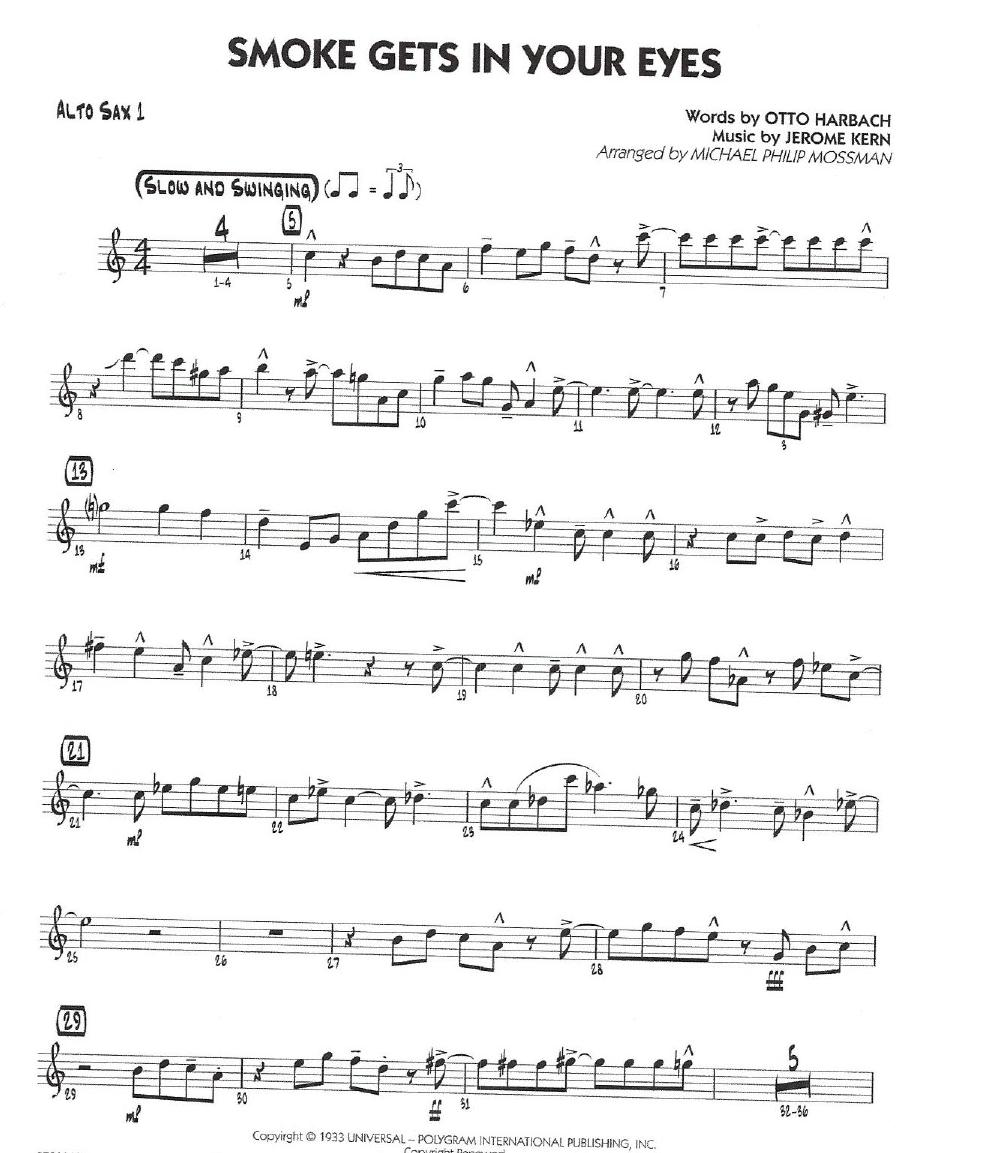
Smoke Gets In Your Eyes (M.P.Mossman) sheet music preview

Smoke Gets In Your Eyes (M.P.Mossman)

Composed by Jerome Kern

Arranged by M.P.Mossman

  • Ensemble: Big Band
  • Pages: 14
  • Instruments (5): Alto Sax 1, Alto Sax 2, Tenor Sax 1, Tenor Sax 2, Baritone Sax
  • Difficulty: easy
  • Content: Individual Parts
  • Format: PDF Download (Instant)
  • Price: $24.99

Jerome Kern and Otto Harbach’s timeless composition "Smoke Gets in Your Eyes," introduced in the 1933 musical *Roberta* and later immortalized by The Platters, stands as one of the most enduring contributions to the Great American Songbook. Over the decades, this poignant ballad has transitioned from a Broadway show tune into a quintessential jazz standard, interpreted by luminaries such as Art Tatum, Thelonious Monk, and Clifford Brown. Its sophisticated harmonic structure, characterized by deceptive resolutions and a sweeping melodic arc, provides an ideal canvas for sophisticated jazz interpretation, inviting artists to explore deep emotional resonance through rich chordal voicings and expressive rubato phrasing. In this masterful big band adaptation, arranger M.P.Mossman transforms the familiar nostalgic theme into a sophisticated vehicle tailored specifically for a dynamic saxophone section comprising two altos, two tenors, and baritone saxophone. The arrangement breathes fresh life into Kern’s original melody by blending lush, modern modal harmonies with traditional swing-era warmth. The emotional landscape shifts seamlessly from introspective, velvety ballad styling to swelling, impassioned peaks, evoking a sense of bittersweet nostalgia and theatrical grandeur. Mossman’s signature writing deftly avoids predictable chord substitutions, opting instead for luminous extended voicings that highlight the rich, dark timbre of the full reed choir. The structural architecture of the chart places the primary melodic weight squarely on the shoulders of the saxophone section, utilizing tight, interlocking block-chords and lush counterpoint reminiscent of classic West Coast cool jazz, yet infused with contemporary bite. Rather than relying on a traditional full-ensemble shout chorus, Mossman constructs an intricate, conversational soli section that tests the section’s intonation, blend, and rhythmic cohesion. Technical challenges lie primarily in maintaining a smooth, legato concept across wide dynamic leaps and navigating subtle rubato transitions without losing collective pulse. Solo opportunities are integrated organically, allowing a featured soloist to soar over shimmering, sustained background pads from the rest of the ensemble. Advanced high school, collegiate, and professional jazz ensembles will find this arrangement an exceptionally rewarding addition to their repertoire. Because it requires a high degree of listening maturity, refined tone control, and precise intonation—particularly within the dense lower-register voicings of the baritone saxophone and second tenor—it serves as an outstanding vehicle for festival performance or formal concert settings. Conductor and ensemble alike will appreciate how Mossman balances accessibility with harmonic sophistication, resulting in a chart that captivates audiences from the opening statement to the final, lingering chord. Balancing intonation and blend across the five saxophone voices is the primary technical hurdle in this arrangement, especially during exposed chordal passages where inner voices carry the harmonic tension. Conductors should insist on a unified concept of vibrato—warm and controlled, but never overpowering the collective sound. The tempo should be approached with a relaxed, flowing ballad feel, avoiding a rigid metric grid in favor of an expressive, elastic pulse that breathes with the soloist. Pay close attention to dynamic markings; the transition from whisper-soft pianissimo pads to full-throated mezzo-forte climaxes must be executed with seamless gradual crescendos. Rehearsal time should be dedicated to isolating the intricate soli sections at a slower tempo, ensuring that syncopated figures lock in precisely before integrating the rhythm section. Players should treat long tones with dynamic shading, ensuring that every voice contributes equally to the shifting color palette of Mossman's sophisticated harmonic framework. Q: What specific instruments and parts are included in this arrangement? A: This chart is scored specifically for a five-piece saxophone section consisting of Alto Saxophone 1, Alto Saxophone 2, Tenor Saxophone 1, Tenor Saxophone 2, and Baritone Saxophone, spanning a total of 14 pages of music. Q: What is the difficulty level of this M.P.Mossman arrangement? A: This arrangement is best suited for advanced high school, collegiate, and professional saxophone sections due to its demanding intonation requirements, dense extended harmonies, and need for refined ensemble blend. Q: What musical style and historical context does this chart represent? A: Based on Jerome Kern’s 1933 standard from *Roberta*, this arrangement reframes the classic ballad within a contemporary jazz idiom, drawing on sophisticated modern voicings while honoring the rich tradition of the Great American Songbook. Q: What makes this particular arrangement unique? A: M.P.Mossman's distinct approach bypasses standard big band clichés by utilizing intricate, conversational saxophone soli sections and luminous extended harmonies that showcase the full emotional depth and dark timbres of the reed choir. Q: What is the recommended performance tempo and feel for this piece? A: The arrangement is set to a relaxed, expressive ballad tempo with an elastic pulse, requiring musicians to balance rubato phrasing with strict collective internal time.

Questions and answers

What is included in the Smoke Gets In Your Eyes (M.P.Mossman) PDF?
The verified current file contains individual parts across 14 pages.
How many instruments or parts are listed for Smoke Gets In Your Eyes (M.P.Mossman)?
The verified instrumentation list contains 5 entries for this Big Band arrangement.
Who is credited for Smoke Gets In Your Eyes (M.P.Mossman)?
Composer: Jerome Kern. Arranger: M.P.Mossman.
What difficulty is listed for Smoke Gets In Your Eyes (M.P.Mossman)?
The verified difficulty level is easy.
Can I preview Smoke Gets In Your Eyes (M.P.Mossman) before buying?
Yes. The product page provides a preview generated from the current PDF file.
How is Smoke Gets In Your Eyes (M.P.Mossman) delivered?
After successful payment, the digital PDF is made available for download. The displayed price is $24.99.

Musicians Also Search For

Smoke Gets In Your Eyes M.P.Mossman PDFSmoke Gets In Your Eyes M.P.Mossman sheet musicSmoke Gets In Your Eyes arranged by M.P.MossmanM.P.Mossman big band chartsM.P.Mossman jazz arrangements PDFSmoke Gets In Your Eyes Jerome Kern sheet musicSmoke Gets In Your Eyes Jerome Kern big band arrangementsJerome Kern big band chartsSmoke Gets In Your Eyes big band arrangementsSmoke Gets In Your Eyes big band PDF downloadSmoke Gets In Your Eyes jazz sheet musicbig band sheet music downloadSmoke Gets In Your Eyes individual parts downloadSmoke Gets In Your Eyes sheet music PDFbuy Smoke Gets In Your Eyes sheet musicdownload Smoke Gets In Your Eyes PDFSmoke Gets In Your Eyes jazz chartsbest M.P.Mossman big band arrangementsJerome Kern arranged by M.P.MossmanSmoke Gets In Your Eyes printable sheet musicbig band repertoire PDF

All arrangements by M.P.Mossman All Jerome Kern sheet music