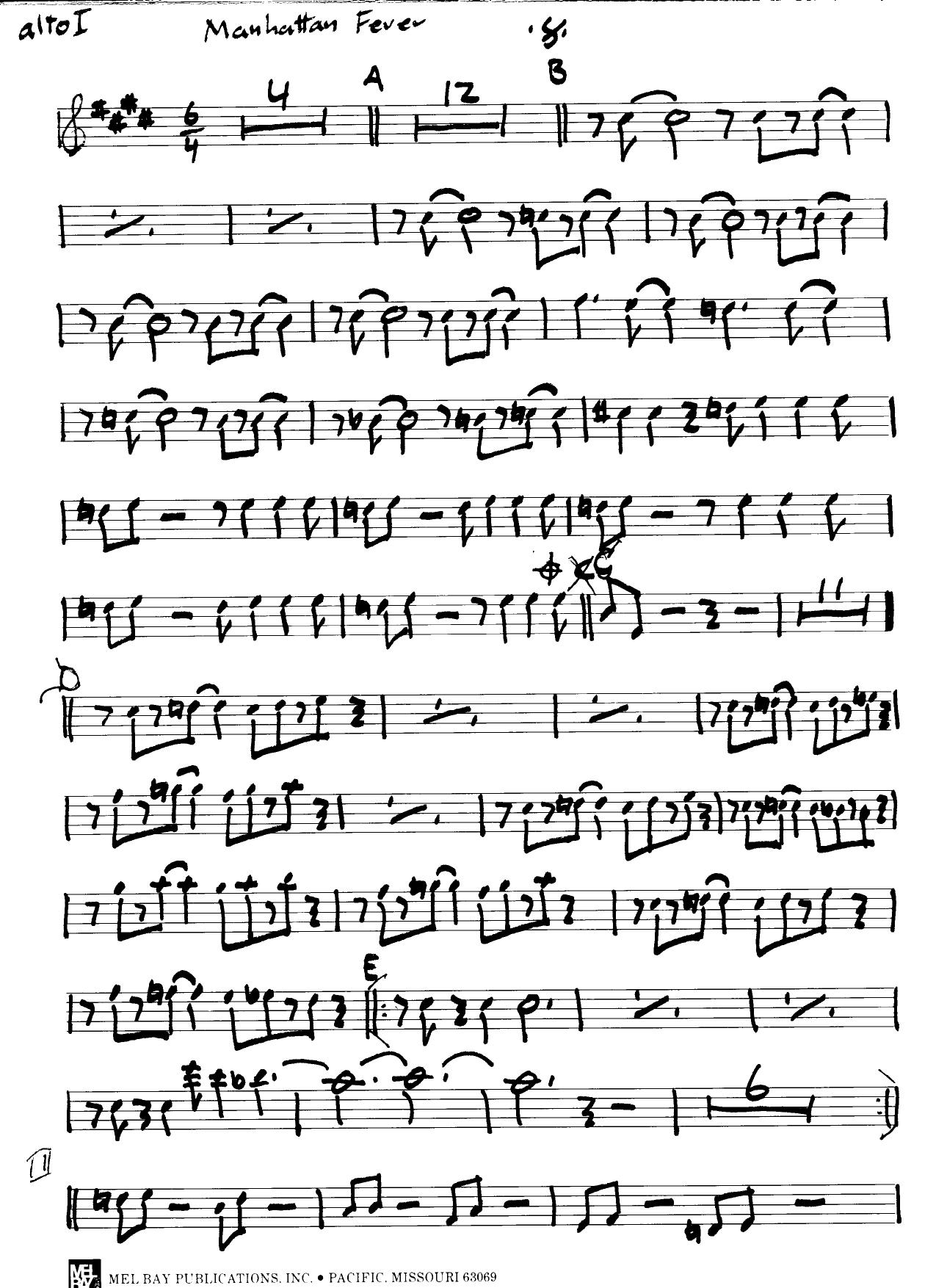
Manhattan Fever (F.Foster)
Composed by Frank Foster
Arranged by Frank Foster
- Ensemble: Big Band
- Pages: 67
- Instruments (17): Alto I, 2nd Alto Sax, 3rd Tenor Sax, 4th Tenor Sax, 5th Baritone Sax, 1st Trumpet, 2nd Trumpet, 3rd Trumpet, 4th Trumpet, 1st Trombone, 2nd Trombone, 3rd Trombone, 4th Trombone (Bass), Piano, Guitar, Bass, Drums
- Difficulty: advanced
- Content: Individual Parts
- Format: PDF Download (Instant)
- Price: $24.99
Originally conceived by NEA Jazz Master Frank Foster as the title track for his acclaimed 1968 Blue Note sextet album and subsequently expanded for his powerhouse Loud Minority Big Band in 1977, "Manhattan Fever" is a masterclass in modern modal-leaning big band writing. Emerging from an era where Foster was bridging the straight-ahead swinging tradition of his foundational years with Count Basie and the more adventurous, expansive horizons of late-sixties and seventies jazz, this arrangement captures the relentless, kinetic pulse of urban life. It stands as a brilliant snapshot of Foster's dual mastery as a titan of the tenor saxophone and a visionary composer who continually pushed big band idioms into sophisticated, contemporary territory. Driven by an infectious, driving medium-to-up-tempo swing feel anchored in an expansive 6/4 framework, the musical character is both gritty and sophisticated. Following a brisk, four-bar bass and drum introduction, the rhythmically jaunty melody is boldly stated by the lower voices—tenor saxophones, baritone saxophone, and trombone—before the upper brass enter to round out the texture. Beneath the straightforward blues-based form lie mildly dissonant harmonies and angular chromatic lines that inject a sense of modern urban urgency and emotional depth. The mood swings effortlessly between punchy, high-octane swagger and expansive, blues-drenched introspection, evoking the hectic yet exhilarating atmosphere of a New York City commute. Foster’s distinctive arranging approach shines through clever sectional interplay and a deep respect for the dynamic capabilities of the ensemble. The chart balances open soloist-oriented corridors—featuring designated spotlight sections for tenor saxophone, trombone, and piano—with meticulously crafted, understated background figures that maintain forward momentum without ever crowding the featured soloists. A standout compositional hallmark is the magnificent ensemble shout section, which serves as a direct nod to Foster's Count Basie heritage; it initiates at a hushed, sub-tone dynamic level before methodically swelling into a roaring, full-ensemble climax. The dynamic shading, sophisticated chord voicings, and robust rhythmic counterlines demand an ensemble that listens closely across sections. Advanced high school bands, collegiate jazz orchestras, and professional big bands will find this chart an exceptionally rewarding challenge. The technical demands lie primarily within maintaining a rock-solid, driving 6/4 swing groove, executing precise articulation across shifting dynamic plateaus, and navigating open-ended solo changes. Offering ample space for stretching out, alongside classic Foster shout-chorus brilliance, this 67-page masterwork provides an unforgettable centerpiece for any ambitious jazz ensemble looking to stretch its stylistic and technical boundaries. Navigating "Manhattan Fever" successfully requires a firm grasp of its underlying 6/4 meter, which must feel as fluid and natural as standard 4/4 swing. Conductors should ensure the rhythm section locks in tightly during the opening four-bar bass and drum setup, establishing a pulse that stays unyielding beneath the low-register melody. * **Tempo & Feel:** Keep the medium-up swing tempo steady and forward-moving; avoid dragging during the extended solo rotations. The 6/4 groove should emphasize a natural two-bar phrasing feel. * **Dynamics:** The ensemble shout section (beginning around measure 117) relies entirely on a disciplined sub-forte starting dynamic. Resist the urge to peak too early; the gradual, measured crescendo over multiple choruses is what generates the thrilling "Basie-style" roar. * **Articulation & Blending:** Ensure that the lower-voice melody statements in the tenor saxes, baritone sax, and trombones project with a dry, articulation-forward weight. Background riffs behind the tenor, trombone, and piano solos must remain strictly subservient in volume, acting as rhythmic cushions rather than competing voices. Q: What instruments and parts are included in this arrangement? A: This publication is scored for a standard big band featuring 5 saxophones (2 altos, 2 tenors, baritone), 5 trumpets, 4 trombones, guitar, piano, bass, and drums, along with optional parts for Trumpet 5 and Tuba, spanning a 67-page comprehensive score and parts set. Q: What is the difficulty level of this chart? A: This arrangement is designated as advanced (difficult), making it best suited for accomplished college jazz ensembles, community big bands, and professional groups equipped to handle sophisticated harmonies, extended forms, and demanding endurance. Q: What is the historical context and musical style of "Manhattan Fever"? A: Originally composed by Frank Foster for a 1968 Blue Note sextet session and later expanded for his Loud Minority Big Band in 1977, the piece is a modern modal swing chart rooted in a 6/4 blues form that reflects Foster's extensive legacy with Count Basie and the New York jazz scene. Q: What makes this specific Frank Foster arrangement unique? A: It is uniquely distinguished by its unconventional 6/4 blues metric framework, intricate lower-register thematic statements, cleanly integrated solo backgrounds, and a classic, whisper-to-roar shout chorus that evokes Foster's arranging pedigree. Q: How long is the performance duration and what is the tempo feel? A: While performance duration can vary based on the length of improvised solo choruses, the piece runs at a driving, medium-up swing tempo built upon an insistent, pulse-driven 6/4 feel.
Questions and answers
- What is included in the Manhattan Fever (F.Foster) PDF?
- The verified current file contains individual parts across 67 pages.
- How many instruments or parts are listed for Manhattan Fever (F.Foster)?
- The verified instrumentation list contains 17 entries for this Big Band arrangement.
- Who is credited for Manhattan Fever (F.Foster)?
- Composer: Frank Foster. Arranger: Frank Foster.
- What difficulty is listed for Manhattan Fever (F.Foster)?
- The verified difficulty level is advanced.
- Can I preview Manhattan Fever (F.Foster) before buying?
- Yes. The product page provides a preview generated from the current PDF file.
- How is Manhattan Fever (F.Foster) delivered?
- After successful payment, the digital PDF is made available for download. The displayed price is $24.99.
Musicians Also Search For
Manhattan Fever Frank Foster PDF • Manhattan Fever Frank Foster sheet music • Manhattan Fever arranged by Frank Foster • Frank Foster big band charts • Frank Foster jazz arrangements PDF • Manhattan Fever Frank Foster big band arrangements • Manhattan Fever big band arrangements • Manhattan Fever big band PDF download • Manhattan Fever jazz sheet music • big band sheet music download • Manhattan Fever individual parts download • Manhattan Fever sheet music PDF • buy Manhattan Fever sheet music • download Manhattan Fever PDF • Manhattan Fever jazz charts • best Frank Foster big band arrangements • Manhattan Fever printable sheet music • big band repertoire PDF