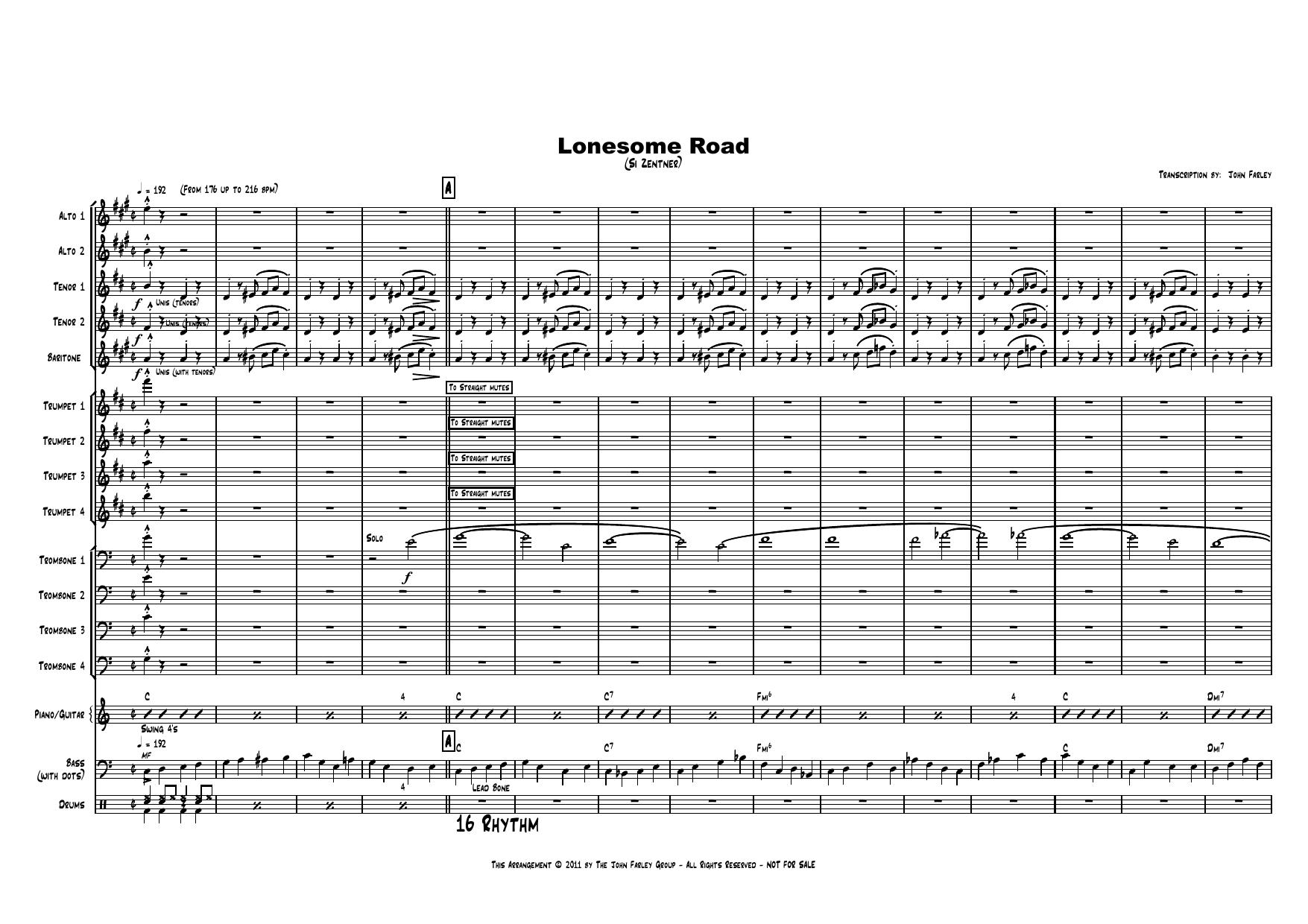
Lonesome Road (J.Farley)
Composed by Nathaniel Shilkret
Arranged by John Farley
- Ensemble: Big Band
- Pages: 59
- Instruments (16): Alto 1, Alto 2, Tenor 1, Tenor 2, Baritone Saxophone, Trumpet 1, Trumpet 2, Trumpet 3, Trumpet 4, Trombone 1, Trombone 2, Trombone 3, Trombone 4, Piano/Guitar, Bass, Drums
- Difficulty: advanced
- Content: Individual Parts
- Format: PDF Download (Instant)
- Price: $24.99
Nathaniel Shilkret’s timeless 1927 composition "The Lonesome Road"—co-written with Gene Austin—occupies a vital space at the intersection of early Tin Pan Alley songwriting and the burgeoning jazz idiom. Originally popularized by vocalists and early jazz orchestras during the late 1920s and 1930s, the tune rapidly transformed from a melancholy spiritual-styled ballad into a flexible vehicle for creative improvisation. Its enduring appeal lies in its deceptively simple, blues-infused melodic contour and its powerful harmonic framework, which invites both introspective ballad interpretation and driving, hard-swinging adaptations. John Farley’s sophisticated big band interpretation reimagines the classic tune as a robust, mid-tempo groove anchored in a rich traditional swing aesthetic. Set in a comfortable, driving minor-key feel, the arrangement radiates a moody, atmospheric energy that balances soulful vulnerability with muscular big band power. The emotional arc transitions seamlessly from smoky, intimate ensemble passages to soaring, high-energy climaxes, capturing the bittersweet essence of a long, lonely journey while keeping the foot tapping and the rhythm section locked into an infectious pocket. Farley approaches the material with a masterclass in dynamic contrast and textural variety. The arrangement opens with a haunting, understated introduction that showcases contemporary-leaning extended harmonies within traditional saxophone voicings, before locking into a driving four-on-the-floor swing feel. A standout feature of this chart is the intricately crafted brass and reed solis, where Farley utilizes close-position harmonies reminiscent of the classic Kenton and Basie idioms, yet infuses them with fresh, modern counterlines. The chart culminates in a towering, multi-tiered shout chorus that exploits the full dynamic spectrum of the ensemble, utilizing strategic syncopation and punchy brass stabs to build relentless tension before a breathless final cadence. Melodic duties are distributed democratically across the ensemble, ensuring that every section shares the spotlight. The arrangement features designated solo spaces for trumpet and tenor saxophone, providing ample room for players to stretch out over changes that alternate between minor blues textures and soaring relative-major releases. Technically, the chart demands crisp articulation, excellent internal time, and precise control over dynamic shading, particularly in the lower woodwinds and trombone section. Advanced high school bands with strong section leaders, as well as collegiate and professional community big bands, will find this chart an exceptionally rewarding centerpiece for festival programs or club sets, offering sophisticated writing that rewards careful rehearsal without relying on inaccessible technical extremes. Conductors should approach John Farley’s arrangement of "Lonesome Road" with a primary focus on maintaining a relaxed yet intensely driven medium-swing tempo, recommended at approximately quarter note = 120-126 BPM. The fundamental technical challenge lies in the execution of the rhythm section's groove: the bass line must walk with absolute authority, while the drummer keeps a feather-light ride cymbal texture that leaves air in the arrangement. Ensure the horn players articulate eighth notes with a traditional jazz swing triplet feel, giving extra weight to offbeat accents, particularly in the syncopated brass shout sections. Special attention should be given to dynamic contrast; the muted trumpet and soft saxophone background figures behind the soloists must remain strictly under the dynamic ceiling to allow the featured improvisers room to breathe. Rehearsal should begin by isolating the ensemble interludes and the harmonically dense soli sections at a slower tempo to lock in intonation and blend before dialing up to performance speed. Encourage the brass section to utilize subtle cup or harmon mutes where indicated to achieve that authentic, smoky late-night tone color. Q: What instruments and parts are included in this arrangement? A: This chart is scored for a flexible 8-instrument big band instrumentation, featuring parts for Alto Saxophone, Tenor Saxophone, Baritone Saxophone, Trumpet, and Trombone, alongside a complete rhythm section. The comprehensive 59-page score and parts packet provides robust, full-ensemble textures designed to sound complete even with a streamlined horn section. Q: What is the difficulty level of this arrangement? A: This piece is classified as intermediate-advanced (Grade 4), making it ideal for advanced high school ensembles, college jazz bands, and professional community groups. It requires strong sectional intonation, rhythmic precision in swing subdivisions, and confident soloists. Q: What is the historical style and musical context of this piece? A: Based on Nathaniel Shilkret’s 1927 classic, this arrangement reimagines the historic standard through a sophisticated, mid-tempo modern swing lens. It honors the blues-inflected roots of the original composition while incorporating contemporary harmonic voicings and dynamic big band arranging techniques. Q: What makes John Farley’s arrangement unique compared to other versions? A: Farley’s treatment stands out through its meticulous textural variety, clever use of close-position horn voicings, and an expansive shout chorus that builds immense tension through clever syncopation. It balances nostalgic early-jazz elements with fresh, sophisticated harmonic twists. Q: What is the recommended performance duration and tempo for this arrangement? A: The arrangement runs for approximately 4 to 5 minutes when performed at the recommended medium-swing tempo of quarter note = 120-126 BPM. This duration makes it an ideal length for festival adjudications, concert openers, or substantive middle-set repertoire pieces.
Questions and answers
- What is included in the Lonesome Road (J.Farley) PDF?
- The verified current file contains a conductor score and individual parts across 59 pages.
- How many instruments or parts are listed for Lonesome Road (J.Farley)?
- The verified instrumentation list contains 16 entries for this Big Band arrangement.
- Who is credited for Lonesome Road (J.Farley)?
- Composer: Nathaniel Shilkret. Arranger: John Farley.
- What difficulty is listed for Lonesome Road (J.Farley)?
- The verified difficulty level is advanced.
- Can I preview Lonesome Road (J.Farley) before buying?
- Yes. The product page provides a preview generated from the current PDF file.
- How is Lonesome Road (J.Farley) delivered?
- After successful payment, the digital PDF is made available for download. The displayed price is $24.99.
Musicians Also Search For
Lonesome Road John Farley PDF • Lonesome Road John Farley sheet music • Lonesome Road arranged by John Farley • John Farley big band charts • John Farley jazz arrangements PDF • Lonesome Road Nathaniel Shilkret sheet music • Lonesome Road Nathaniel Shilkret big band arrangements • Nathaniel Shilkret big band charts • Lonesome Road big band arrangements • Lonesome Road big band PDF download • Lonesome Road jazz sheet music • big band sheet music download • Lonesome Road conductor score PDF • Lonesome Road individual parts download • Lonesome Road sheet music PDF • buy Lonesome Road sheet music • download Lonesome Road PDF • Lonesome Road jazz charts • best John Farley big band arrangements • Nathaniel Shilkret arranged by John Farley • Lonesome Road printable sheet music • big band repertoire PDF