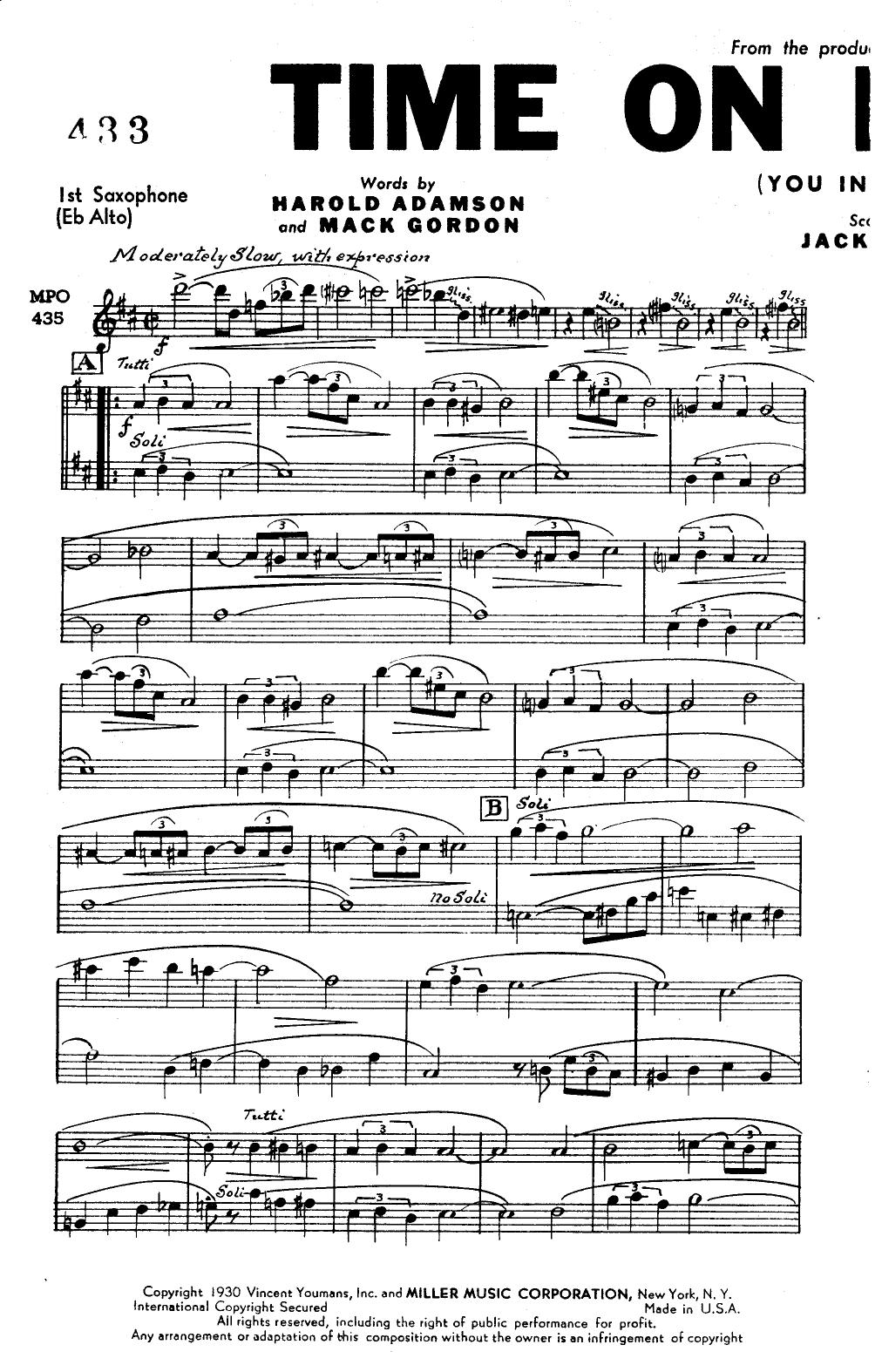
Time On My Hands (J.Mason) sheet music preview

Time On My Hands (J.Mason)

Composed by Vincent Youmans

Arranged by Jack Mason

  • Ensemble: Big Band
  • Pages: 26
  • Instruments (12): 1st Saxophone (Eb Alto), 3rd Saxophone (Eb Alto), 2nd Saxophone (Bb Tenor), 4th Saxophone (Bb Tenor), 1st Trumpet in Bb, 2nd Trumpet in Bb, 3rd Trumpet in Bb, 1st Trombone, 2nd Trombone, Piano, Guitar, Bass
  • Difficulty: medium
  • Content: Individual Parts
  • Format: PDF Download (Instant)
  • Price: $24.99

Vincent Youmans, alongside lyricists Harold Adamson and Mack Gordon, penned "Time on My Hands" for the 1930 Broadway musical *Smiles*, little knowing it would swiftly ascend into the upper echelon of the Great American Songbook. Immortalized by legendary interpreters such as Mildred Bailey, Art Tatum, and later definitive big band readings by the likes of Tommy Dorsey and Glenn Miller, the composition epitomizes the sophisticated, bittersweet melodicism of the early 1930s popular song era. Its rich harmonic framework, built on unexpected chromatic descents and sweeping intervals, has made it a perennial favorite for jazz improvisers seeking a sophisticated vehicle for expressive balladry and relaxed medium-tempo swing treatments. Jack Mason’s masterwork big band adaptation captures the sultry, sophisticated essence of the classic swing era while injecting contemporary harmonic colorings that keep modern audiences completely engaged. Set primarily in a lush, flowing medium swing groove, the chart evokes an atmosphere of late-night smoky lounges and cinematic nostalgia. The mood shifts effortlessly between intimate, tender ensemble passages and soaring, brass-heavy climaxes that showcase the full dynamic range of a standard jazz orchestra. Mason crafts an arrangement where the underlying pulse remains relaxed and unhurried, allowing the rich, cascading chord structures to breathe and envelop the listener in a warm, resonant sonic texture. Mason’s distinctive arranging approach shines through his meticulous voice-leading and textural variety. Rather than relying on static block-chord harmonization, the chart utilizes interwoven countermelodies and shifting woodwind colors—spotlighting the front-line interplay between alto and tenor saxophones. The ensemble writing features lush, Ellingtonian voicings in the brass sections, punctuated by subtle plunger effects and delicate harmonic suspensions. The arrangement builds organically toward a tightly knit shout chorus that avoids excessive volume in favor of dense, sophisticated chordal extensions, demonstrating Mason's innate understanding of how to maximize the impact of a 12-instrument ensemble without sacrificing transparency or balance. Conductors and performers will find this chart deeply rewarding due to its intelligent distribution of thematic material and manageable yet engaging technical demands. The melody is shared fluidly across the saxophone section, requiring a unified concept of phrasing, vibrato, and intonation, while designated solo space allows featured instrumentalists to stretch out over standard changes. Technical challenges center primarily on stylistic cohesion—maintaining a consistent, laid-back swing eighth-note feel at a moderate tempo, and executing dynamic swells with absolute precision. Advanced high school ensembles with strong section leaders, as well as college and community jazz orchestras looking for a sophisticated change of pace from up-tempo burners, will find this arrangement an ideal centerpiece for any concert or festival program. Achieving an authentic rendition of Jack Mason’s arrangement requires careful attention to stylistic nuance, particularly the execution of swung eighth notes at a relaxed, medium tempo. Avoid rushing the beat; the rhythm section must lock into a deep, driving pocket that anchors the harmonic shifts of the horns. The drummer should utilize a classic ride-cymbal swing pattern with light hi-hat chokes on beats two and four, keeping fills tasteful and supportive of the ensemble texture. For the wind sections, balance is critical during the lush, harmonized soli passages. Saxophones must blend their tone colors carefully, ensuring that inner voices do not obscure the lead alto. Brass players should approach muted passages with a warm, rounded tone rather than a shrill edge, reserving open-bell playing for moments of maximum dynamic release. Rehearsals should initially focus on sectional intonation, especially during the chromatic chord progressions where minor second intervals can easily destabilize the pitch center. Pay close attention to dynamic markings; the contrast between whispered sub-tone passages and full-ensemble warmth defines the emotional arc of the performance. Q: What specific instruments and parts are included in this arrangement? A: This arrangement is scored for a 12-instrument big band ensemble, featuring dedicated parts for Alto Saxophone 1, Alto Saxophone 3, Tenor Saxophone 2, Tenor Saxophone 4, and Trumpet 1, alongside a full rhythm section and complementary horn voicings spanning 26 total pages of music. Q: What is the difficulty level of this Jack Mason arrangement? A: It is ideally suited for advanced high school, collegiate, and community jazz bands that possess a solid grasp of swing style, basic jazz harmony, and balanced section playing. Q: What is the historical context and musical style of "Time On My Hands"? A: Originally composed by Vincent Youmans for the 1930 Broadway show *Smiles*, this piece is a cornerstone jazz standard of the swing era, arranged here in a classic, sophisticated medium swing style. Q: What makes this particular arrangement by Jack Mason unique? A: Mason’s chart stands out due to its rich, Ellingtonian harmonic voicings, intricate countermelodies shared across the saxophone section, and a meticulously crafted shout chorus that maximizes the texture of a 12-piece ensemble. Q: What is the recommended performance tempo and duration? A: The arrangement is designed for a relaxed medium swing tempo (approximately 112–120 BPM), resulting in a performance duration of roughly 3 to 4 minutes depending on the length of the improvised solos.

Questions and answers

What is included in the Time On My Hands (J.Mason) PDF?
The verified current file contains individual parts across 26 pages.
How many instruments or parts are listed for Time On My Hands (J.Mason)?
The verified instrumentation list contains 12 entries for this Big Band arrangement.
Who is credited for Time On My Hands (J.Mason)?
Composer: Vincent Youmans. Arranger: Jack Mason.
What difficulty is listed for Time On My Hands (J.Mason)?
The verified difficulty level is medium.
Can I preview Time On My Hands (J.Mason) before buying?
Yes. The product page provides a preview generated from the current PDF file.
How is Time On My Hands (J.Mason) delivered?
After successful payment, the digital PDF is made available for download. The displayed price is $24.99.

Musicians Also Search For

Time On My Hands Jack Mason PDFTime On My Hands Jack Mason sheet musicTime On My Hands arranged by Jack MasonJack Mason big band chartsJack Mason jazz arrangements PDFTime On My Hands Vincent Youmans sheet musicTime On My Hands Vincent Youmans big band arrangementsVincent Youmans big band chartsTime On My Hands big band arrangementsTime On My Hands big band PDF downloadTime On My Hands jazz sheet musicbig band sheet music downloadTime On My Hands individual parts downloadTime On My Hands sheet music PDFbuy Time On My Hands sheet musicdownload Time On My Hands PDFTime On My Hands jazz chartsbest Jack Mason big band arrangementsVincent Youmans arranged by Jack MasonTime On My Hands printable sheet musicbig band repertoire PDF

All arrangements by Jack Mason All Vincent Youmans sheet music