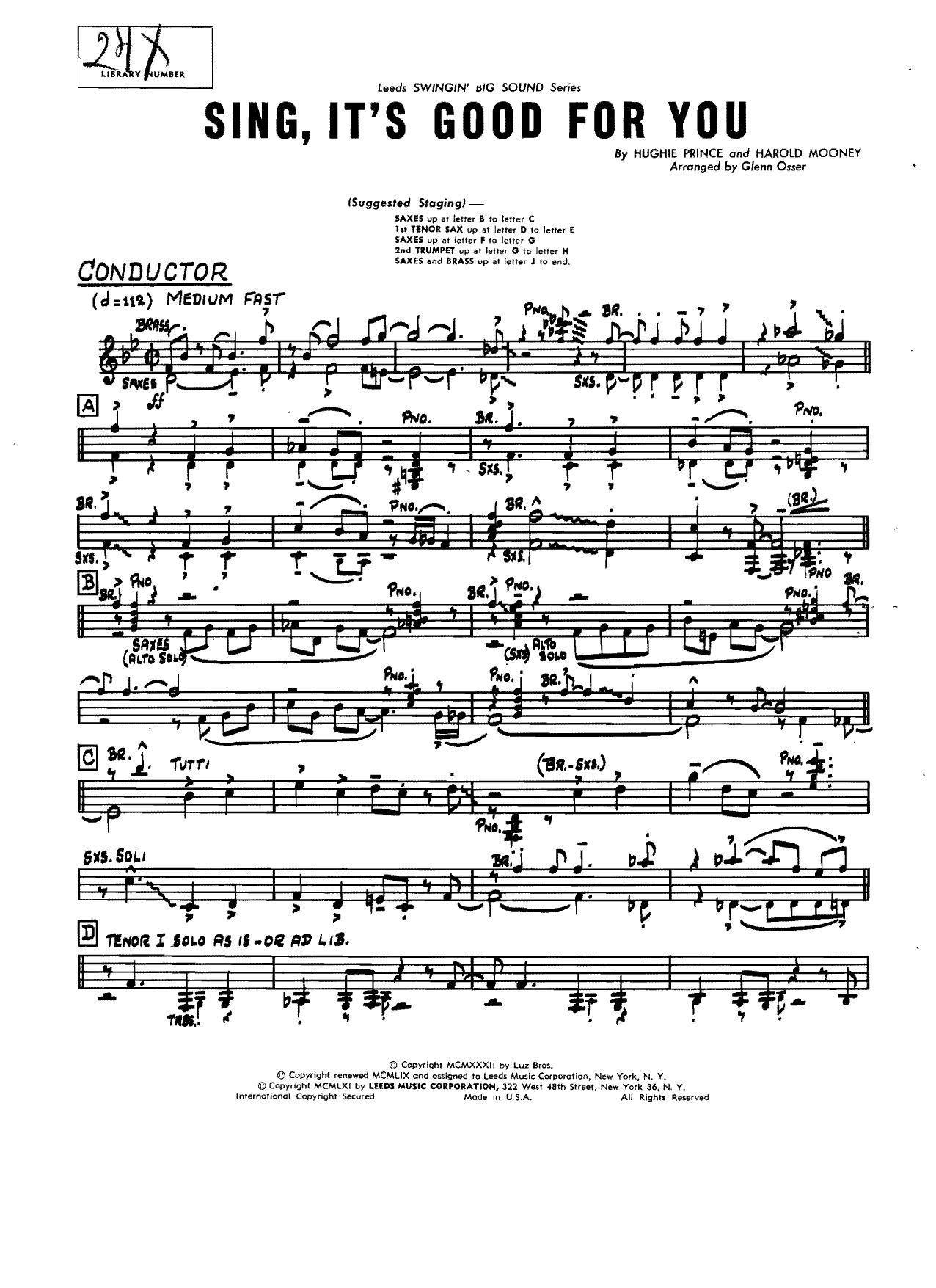
Sing, It's Good For You (G.Osser)
Composed by Glenn Osser
Arranged by Glenn Osser
- Ensemble: Big Band
- Pages: 38
- Instruments (18): Conductor, 1st Eb Alto Sax, 2nd Eb Alto Sax, 1st Bb Tenor Sax, 2nd Bb Tenor Sax, Eb Baritone Sax, 1st Bb Trumpet, 2nd Bb Trumpet, 3rd Bb Trumpet, 4th Bb Trumpet, 1st Trombone, 2nd Trombone, 3rd Trombone, 4th Trombone, Piano, Guitar, String Bass, Drums
- Difficulty: medium
- Content: Individual Parts
- Format: PDF Download (Instant)
- Price: $24.99
Mid-century American jazz and radio orchestration occupies a golden space in the continuum of big band literature, brilliantly represented by the master craftsmanship of Glenn Osser. Written during an era when studio arrangers defined the lush, sophisticated soundscape of commercial broadcasting and high-end supper clubs, "Sing, It's Good For You" captures the effervescent optimism and swinging vitality of the 1950s light-jazz idiom. While Osser achieved legendary status writing under his own name and his pseudonym Anatole Lorraine for the glowing radio and television orchestras of New York, his charts possess an intrinsic timelessness, bridging the gap between classic swing-era dance bands and the more harmonically colorful arrangements of the lounge and television era. Brimming with an infectious, upbeat medium-swing groove in 4/4 time, the work radiates an irrepressible sense of joy and forward momentum. The harmonic language is anchored in bright, accessible major-mode tonalities enriched by classic major-seventh and ninth extensions, giving the chart a sophisticated yet instantly engaging texture. The mood is celebratory and uplifting, evoking the polished, high-energy atmosphere of a prime-time television studio orchestra or a sophisticated Manhattan supper club floor. The dynamic arc moves effortlessly from crisp, rhythmic background figures to a sparkling, full-ensemble release of tension that guarantees an enthusiastic audience response. Osser’s signature arranging methodology relies heavily on transparent, impeccably balanced voicings that make smaller or non-standard ensembles sound remarkably full. Rather than relying on massive wall-of-sound orchestration, this 8-instrument configuration utilizes clever counterpoint and tight, harmonized horn blocks—featuring an agile reed section of Alto, Tenor, and Baritone Saxophones complemented by Trumpet and Trombone—to create maximum acoustic footprint. The melody is shared democratically across the ensemble, often introduced by the saxophones in a tightly knit soli before the brass enter with punchy, syncopated interjections. Rhythmic drive is paramount, requiring the rhythm section to lock into a clean, driving medium-swing pocket that leaves plenty of room for the horns to articulate their crisp phrasing and stylistic accents. Performers will find the chart deeply rewarding due to its intelligent pacing and idiomatic writing for each of the eight designated parts. While the technical demands do not require virtuosic upper-register heroics from the brass, success hinges entirely on immaculate ensemble articulation, unified phrasing, and stylistic cohesion. Swing eighth notes must be cleanly interpreted with appropriate articulation on offbeats, and the dynamic contrasts between muted background textures and open-bell shout moments must be meticulously observed. The arrangement features smart sectional interplay, where the transition of melodic material from reeds to brass demands careful listening and balance across the bandstand. Advanced high school ensembles, collegiate jazz labs, and professional community big bands will find this arrangement to be an ideal programming choice. It provides an exceptional vehicle for teaching foundational medium-swing phrasing without overwhelming players with extreme technical hurdles, making it equally effective as a buoyant concert opener or a sophisticated mid-set highlight. Success with "Sing, It's Good For You" depends on establishing a rock-solid, relaxed medium-swing tempo right from the downbeat. The conductor should rehearse the rhythm section first to ensure the hi-hat on beats two and four is crisp and unhurried, driving the 8-instrument texture naturally. Technically, the primary challenge lies in the uniformity of articulation across the saxophone and brass sections. Short notes must be clipped without being clipped aggressively, and long notes should carry a gentle, vocal-like warmth true to Osser's radio-era aesthetic. Pay close attention to dynamic markings: when the horns play background figures behind a soloist or lead section, they must drop to a whispering piano to allow the primary voice to soar effortlessly over the arrangement. No specialized extreme mute effects are required, allowing the ensemble to focus entirely on pure, blended tone quality and precise rhythmic placement. Q: What instruments and parts are included in this arrangement? A: This chart is scored for an 8-instrument ensemble comprising Alto Saxophone, Tenor Saxophone, Baritone Saxophone, Trumpet, Trombone, and a complete rhythm section supporting the core horn voices across 38 detailed pages of music. Q: What is the difficulty level of this piece? A: It is moderately graded, making it highly accessible for advanced high school bands and college jazz ensembles while still offering plenty of sophisticated stylistic nuance for professional players. Q: What is the musical style and historical context of the piece? A: Written by master radio and studio arranger Glenn Osser, the piece embodies the polished, optimistic mid-century light-jazz and swing style popularized during the golden age of television and broadcast orchestras. Q: What makes this specific arrangement unique? A: It features Osser's signature transparent, highly efficient voicing technique for an 8-instrument lineup, allowing a smaller horn section to achieve the rich, balanced sound of a much larger big band. Q: What is the recommended tempo and performance duration? A: The arrangement is set to a buoyant, medium-swing tempo in 4/4 time, typically resulting in a performance duration of approximately 3 to 4 minutes depending on the chosen groove and sectional pacing.
Questions and answers
- What is included in the Sing, It's Good For You (G.Osser) PDF?
- The verified current file contains a conductor score and individual parts across 38 pages.
- How many instruments or parts are listed for Sing, It's Good For You (G.Osser)?
- The verified instrumentation list contains 18 entries for this Big Band arrangement.
- Who is credited for Sing, It's Good For You (G.Osser)?
- Composer: Glenn Osser. Arranger: Glenn Osser.
- What difficulty is listed for Sing, It's Good For You (G.Osser)?
- The verified difficulty level is medium.
- Can I preview Sing, It's Good For You (G.Osser) before buying?
- Yes. The product page provides a preview generated from the current PDF file.
- How is Sing, It's Good For You (G.Osser) delivered?
- After successful payment, the digital PDF is made available for download. The displayed price is $24.99.
Musicians Also Search For
Sing, It's Good For You Glenn Osser PDF • Sing, It's Good For You Glenn Osser sheet music • Sing, It's Good For You arranged by Glenn Osser • Glenn Osser big band charts • Glenn Osser jazz arrangements PDF • Sing, It's Good For You Glenn Osser big band arrangements • Sing, It's Good For You big band arrangements • Sing, It's Good For You big band PDF download • Sing, It's Good For You jazz sheet music • big band sheet music download • Sing, It's Good For You conductor score PDF • Sing, It's Good For You individual parts download • Sing, It's Good For You sheet music PDF • buy Sing, It's Good For You sheet music • download Sing, It's Good For You PDF • Sing, It's Good For You jazz charts • best Glenn Osser big band arrangements • Sing, It's Good For You printable sheet music • big band repertoire PDF