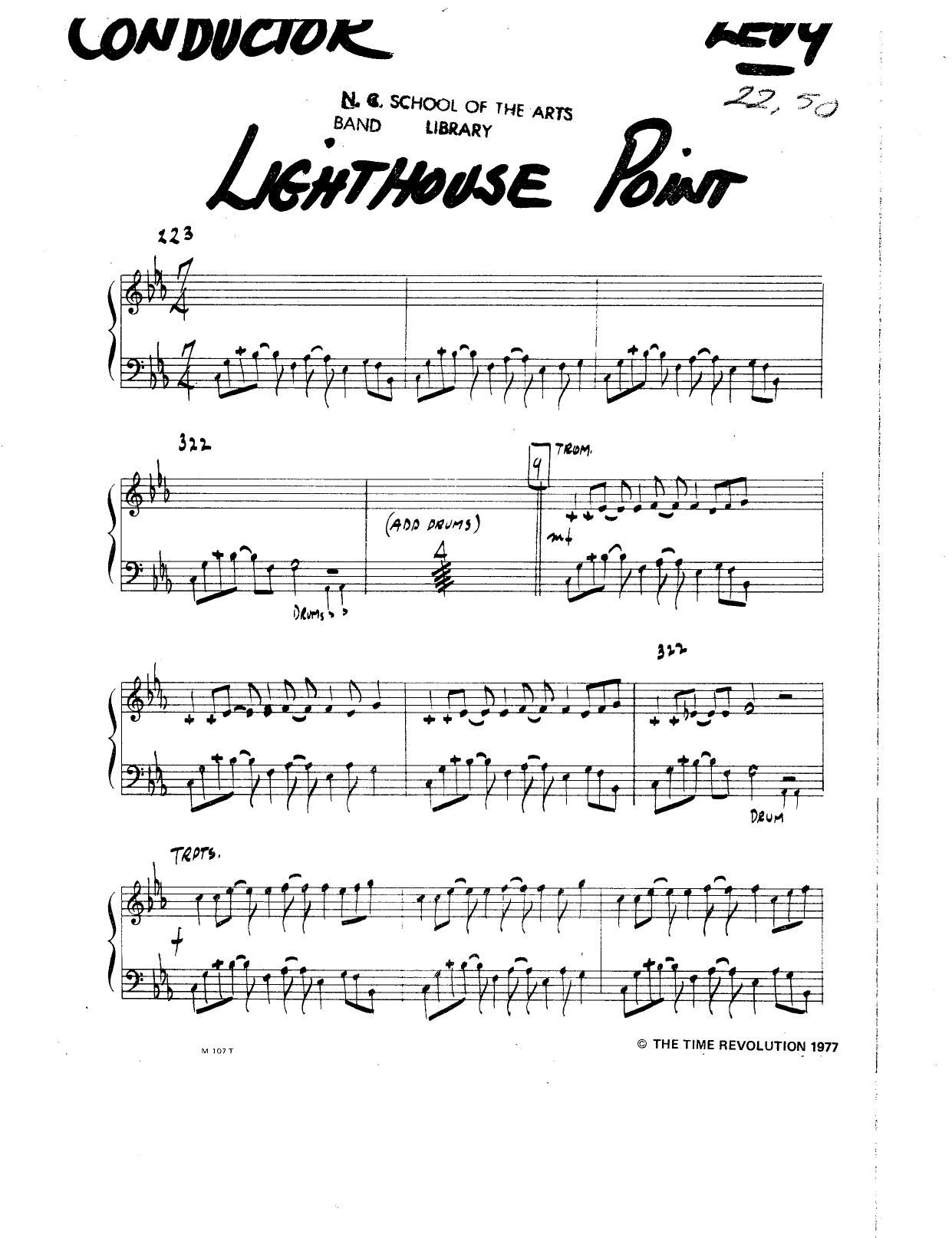
Lighthouse Point (H.Levy)
Composed by Hank Levy
Arranged by Hank Levy
- Ensemble: Big Band
- Pages: 90
- Instruments (24): Conductor, Alto Saxophone, Tenor Saxophone I, Tenor Saxophone II, Baritone Saxophone I, Baritone Saxophone II, Trumpet I, Trumpet II, Trumpet III, Trumpet IV, Trumpet V, Trombone I, Trombone II, Trombone III, Trombone IV, Trombone V, Horn I, Horn II, Horn III, Horn IV, Guitar, Piano, Bass, Drums
- Difficulty: advanced
- Content: Individual Parts
- Format: PDF Download (Instant)
- Price: $24.99
Hank Levy’s “Lighthouse Point” stands as a brilliant testament to the innovative compositional voice of a master who forever changed the rhythmic landscape of modern big band jazz. Emerging from the progressive big band movement of the mid-20th century—an era famously championed by innovators like Don Ellis and Stan Kenton—Levy’s work carved out a distinct niche by applying complex, asymmetrical meters to standard jazz ensemble instrumentation. Written during a period when composers eagerly pushed the boundaries of modal harmony and global time signatures, “Lighthouse Point” captures the restless, avant-garde spirit of contemporary jazz exploration, moving far beyond standard swing-era conventions into a realm of sophisticated rhythmic architecture. Driving forward with an intense, pulsing momentum, “Lighthouse Point” is anchored by an unusual meter that creates a perpetual state of forward propulsion and hypnotic tension. Rather than settling into a comfortable 4/4 groove, the arrangement relies on additive rhythms that give the underlying vamp and primary themes a shifting, wave-like cadence evocative of its coastal title. The mood shifts dynamically from brooding, atmospheric tension to explosive, brass-heavy climaxes, evoking the unpredictable power of the sea meeting a rugged shoreline. The harmonic language is rich with extended and altered chords, utilizing sharp dissonance and open fourths and fifths to paint a striking, modernistic sonic picture. As both composer and arranger, Levy brings his signature mathematical precision and structural genius to the score, ensuring that every section of the big band engages in an intricate dialogue. Rather than utilizing traditional block-chord voicings, Levy constructs counterpoint where lines weave independently across the saxophones, trumpets, and trombones, demanding absolute independence of parts. The arrangement features sweeping saxophone solis that ripple through odd-meter subdivisions, alongside aggressive brass shout choruses that exploit the full dynamic range of the ensemble. Levy’s treatment avoids predictable resolutions, instead building structural tension through cyclical harmonic loops and sudden metric modulations that keep both performers and listeners on edge. Mastering this 90-page, 8-instrument chart requires an ensemble with exceptional rhythmic literacy, precise articulation, and deep familiarity with odd-meter execution. The woodwind section—featuring alto, tenor, and baritone saxophones—carries intricate, linear melodies that often cross bar lines in unexpected ways, while the brass section must execute razor-sharp punches that define the underlying groove. Extended solo opportunities allow featured improvisers to stretch out over modal vamps, testing their ability to phrase fluently outside of standard time feels. Advanced collegiate, top-tier high school, and professional cutting-edge jazz orchestras will find this chart an exhilarating challenge and a deeply rewarding centerpiece for contemporary concert programs. Conductors approaching “Lighthouse Point” must first guide the ensemble through a rigorous study of the odd-meter subdivisions before attempting any stylistic interpretation. The primary challenge lies in internalizing the additive pulse so that the rhythmic groupings feel completely natural rather than counted mathematically. Rehearsals should begin slowly, utilizing a metronome that subdivides the pulse rather than clicking the macro-beat, ensuring that the entire rhythm section—particularly the drummer and bassist—maintains a rock-solid foundation. Special attention must be paid to articulation markings; short, staccato punches must be executed with extreme crispness to highlight the angular nature of Levy’s lines, while legato phrases require seamless air support to maintain momentum across shifting bar lines. Trumpets and trombones should be mindful of balance during dense contrapuntal sections, ensuring that inner voices project without masking the primary melodic statements in the reeds. When rehearsing, isolate the complex transitional interludes, having the horns practice their interlocking figures slowly at half-tempo before layering in the rhythm section's persistent vamp. Q: What specific instruments and parts are included in this arrangement? A: This arrangement is scored for an 8-instrument ensemble featuring Alto Saxophone, Tenor Saxophone, Baritone Saxophone, Trumpet, and Trombone parts, alongside a comprehensive rhythm section framework. Q: What is the difficulty level of this arrangement? A: This chart is designed for advanced college, professional, or elite high school jazz orchestras due to its complex odd-meter subdivisions, extended harmonies, and advanced technical demands. Q: What is the historical style and musical context of "Lighthouse Point"? A: Composed by Hank Levy, this piece represents the progressive, avant-garde big band movement of the mid-20th century, famous for pioneering non-traditional time signatures and modal jazz composition. Q: What makes this specific arrangement unique? A: The arrangement is distinct for its complex additive time signatures, intricate contrapuntal horn writing, and atmospheric tension that avoids standard swing conventions in favor of modern modal exploration. Q: What is the performance duration and tempo character of the piece? A: While performance duration varies based on the length of improvised solos, the piece is driven by a fast, pulsing, and shifting tempo feel designed to maintain high energetic momentum throughout.
Questions and answers
- What is included in the Lighthouse Point (H.Levy) PDF?
- The verified current file contains a conductor score and individual parts across 90 pages.
- How many instruments or parts are listed for Lighthouse Point (H.Levy)?
- The verified instrumentation list contains 24 entries for this Big Band arrangement.
- Who is credited for Lighthouse Point (H.Levy)?
- Composer: Hank Levy. Arranger: Hank Levy.
- What difficulty is listed for Lighthouse Point (H.Levy)?
- The verified difficulty level is advanced.
- Can I preview Lighthouse Point (H.Levy) before buying?
- Yes. The product page provides a preview generated from the current PDF file.
- How is Lighthouse Point (H.Levy) delivered?
- After successful payment, the digital PDF is made available for download. The displayed price is $24.99.
Musicians Also Search For
Lighthouse Point Hank Levy PDF • Lighthouse Point Hank Levy sheet music • Lighthouse Point arranged by Hank Levy • Hank Levy big band charts • Hank Levy jazz arrangements PDF • Lighthouse Point Hank Levy big band arrangements • Lighthouse Point big band arrangements • Lighthouse Point big band PDF download • Lighthouse Point jazz sheet music • big band sheet music download • Lighthouse Point conductor score PDF • Lighthouse Point individual parts download • Lighthouse Point sheet music PDF • buy Lighthouse Point sheet music • download Lighthouse Point PDF • Lighthouse Point jazz charts • best Hank Levy big band arrangements • Lighthouse Point printable sheet music • big band repertoire PDF