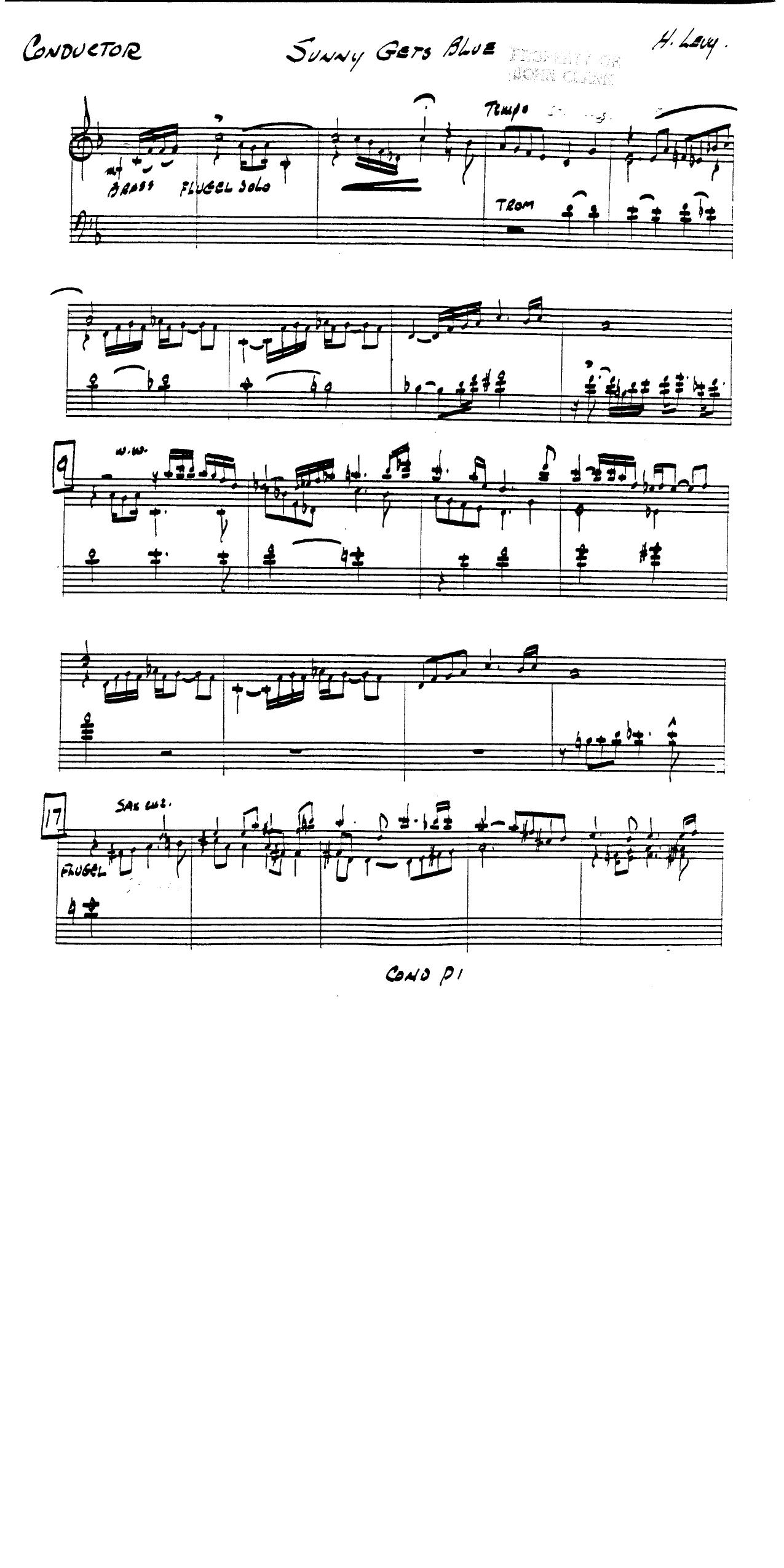
When Sunny Gets Blue (H.Levy) sheet music preview

When Sunny Gets Blue (H.Levy)

Composed by Hank Levy

Arranged by Hank Levy

  • Ensemble: Big Band
  • Pages: 37
  • Instruments (21): Conductor (Condensed Score), Alto Saxophone I (doubling Flute), Alto Saxophone II (doubling Flute), Tenor Saxophone I (doubling Flute), Tenor Saxophone II (doubling Flute), Baritone Saxophone (doubling Bassoon), Trumpet I (doubling Flugelhorn), Trumpet II (doubling Flugelhorn), Trumpet III (doubling Flugelhorn), Trumpet IV (doubling Flugelhorn), Solo Trumpet (doubling Flugelhorn), Trombone I, Trombone II, Trombone III, Trombone IV, Trombone V, Piano, Vibraphone, Guitar, Bass, Drums
  • Difficulty: medium
  • Content: Individual Parts
  • Format: PDF Download (Instant)
  • Price: $24.99

"When Sunny Gets Blue," originally penned by Marvin Fisher and Jack Segal, attained legendary status through vocal interpretations by icons like Johnny Mathis and instrumental treatments in modern jazz. However, filtering this melancholy standard through the singular compositional and arranging lens of Hank Levy transforms a familiar vocal lament into a masterclass of rhythmic displacement and advanced harmonic architecture. Known globally for his pioneering work with the Towson State College Big Band and his contributions to the Stan Kenton Orchestra, Levy approaches the standard repertoire not with conventional swing or ballad formulas, but by dismantling and rebuilding standard meters into complex, shifting metric frameworks. Levy’s adaptation maintains the underlying emotional vulnerability of the original melody while recasting it in an unconventional time signature environment that demands absolute precision and rhythmic agility from the ensemble. The mood shifts seamlessly from introspective, smoky stillness to sweeping, tension-laden climaxes that evoke a profound sense of yearning. Rather than relying on standard 4/4 or 3/4 time, Levy utilizes irregular meters to reshape the phrasing of the tune, creating an undulating, hypnotic groove that keeps both performers and listeners on the edge of their seats. The harmonies are rich, featuring extended and altered dominant voicings that expand far beyond traditional chord-melody structures, giving the brass and saxophones a dense, contemporary European classical flavor fused with post-bop modal tension. The woodwind section serves as the primary vehicle for the thematic material, navigating intricate, overlapping lines where Alto Saxophones 1 and 2 often weave tight, contrapuntal counter-melodies against the broader brass backdrop. Featured solo space allows an expressive soloist—ideally on tenor saxophone or trumpet—to stretch out over sophisticated modal changes, requiring a player comfortable with navigating non-traditional harmonic terrain. Technical challenges abound primarily in the rhythm section and lower brass, who must anchor the shifting metric pulses without sounding rigid or hesitant. The reward for mastering the chart lies in the sheer organic fluidity the ensemble achieves once the unusual meters begin to feel entirely natural, culminating in a lush, harmonically suspended climax that leaves a lingering emotional impact. Advanced collegiate ensembles, elite high school jazz orchestras, and professional big bands will find this chart an exceptional vehicle for stretching their technical and stylistic boundaries. Because Levy's writing relies heavily on internal subdivision and collective rhythmic security, it serves as an extraordinary pedagogical tool for developing advanced rhythmic literacy. Any ambitious jazz ensemble seeking to program repertoire that deviates from the standard swing-era or contemporary funk mold will discover that this arrangement offers a gripping, intellectually stimulating concert centerpiece. Unlocking the emotional depth of this Hank Levy arrangement requires strict adherence to internal subdivision, particularly when navigating the shifting meters. Conductors should spend initial rehearsals isolating the rhythm section—especially the drummer and bassist—to ensure the irregular groove feels weightless rather than forced. Avoid hammering down beats; instead, focus on the flowing horizontal movement of the phrase. The brass section must exercise extreme dynamic control, ensuring that background figures remain lush and transparent without masking the lead alto saxophone or the featured soloist. Mutes, where indicated, should be carefully matched in timbre across the section to maintain a unified, dark acoustic palette. Pay close attention to the exposed rubato sections, allowing the soloist rhythmic freedom while keeping the ensemble cues sharp and unified. Rehearsal time is best optimized by practicing passages slowly with a metronome clicking on eighth-note subdivisions to internalize the metric modulation points cleanly. Q: What instruments and parts are included in this publication? A: The arrangement is scored for a 19-instrument standard big band instrumentation, featuring Alto Saxophone 1, Alto Saxophone 2, Tenor Saxophone 1, Tenor Saxophone 2, Baritone Saxophone, standard brass and rhythm sections, and a comprehensive conductor score spanning 37 pages. Q: What is the difficulty level of this arrangement? A: This piece is graded as advanced, making it best suited for collegiate, professional, and top-tier high school jazz orchestras with strong sight-reading capabilities and advanced rhythmic fluency. Q: What style and historical context define this chart? A: It is a modern jazz arrangement by avant-garde innovator Hank Fisher Levy, combining the emotional resonance of a classic torch song standard with his signature irregular time signatures and complex modal harmonies. Q: What makes this Hank Levy arrangement unique compared to standard big band charts? A: Unlike conventional swing or ballad arrangements of this standard, Levy recontextualizes the melody within sophisticated, shifting meters and dense, contemporary extended voicings that draw heavily on modern classical influences. Q: What is the general tempo and performance duration of the piece? A: While tempo markings feature expressive rubato passages and a fluid underlying pulse rather than a rigid dance groove, a typical performance runs approximately 5 to 6 minutes depending on the length of the improvised solos.

Questions and answers

What is included in the When Sunny Gets Blue (H.Levy) PDF?
The verified current file contains a conductor score and individual parts across 37 pages.
How many instruments or parts are listed for When Sunny Gets Blue (H.Levy)?
The verified instrumentation list contains 21 entries for this Big Band arrangement.
Who is credited for When Sunny Gets Blue (H.Levy)?
Composer: Hank Levy. Arranger: Hank Levy.
What difficulty is listed for When Sunny Gets Blue (H.Levy)?
The verified difficulty level is medium.
Can I preview When Sunny Gets Blue (H.Levy) before buying?
Yes. The product page provides a preview generated from the current PDF file.
How is When Sunny Gets Blue (H.Levy) delivered?
After successful payment, the digital PDF is made available for download. The displayed price is $24.99.

Musicians Also Search For

When Sunny Gets Blue Hank Levy PDFWhen Sunny Gets Blue Hank Levy sheet musicWhen Sunny Gets Blue arranged by Hank LevyHank Levy big band chartsHank Levy jazz arrangements PDFWhen Sunny Gets Blue Hank Levy big band arrangementsWhen Sunny Gets Blue big band arrangementsWhen Sunny Gets Blue big band PDF downloadWhen Sunny Gets Blue jazz sheet musicbig band sheet music downloadWhen Sunny Gets Blue conductor score PDFWhen Sunny Gets Blue individual parts downloadWhen Sunny Gets Blue sheet music PDFbuy When Sunny Gets Blue sheet musicdownload When Sunny Gets Blue PDFWhen Sunny Gets Blue jazz chartsbest Hank Levy big band arrangementsWhen Sunny Gets Blue printable sheet musicbig band repertoire PDF

All arrangements by Hank Levy All Hank Levy sheet music