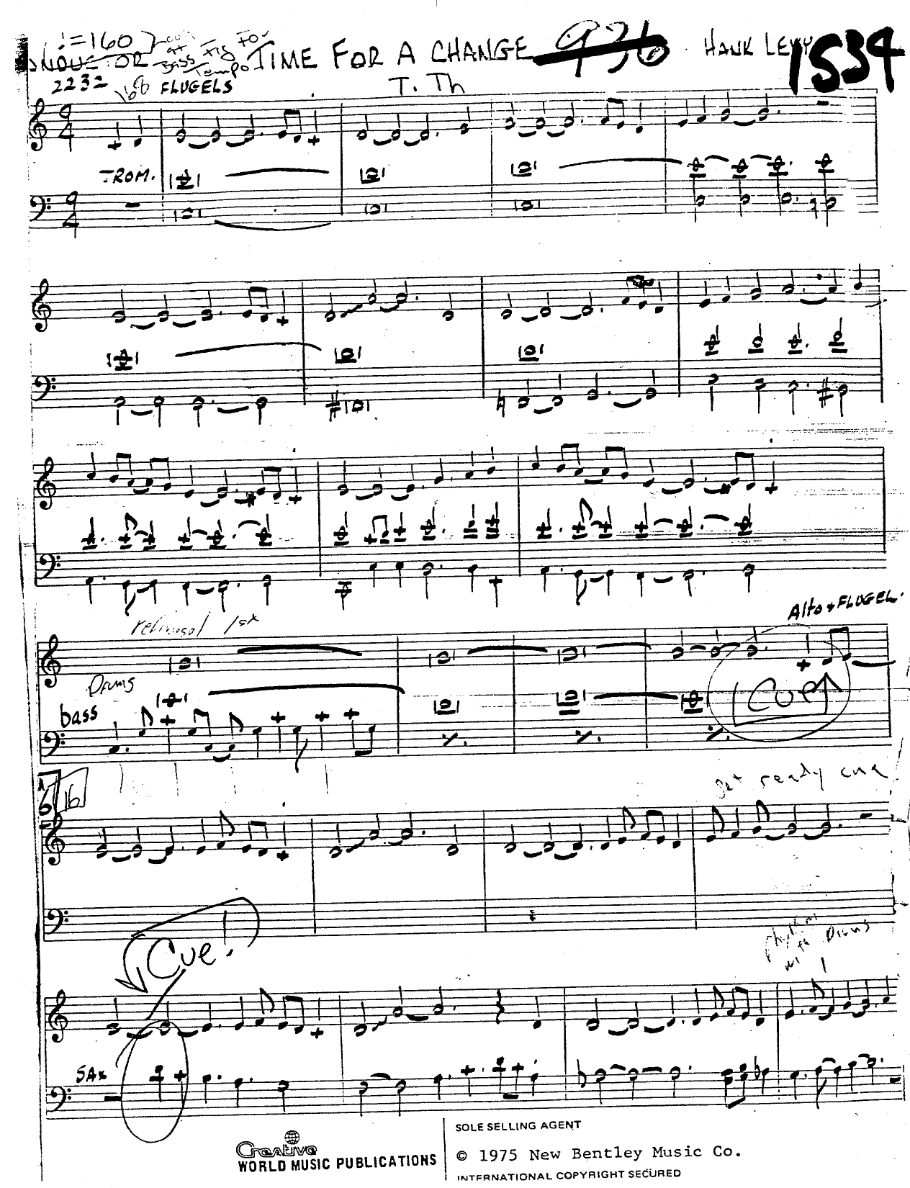
Time For A Change (H.Levy)
Composed by Hank Levy
Arranged by Hank Levy
- Ensemble: Big Band
- Pages: 74
- Instruments (18): Alto Saxophone I, Alto Saxophone II, Tenor Saxophone I, Tenor Saxophone II, Baritone Saxophone I, Baritone Saxophone II, Trumpet I, Trumpet II, Trumpet III, Trumpet IV, Trumpet V, Trombone I, Trombone II, Trombone III, Trombone IV, Piano, Bass, Drums
- Difficulty: advanced
- Content: Individual Parts
- Format: PDF Download (Instant)
- Price: $24.99
Hank Levy’s groundbreaking compositional style occupies a legendary, singular niche in modern big band history, bridging the gap between intricate contemporary classical structures and high-octane modern jazz. Coming to prominence through his landmark work with the Stan Kenton Orchestra in the late 1960s and 1970s, Levy pioneered the exploration of unusual and asymmetric time signatures—such as 5/4, 7/4, 9/4, and 12/8—long before odd meters became common currency in progressive instrumental music. "Time For A Change" stands as a quintessential representation of this exploratory ethos, capturing the electric, forward-thinking energy of the progressive big band movement. Rather than treating odd meters as dry intellectual exercises, Levy infuses them with an undeniable, driving momentum that forces both player and listener to feel the pulse in entirely new subdivisions. Propelled by an insistent, high-energy groove, "Time For A Change" plays with listener expectations through shifting rhythmic hierarchies and razor-sharp syncopation. The emotional landscape is urgent, intellectual, and exhilarating, shifting seamlessly from tense, angular harmonic plateaus to wide-open, cinematic brass declarations. The harmonic language relies heavily on modal expansions, upper-structure triads, and sharp dissonance that resolves into lush, unexpected chordal colors. The mood is persistently driving and sophisticated, evoking the intellectual rigor of West Coast progressive jazz fused with the sheer visceral power of a full powerhouse brass section. True to Levy’s signature methodology, the arrangement treats the rhythm section as the primary engine for navigating complex metric modulations, laying down a resilient foundation over which the horns weave intricate, interlocking counterlines. The woodwind section—featuring parts for Alto, Tenor, and Baritone Saxophones—frequently operates as a unified harmonic block, executing rapid, linear scalar passages that demand absolute technical clarity. Brass scoring is dense and demanding, utilizing extended ranges and tight voicings in the trumpets and trombones to create a wall of sound that feels both modern and deeply rooted in the big band tradition. Solos are strategically integrated to emerge organically from the shifting textures, giving featured improvisers a challenging harmonic framework built on non-traditional metric pulses. Reaching a total length across its 74 comprehensive pages of score and parts, this chart is engineered specifically for advanced collegiate ensembles, top-tier high school jazz orchestras with strong rhythm sections, and professional big bands looking to push their technical boundaries. The primary performance hurdle lies in internalizing the odd meter so that it swings or drives with the fluidity of standard 4/4 time. Ensembles that master this metric fluency will find "Time For A Change" to be an electrifying, deeply rewarding centerpiece for concerts and festivals, leaving audiences captivated by its rhythmic ingenuity and breathtaking dynamic peaks. Conductors approaching "Time For A Change" must first ensure the ensemble internalizes the underlying subdivision before attempting to layer dynamics or articulation. The rhythm section—particularly the drummer and bassist—acts as the primary anchor; they must lock in a steady, hypnotic ostinato that frees the horns to phrase across the bar lines without rushing or dragging. Technically, the chart demands exceptional finger dexterity from the saxophones and clear articulation from the brass. Trumpets should approach upper-register passages with controlled brilliance rather than brute force, ensuring intonation remains locked within the dense, altered chords. Rehearsal should begin away from full tempo. Isolate the metric shifts and have the ensemble clap or voice the subdivisions before picking up their instruments. Pay close attention to dynamic contrast; the abrupt shifts from aggressive, biting ensemble punches to sparse, atmospheric textures are critical to capturing the dramatic arc of Levy’s writing. Ensure that short notes are crisp and clipped, while linear bebop-inspired lines maintain a smooth, connected airflow. Q: What instruments and parts are included in this 74-page arrangement? A: This arrangement is scored for an 8-instrument core plus standard big band instrumentation, featuring specific parts for Alto Saxophone, Tenor Saxophone, Baritone Saxophone, Trumpet, and Trombone sections, backed by a comprehensive rhythm section score. Q: What is the difficulty level of "Time For A Change"? A: This piece is graded as advanced, making it best suited for collegiate jazz ensembles, professional big bands, and highly accomplished high school groups with exceptional rhythm section stability and sight-reading capabilities. Q: What style and historical period does this composition represent? A: Composed by Hank Levy, this piece represents the progressive jazz era of the late 1960s and 1970s, famously associated with the Stan Kenton style of adventurous, modern big band arranging. Q: What makes this specific Hank Levy arrangement unique? A: It is defined by Levy’s masterclass use of asymmetric time signatures and complex metric modulations, which challenge conventional big band phrasing while maintaining an infectious, high-energy jazz groove. Q: What is the performance duration and tempo approach for this chart? A: While performance duration varies slightly based on the chosen tempo and the inclusion of open solo sections, the chart is driven by a brisk, demanding tempo that requires absolute rhythmic precision from the outset.
Questions and answers
- What is included in the Time For A Change (H.Levy) PDF?
- The verified current file contains a conductor score and individual parts across 74 pages.
- How many instruments or parts are listed for Time For A Change (H.Levy)?
- The verified instrumentation list contains 18 entries for this Big Band arrangement.
- Who is credited for Time For A Change (H.Levy)?
- Composer: Hank Levy. Arranger: Hank Levy.
- What difficulty is listed for Time For A Change (H.Levy)?
- The verified difficulty level is advanced.
- Can I preview Time For A Change (H.Levy) before buying?
- Yes. The product page provides a preview generated from the current PDF file.
- How is Time For A Change (H.Levy) delivered?
- After successful payment, the digital PDF is made available for download. The displayed price is $24.99.
Musicians Also Search For
Time For A Change Hank Levy PDF • Time For A Change Hank Levy sheet music • Time For A Change arranged by Hank Levy • Hank Levy big band charts • Hank Levy jazz arrangements PDF • Time For A Change Hank Levy big band arrangements • Time For A Change big band arrangements • Time For A Change big band PDF download • Time For A Change jazz sheet music • big band sheet music download • Time For A Change conductor score PDF • Time For A Change individual parts download • Time For A Change sheet music PDF • buy Time For A Change sheet music • download Time For A Change PDF • Time For A Change jazz charts • best Hank Levy big band arrangements • Time For A Change printable sheet music • big band repertoire PDF