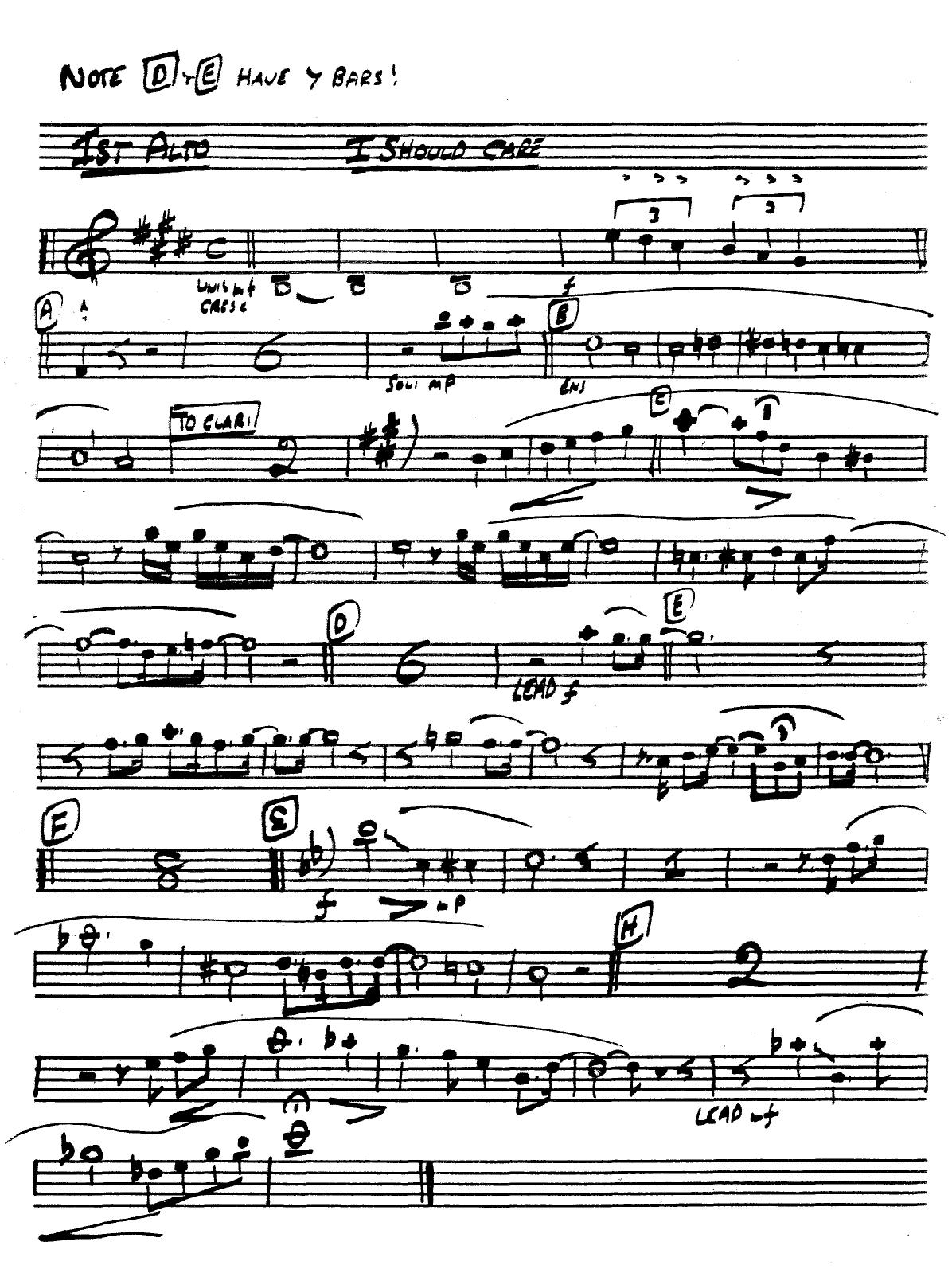
I Should Care (J.Farley) sheet music preview

I Should Care (J.Farley)

Composed by John Farley

Arranged by Glen Miller

  • Ensemble: Big Band
  • Pages: 21
  • Instruments (17): 1st Alto Saxophone, 2nd Alto Saxophone, 1st Tenor Saxophone, 2nd Tenor Saxophone, Baritone Saxophone, 1st Trumpet, 2nd Trumpet, 3rd Trumpet, 4th Trumpet, 1st Trombone, 2nd Trombone, 3rd Trombone, 4th Trombone, Piano, Bass, Drums, Vocal
  • Difficulty: medium
  • Content: Individual Parts
  • Format: PDF Download (Instant)
  • Price: $24.99

The timeless standard "I Should Care," originally composed by Axel Stordahl, Paul Weston, and Sammy Cahn (often associated in jazz lore with writers like John Farley through classic interpretations), represents the pinnacle of the 1940s American popular songbook lyricism transformed into jazz harmony. First published in 1944 and subsequently popularized by legendary vocalists and instrumentalists such as Frank Sinatra, Dexter Gordon, and Thelonious Monk, the composition has endured as a vehicle for profound emotional expression. Its inherent melancholy and sophisticated harmonic progression make it a cornerstone of ballad playing, challenging ensembles to balance structural clarity with deep expressive nuance. In this masterful setting by arranger Glen Miller, the composition is reframed as a lush, introspective ballad with a lingering medium-slow swing feel in 4/4 time. The emotional landscape shifts seamlessly between bittersweet introspection and swelling, cinematic warmth. Miller utilizes a rich, contemporary harmonic palette characterized by extended tertian voicings, subtle chromatic descents, and rich chordal suspensions that evoke a late-night, smoky atmosphere. The mood is deeply reflective, inviting the audience into a narrative of unrequited affection and quiet resilience, driven by a pulsating yet restrained rhythm section foundation. Glen Miller’s distinctive approach to the 7-instrument small big band (or expanded combo) format shines through clever counterpoint and tight, homogenous voicing. Rather than relying on massive wall-of-sound tuttis, Miller distributes the harmonic weight carefully across the frontline—Alto Sax, Tenor Sax, Trumpet, and Trombone—backed by a versatile rhythm section featuring piano. The arrangement opens with a rubato piano introduction that establishes the tender harmonic context before the horns enter with a harmonically rich, interwoven head statement. A standout feature of this arrangement is the expressive saxophone soli that bridges the middle section, showcasing delicate dynamic shading and fluid voice-leading. The climax arrives through a tastefully restrained, soaring shout chorus that builds intensity without ever sacrificing the intimate ballad character of the tune, before dissolving back into a quiet, unresolved final chord. Performing this 21-page arrangement requires a mature command of intonation, blend, and sustained breath support, making it exceptionally rewarding for advanced high school, collegiate, and professional jazz ensembles. The primary technical challenges lie in maintaining consistent time and pristine balance during exposed, slow-tempo passages where every nuance is audible. Horn players must possess strong control over their lower registers and delicate vibrato usage, while the rhythm section must master the art of the "push" beat and supportive, un-intrusive comping. It serves as an ideal centerpiece for a concert program looking to showcase an ensemble's lyrical sensitivity, tonal beauty, and sophisticated phrasing capability. Conductors should approach "I Should Care" with a strict focus on horizontal line-driving and ultra-smooth voice-leading. The tempo should sit comfortably around 72-76 BPM, maintaining a relaxed, pulsing feel rather than a rigid, dragging clock. Intonation is the single greatest hurdle in this arrangement; spend the initial rehearsals isolating the dense chord clusters in the brass and saxophones to lock in the harmonic balance. For the horn players, vibrato should be warm and controlled, avoiding excessive width that could muddy Miller’s delicate voicings. The rhythm section must treat the time flexibly yet securely, utilizing sparse, supportive comping that leaves plenty of room for the frontline melodies to breathe. Ensure that the transitional rubato sections are rehearsed with visual cues from the conductor, allowing the ensemble to stretch and compress time organically without losing their collective ensemble awareness. Q: What specific instrumentation and parts are included in this arrangement? A: This arrangement is scored for a 7-instrument ensemble consisting of Alto Saxophone, Tenor Saxophone, Trumpet, Trombone, Piano, Bass, and Drums, spread across a comprehensive 21-page score and parts set. Q: What is the difficulty level of this Glen Miller arrangement? A: It is designed for advanced high school, collegiate, and professional jazz ensembles due to its demanding intonation requirements, slow-tempo breath control, and sophisticated harmonic reading. Q: What musical style and historical era does this piece represent? A: It embodies the golden era of 1940s jazz ballads and the Great American Songbook, reinterpreted through a sophisticated, modern small-big-band jazz arranging lens. Q: What makes this particular arrangement by Glen Miller unique? A: It uniquely scales down the grand, cinematic voicings of a full big band into a tight 7-instrument texture, featuring an intricate saxophone soli and a restrained, emotionally potent shout chorus. Q: What is the recommended performance tempo and duration for this piece? A: The arrangement is set at a relaxed medium-slow ballad tempo of approximately 72 to 76 BPM, yielding a performance duration of roughly 4 to 5 minutes depending on the chosen rubato stretches and solo spaces.

Questions and answers

What is included in the I Should Care (J.Farley) PDF?
The verified current file contains individual parts across 21 pages.
How many instruments or parts are listed for I Should Care (J.Farley)?
The verified instrumentation list contains 17 entries for this Big Band arrangement.
Who is credited for I Should Care (J.Farley)?
Composer: John Farley. Arranger: Glen Miller.
What difficulty is listed for I Should Care (J.Farley)?
The verified difficulty level is medium.
Can I preview I Should Care (J.Farley) before buying?
Yes. The product page provides a preview generated from the current PDF file.
How is I Should Care (J.Farley) delivered?
After successful payment, the digital PDF is made available for download. The displayed price is $24.99.

Musicians Also Search For

I Should Care Glen Miller PDFI Should Care Glen Miller sheet musicI Should Care arranged by Glen MillerGlen Miller big band chartsGlen Miller jazz arrangements PDFI Should Care John Farley sheet musicI Should Care John Farley big band arrangementsJohn Farley big band chartsI Should Care big band arrangementsI Should Care big band PDF downloadI Should Care jazz sheet musicbig band sheet music downloadI Should Care individual parts downloadI Should Care sheet music PDFbuy I Should Care sheet musicdownload I Should Care PDFI Should Care jazz chartsbest Glen Miller big band arrangementsJohn Farley arranged by Glen MillerI Should Care printable sheet musicbig band repertoire PDF

All arrangements by Glen Miller All John Farley sheet music