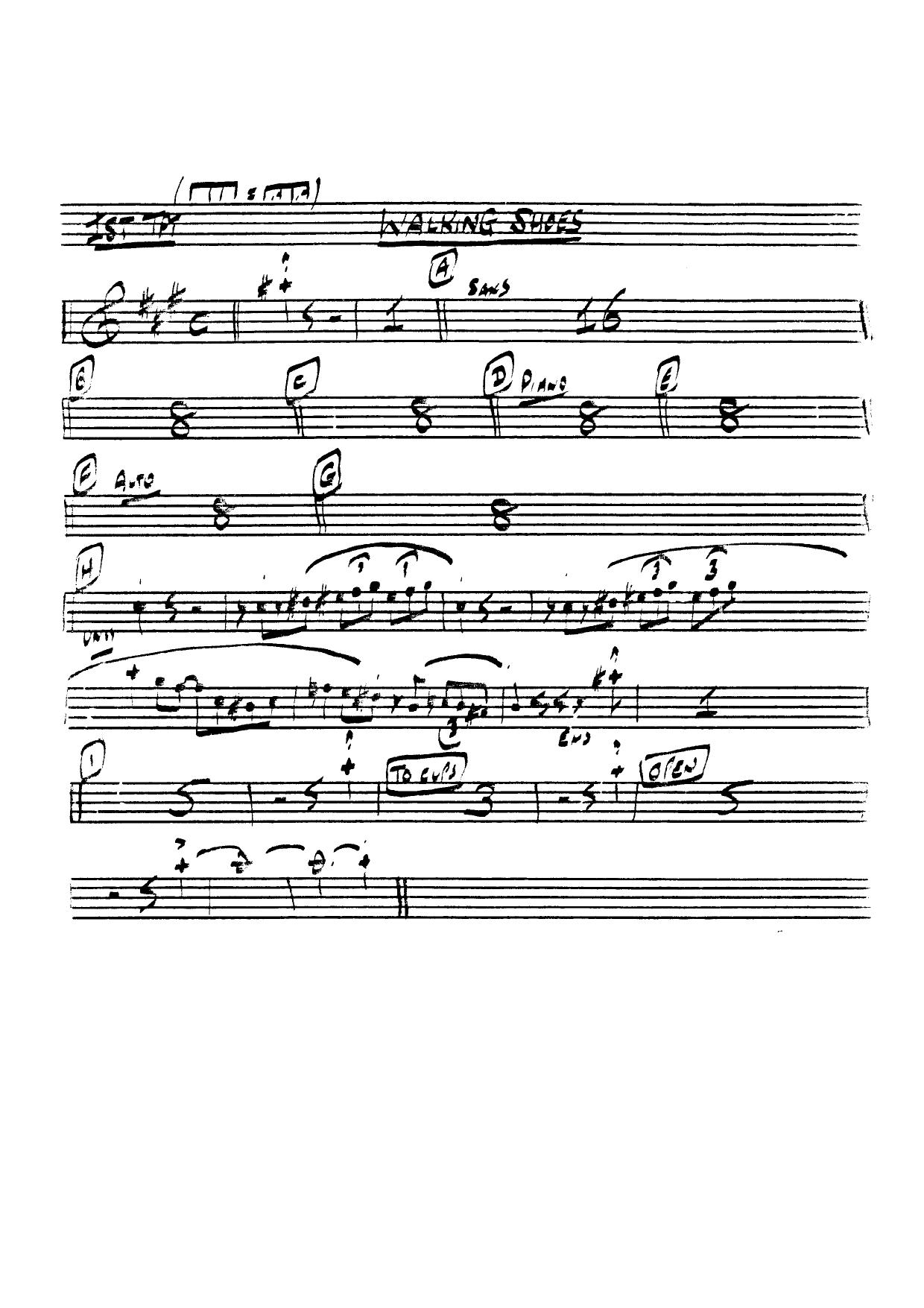
Walking Shoes (J.Farley)
Composed by John Farley
Arranged by John Farley
- Ensemble: Big Band
- Pages: 18
- Instruments (17): 1st Trumpet, 2nd Trumpet, 3rd Trumpet, 4th Trumpet, 1st Trombone, 2nd Trombone, 3rd Trombone, 4th Trombone, 1st Alto Saxophone, 2nd Alto Saxophone, 1st Tenor Saxophone, 2nd Tenor Saxophone, Baritone Saxophone, Bass, Drums, Piano, Concert
- Difficulty: easy
- Content: Individual Parts
- Format: PDF Download (Instant)
- Price: $24.99
"Walking Shoes," originally conceived in the rich tradition of mid-century cool jazz and West Coast counterpoint, captures the effortless stride and sophisticated harmonic movement characteristic of the genre's formative 1950s innovators. Composed and arranged by John Farley, this sophisticated chart reimagines the classic small-group contrapuntal aesthetic for a dynamic 6-instrument chamber jazz ensemble. The composition pays homage to the ground-breaking Gerry Mulligan-style pianoless quartet writing while expanding the textural possibilities through a modern, integrated rhythm section. It evokes an atmosphere of urban sophistication, late-night cruising, and relaxed intellectual intensity, anchoring its momentum in a purposeful, forward-moving bass line that justifies the iconic title. The musical character is defined by an infectious, relaxed medium-swing feel in 4/4 time, anchored around a clever chromatic walking bass foundation. Farley sets a sophisticated mood that balances intricate linear counterpoint with lush, open-voiced harmonies. The melody is initially introduced in an engaging two-part counterpoint split dynamically between the Alto Saxophone and Guitar, creating an airy, linear transparency reminiscent of classic West Coast cool jazz recordings. As the chart unfolds, the arrangement builds in harmonic density, transitioning from breezy, transparent textures into a robust, swinging ensemble chorus that showcases Farley’s knack for economic yet striking voice-leading. Farley’s arranging approach avoids cluttered tutti writing, favoring instead clever interdependent horn lines and nimble chordal accompaniment from the Piano and Guitar that leave plenty of breathing room for the soloists. The arrangement features open solo sections for both Alto Saxophone and Guitar over a harmonically sophisticated yet accessible blues-infused form, allowing performers to stretch out creatively. Technical challenges lie primarily in maintaining crisp articulation, precise rhythmic unison during the contrapuntal head statements, and achieving a unified, laid-back swing eighth-note feel at a moderate tempo. The 18 pages of total score and parts provide meticulous articulations, dynamic markings, and chord voicings that guide the ensemble toward an authentic stylistic interpretation. Advanced high school ensembles, collegiate chamber jazz groups, and professional freelance combos will find this chart an ideal vehicle for developing ensemble interplay, intonation, and stylistic versatility. Because it strips away the sheer volume of a full 18-piece big band in favor of a nimble 6-instrument configuration (Alto Saxophone, Piano, Bass, Drum Set, Guitar, and an additional integrated voice), every player carries significant responsibility. This transparent instrumentation demands exceptional listening skills and individual accountability, making rehearsals deeply rewarding and ensuring that every performance sparkles with chamber-jazz clarity and sophisticated swing energy. Achieving an authentic rendition of "Walking Shoes" requires careful attention to the stylistic nuances of cool jazz and polished medium-swing articulation. Conductor and ensemble focus should center on the rhythm section, where the bass player must lay down a rock-solid, unhurried walking quarter-note line that acts as the anchor for the entire chart. The drummer should keep ride-cymbal definition crisp and dry, using subtle feathering on the bass drum and crisp hi-hat chokes on beats two and four to maintain a relaxed, forward-driving momentum without rushing the tempo, which is suggested at a comfortable medium swing (approx. Quarter Note = 116–124 BPM). Technically, the primary challenge for the Alto Saxophone and Guitar lies in the execution of the intricate contrapuntal head. Practice these interlocking lines slowly at first, ensuring that all written articulations—especially the detached staccato marks and accented syncopations—match precisely between instruments. Avoid heavy vibrato; a cooler, more centered tone quality suits this stylistic framework best. Piano and guitar comping should remain sparse and tasteful, utilizing rootless shell voicings that leave ample sonic space for the melodic lines. Rehearsals should initially isolate the rhythm section to lock in the groove before layering in the horn parts to achieve seamless ensemble balance. Q: What instruments and parts are included in this arrangement? A: This chart is scored for a 6-instrument ensemble consisting of Alto Saxophone, Guitar, Piano, Bass, Drum Set, and an additional instrumental part, spanning 18 total pages of comprehensive score and individual performance materials. Q: What is the difficulty level of this arrangement? A: It is graded as advanced intermediate to advanced, making it ideal for skilled high school players, collegiate jazz combos, and professional musicians who possess strong sight-reading skills and familiarity with swing articulation. Q: What is the stylistic background and historical context of the piece? A: Written by John Farley, the arrangement draws deep inspiration from the 1950s West Coast cool jazz movement, emphasizing linear counterpoint, sophisticated harmonies, and a relaxed, sophisticated aesthetic reminiscent of Gerry Mulligan and Chet Baker collaborations. Q: What makes this specific arrangement by John Farley unique? A: Farley successfully translates dense, multi-horn counterpoint into a flexible 6-instrument format, utilizing transparent voicings, clever conversational interplay between the saxophone and guitar, and an open form that encourages interactive small-group improvisation. Q: What is the recommended performance duration and tempo for this piece? A: The arrangement is designed for a performance duration of approximately 4 to 5 minutes, performed at a comfortable medium-swing tempo of roughly 116 to 124 beats per minute.
Questions and answers
- What is included in the Walking Shoes (J.Farley) PDF?
- The verified current file contains individual parts across 18 pages.
- How many instruments or parts are listed for Walking Shoes (J.Farley)?
- The verified instrumentation list contains 17 entries for this Big Band arrangement.
- Who is credited for Walking Shoes (J.Farley)?
- Composer: John Farley. Arranger: John Farley.
- What difficulty is listed for Walking Shoes (J.Farley)?
- The verified difficulty level is easy.
- Can I preview Walking Shoes (J.Farley) before buying?
- Yes. The product page provides a preview generated from the current PDF file.
- How is Walking Shoes (J.Farley) delivered?
- After successful payment, the digital PDF is made available for download. The displayed price is $24.99.
Musicians Also Search For
Walking Shoes John Farley PDF • Walking Shoes John Farley sheet music • Walking Shoes arranged by John Farley • John Farley big band charts • John Farley jazz arrangements PDF • Walking Shoes John Farley big band arrangements • Walking Shoes big band arrangements • Walking Shoes big band PDF download • Walking Shoes jazz sheet music • big band sheet music download • Walking Shoes individual parts download • Walking Shoes sheet music PDF • buy Walking Shoes sheet music • download Walking Shoes PDF • Walking Shoes jazz charts • best John Farley big band arrangements • Walking Shoes printable sheet music • big band repertoire PDF