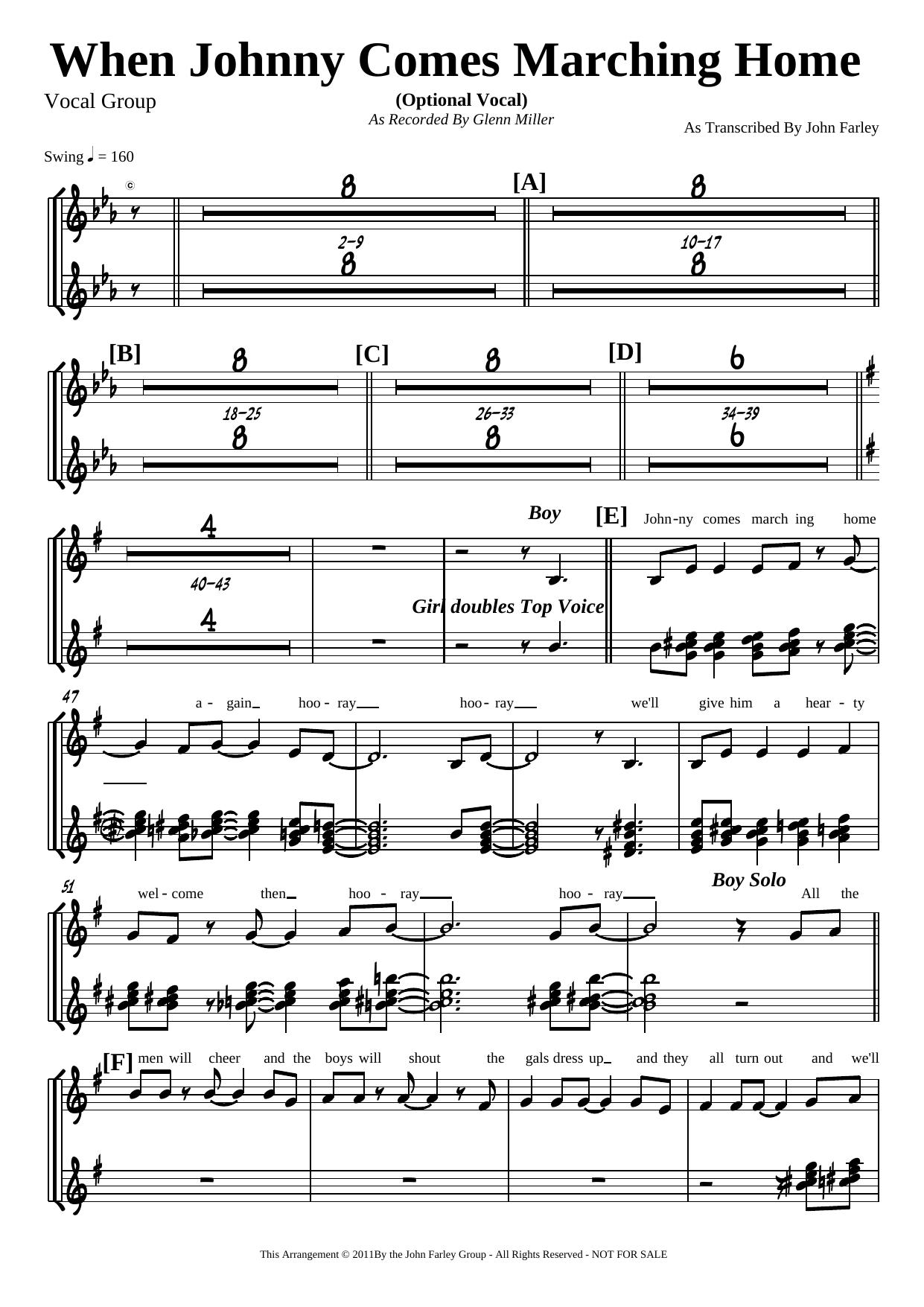
When Johnny Comes Marching Home (J.Farley)
Composed by John Farley
Arranged by John Farley
- Ensemble: Big Band
- Pages: 49
- Instruments (18): Vocal Group, Alto 1, Alto 2, Tenor 1, Tenor 2, Bari, Trumpet 1, Trumpet 2, Trumpet 3, Trumpet 4, Trombone 1, Trombone 2, Trombone 3, Bass Trombone, Jazz Guitar, Piano, Bass, Drums
- Difficulty: medium
- Content: Individual Parts
- Format: PDF Download (Instant)
- Price: $24.99
Rooted in the Civil War-era patriotic anthem popularized by Patrick Gilmore, "When Johnny Comes Marching Home" undergoes a striking metamorphosis in this sophisticated big band setting by John Farley. While the original melody carries a minor-mode haunting gravity that has resonated through American musical consciousness for over a century, Farley recontextualizes the buoyant yet melancholic tune through a modern jazz lens. This arrangement bridges traditional Americana with contemporary harmonic language, transforming a familiar fife-and-drum march into a compelling vehicle for driving swing and modal exploration. Farley constructs the arrangement around a brisk, energetic medium-up swing feel in 4/4 time, anchored by a relentless walking bass line and crisp ride cymbal patterns. The mood shifts masterfully between brooding, secretive unison horn lines and explosive, brass-heavy proclamations. The key centers utilize rich modal interchange, moving fluidly between minor tonalities and unexpected major-mode triumphs that heighten the dramatic tension. The emotional arc takes the listener from a tense, cinematic introduction through swirling counterpoint, ultimately culminating in a triumphant, high-energy shout chorus that demands precision and stamina from the entire ensemble. Distinguished by inventive voice-leading and dense, contemporary extended harmonies, Farley’s scoring avoids predictable block-chord writing in favor of interlocking horn textures and contrapuntal movement. The saxophones are treated as a flexible choir capable of whispering delicate, bebop-inflected lines before pivoting to aggressive, punchy backgrounds. A standout feature of the arrangement is an extended, harmonically rich soli section that spotlights the reed and trombone sections, showcasing intricate rhythmic unisons and altered dominant extensions. The rhythm section acts as an equal partner, with the piano utilizing comping voicings that draw from fourth-chords and cluster-style voicings, giving the chart a distinctly modern edge reminiscent of contemporary ECM or post-bop big band literature. Clocking in as a substantial 49-page score, this chart is meticulously tailored for advanced college ensembles, professional big bands, and elite high school groups with exceptionally strong rhythm sections and lead players. The melody is shared dynamically across the brass and reed sections, while designated solo changes provide ample room for featured improvisers—typically tenor saxophone and trumpet—to stretch out over sophisticated changes. Technical challenges center primarily on tight ensemble phrasing, rapid tempo management during transitional rubato moments, and maintaining a clean, driving articulation throughout dense multi-metric figures. Performers and audiences alike will find the chart immensely rewarding for its clever subversion of a historical warhorse into a visceral, modern jazz masterpiece. Executing John Farley’s arrangement of "When Johnny Comes Marching Home" requires meticulous attention to articulation, dynamic contrast, and time-feel integrity. The primary technical challenge lies in the execution of rapid, syncopated unison figures shared between the saxophones and brass; conductors should isolate these passages during early rehearsals, practicing them slowly with a metronome to lock in the articulation—emphasizing short, accented notes while keeping the swing eighths even and buoyant. The tempo should settle comfortably around quarter note = 192 BPM, ensuring the groove drives forward without rushing the complex background figures. The rhythm section is the engine of this chart: the drummer should maintain a crisp, interactive ride cymbal texture with crisp hi-hat chicks on beats two and four, while avoiding overplaying during the exposed horn solis. The pianist should voice chords sparingly, utilizing rootless shell voicings that leave space for the horns. Brass players should utilize subtle cup mutes or open horns depending on the dynamic marking, reserving open, aggressive tones for the climactic shout chorus where full-bore projection is required. Pay close attention to dynamic shading; the contrast between the hushed, mysterious opening and the roaring tutti sections is what gives this arrangement its dramatic weight. Q: What instruments and parts are included in this arrangement? A: Scored for a flexible 7-instrument big band instrumentation, the package includes dedicated charts for Alto Saxophone, Tenor Saxophone, Trumpet, Trombone, and a fully realized Piano part, along with the complete 49-page conductor's score and rhythm section guides. Q: What is the difficulty level of this chart? A: This arrangement is graded as advanced, making it ideal for collegiate jazz ensembles, professional big bands, and elite high school groups with strong improvisers and mature section players capable of handling complex metric modulations and fast unison lines. Q: What is the stylistic approach and historical context of the piece? A: John Farley takes the classic 19th-century Civil War tune and reharmonizes it through a modern modal jazz and post-bop framework, blending traditional Americana melodies with contemporary extended harmonies and driving medium-up swing feels. Q: What makes this specific arrangement by John Farley unique? A: It stands out due to its inventive counterpoint, rich fourth-chord voicings, a dense harmonized soli section for reeds and trombones, and a thrilling, high-energy shout chorus that completely reinvents the familiar melody. Q: What is the recommended performance duration and tempo for this arrangement? A: The piece runs approximately 4 to 5 minutes in duration and is designed to be performed at a brisk, driving medium-up swing tempo of around 192 BPM.
Questions and answers
- What is included in the When Johnny Comes Marching Home (J.Farley) PDF?
- The verified current file contains a conductor score and individual parts across 49 pages.
- How many instruments or parts are listed for When Johnny Comes Marching Home (J.Farley)?
- The verified instrumentation list contains 18 entries for this Big Band arrangement.
- Who is credited for When Johnny Comes Marching Home (J.Farley)?
- Composer: John Farley. Arranger: John Farley.
- What difficulty is listed for When Johnny Comes Marching Home (J.Farley)?
- The verified difficulty level is medium.
- Can I preview When Johnny Comes Marching Home (J.Farley) before buying?
- Yes. The product page provides a preview generated from the current PDF file.
- How is When Johnny Comes Marching Home (J.Farley) delivered?
- After successful payment, the digital PDF is made available for download. The displayed price is $24.99.
Musicians Also Search For
When Johnny Comes Marching Home John Farley PDF • When Johnny Comes Marching Home John Farley sheet music • When Johnny Comes Marching Home arranged by John Farley • John Farley big band charts • John Farley jazz arrangements PDF • When Johnny Comes Marching Home John Farley big band arrangements • When Johnny Comes Marching Home big band arrangements • When Johnny Comes Marching Home big band PDF download • When Johnny Comes Marching Home jazz sheet music • big band sheet music download • When Johnny Comes Marching Home conductor score PDF • When Johnny Comes Marching Home individual parts download • When Johnny Comes Marching Home sheet music PDF • buy When Johnny Comes Marching Home sheet music • download When Johnny Comes Marching Home PDF • When Johnny Comes Marching Home jazz charts • best John Farley big band arrangements • When Johnny Comes Marching Home printable sheet music • big band repertoire PDF