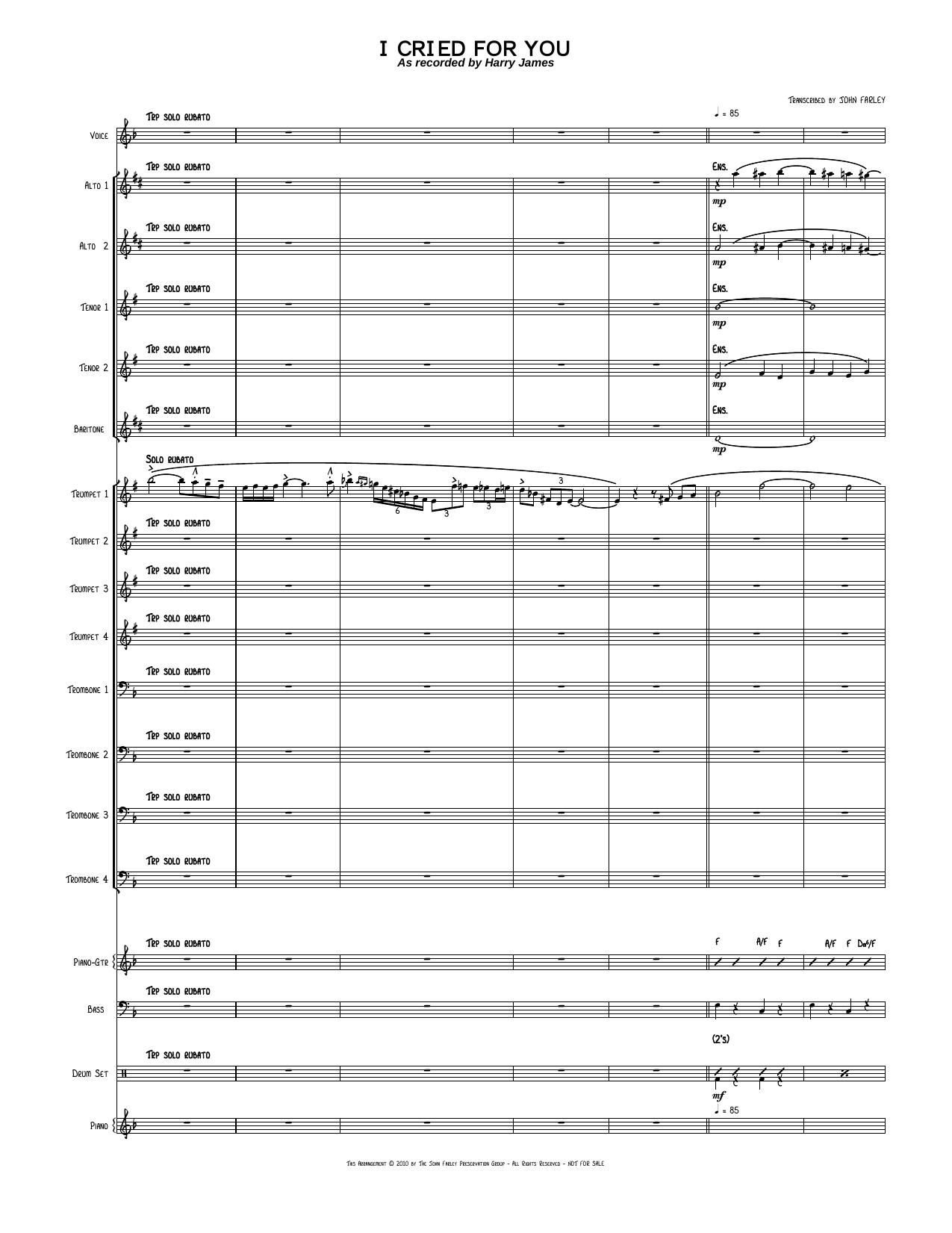
I Cried For You (J. Farley-H. James-H.Forrest) sheet music preview

I Cried For You (J. Farley-H. James-H.Forrest)

Composed by Gus Arnheim, Abe Lyman, Harry James

Arranged by Harry James

  • Ensemble: Big Band
  • Pages: 44
  • Instruments (19): Voice, Alto Sax 1, Alto Sax 2, Tenor Sax 1, Flute, Tenor Sax 2, Baritone Sax, Trumpet 1, Trumpet 2, Trumpet 3, Trumpet 4, Trombone 1, Trombone 2, Trombone 3, Trombone 4, Piano, Guitar, Bass, Drum Set
  • Difficulty: medium
  • Content: Individual Parts
  • Format: PDF Download (Instant)
  • Price: $24.99

Originally popularized during the golden age of the big band era, "I Cried For You"—credited to the collaborative writing efforts of Gus Arnheim, Abe Lyman, and trumpet virtuoso Harry James—stands as a quintessential mid-century vocal-instrumental vehicle that bridges late-swing sentimentality with sophisticated dance band orchestration. While the tune has been interpreted by numerous pop and jazz luminaries, the definitive instrumental and stylistic blueprint remains inextricably linked to Harry James and his Orchestra. James, renowned for his dazzling technical facility, soaring upper-register pyrotechnics, and deeply expressive, vibrato-laden ballad style, infused the standard with a distinctively lush yet swinging sensibility that defined the sound of 1940s radio broadcasts and Capitol/Columbia recordings. Unfolding at a relaxed, persuasive medium-swing tempo, this arrangement exudes a sophisticated, late-night mood characterized by rich harmonic textures and a warm, enveloping emotional core. The arrangement opens with a seductive, harmonically layered introduction that immediately establishes a sultry, introspective atmosphere before settling into an effortless, driving 4/4 groove. Rather than relying solely on high-octane bombast, James crafts a dynamic narrative arc that contrasts tender, whispered brass voicings with swelling, romantic reed solis. The emotional landscape shifts fluidly from melancholic introspection to triumphant, brass-heavy optimism, evoking the classic cinematic ballroom aesthetic of the post-war era. Harry James’s distinctive arranging hand is unmistakably stamped across the score through his trademark treatment of the brass section. Meticulous voicing places dense, four-part harmony across the trumpets, utilizing cup and harmon mutes to create a velvety, shimmering backdrop that supports the saxophones. The chart features a masterclass in dynamic contrast, highlighted by a tightly knit reed soli that paraphrases the main melody with fluid grace, leading into a brilliantly constructed shout chorus. This climactic section showcases James's characteristic penchant for biting brass accents, controlled high-note extensions for the lead trumpet, and a swinging counterpoint that drives the ensemble forward without ever sacrificing the underlying lyricism of the tune. Carrying the melodic weight is a shared responsibility between the lead alto saxophone and the principal trumpet chair, allowing ample room for a featured soloist to step forward and capture the improvisational spirit of the era. Technical demands center on ensemble articulation, stylistic cohesion, and endurance in the upper register rather than breakneck velocity. Brass players must navigate precise lip slurs, subtle plunger work, and nuanced dynamic gradations, while the rhythm section is tasked with maintaining an authentic, unhurried pocket that swings with a heavy, blues-inflected pulse. Advanced high school ensembles, collegiate jazz orchestras, and professional repertory big bands will find this arrangement an exceptionally rewarding addition to their libraries. Because it demands refined listening skills, balance, and a mature command of swing phrasing over sheer technical firepower, it serves as an ideal pedagogical tool for teaching authentic 1940s stylistic interpretation. Performing this chart offers musicians a masterclass in ensemble blend, dynamic control, and the art of sustaining tension and release within a classic big band framework. Conductors approaching this arrangement should prioritize a relaxed, buoyant medium-swing feel, ensuring the eighth notes are properly swung without rushing the tempo. The primary technical hurdle lies in achieving a seamless blend between the muted brass and the warm, open saxophones, particularly during the exposed introductory passages where intonation and balance are critical. Section leaders must emphasize uniform articulation; short, accented notes should be crisp and detached, while lyrical lines require a smooth, vocal-like legato. Trumpet 1 bears significant responsibility, navigating demanding upper-register demands that require a brilliant, focused tone rather than forced volume. The rhythm section should anchor the groove with a steady, unhurried walking bass line and a crisp ride-cymbal pulse that stays out of the way of the horn voicings. Rehearsals should initially focus on sectional balance, isolating the reed soli to ensure the inner voices project clearly beneath the melody. Encourage the ensemble to listen closely to dynamic markings, utilizing sudden subitos and dramatic swells to heighten the emotional impact of James’s harmonic twists. Q: What instruments and parts are included in this arrangement? A: The arrangement is scored for a standard 17-instrument big band instrumentation, comprising 4 trumpets, 4 trombones, 5 saxophones (with standard double woodwind assignments), and a full 4-piece rhythm section (piano, guitar, bass, and drums). Q: What is the difficulty level of this chart? A: This piece is graded as advanced, making it best suited for collegiate jazz orchestras, advanced high school bands, and professional community ensembles due to its stylistic nuances and upper-register demands. Q: What is the historical style and context of this piece? A: Written during the height of the big band era, this chart reflects the sophisticated swing and ballad styling famously championed by trumpeter and bandleader Harry James. Q: What makes this particular arrangement unique? A: It features Harry James’s signature arranging hallmarks, including lush muted brass voicings, intricate reed solis, and a dynamic shout chorus tailored to capture the romantic yet swinging 1940s ballroom aesthetic. Q: What is the performance duration and tempo feel? A: The arrangement is performed at a relaxed, persuasive medium-swing tempo, typically clocking in around 3 to 4 minutes depending on the length of improvised solo sections.

Questions and answers

What is included in the I Cried For You (J. Farley-H. James-H.Forrest) PDF?
The verified current file contains a conductor score and individual parts across 44 pages.
How many instruments or parts are listed for I Cried For You (J. Farley-H. James-H.Forrest)?
The verified instrumentation list contains 19 entries for this Big Band arrangement.
Who is credited for I Cried For You (J. Farley-H. James-H.Forrest)?
Composer: Gus Arnheim, Abe Lyman, Harry James. Arranger: Harry James.
What difficulty is listed for I Cried For You (J. Farley-H. James-H.Forrest)?
The verified difficulty level is medium.
Can I preview I Cried For You (J. Farley-H. James-H.Forrest) before buying?
Yes. The product page provides a preview generated from the current PDF file.
How is I Cried For You (J. Farley-H. James-H.Forrest) delivered?
After successful payment, the digital PDF is made available for download. The displayed price is $24.99.

Musicians Also Search For

I Cried For You Harry James PDFI Cried For You Harry James sheet musicI Cried For You arranged by Harry JamesHarry James big band chartsHarry James jazz arrangements PDFI Cried For You Gus Arnheim, Abe Lyman, Harry James sheet musicI Cried For You Gus Arnheim, Abe Lyman, Harry James big band arrangementsGus Arnheim, Abe Lyman, Harry James big band chartsI Cried For You big band arrangementsI Cried For You big band PDF downloadI Cried For You jazz sheet musicbig band sheet music downloadI Cried For You conductor score PDFI Cried For You individual parts downloadI Cried For You sheet music PDFbuy I Cried For You sheet musicdownload I Cried For You PDFI Cried For You jazz chartsbest Harry James big band arrangementsGus Arnheim, Abe Lyman, Harry James arranged by Harry JamesI Cried For You printable sheet musicbig band repertoire PDF

All arrangements by Harry James All Gus Arnheim, Abe Lyman, Harry James sheet music