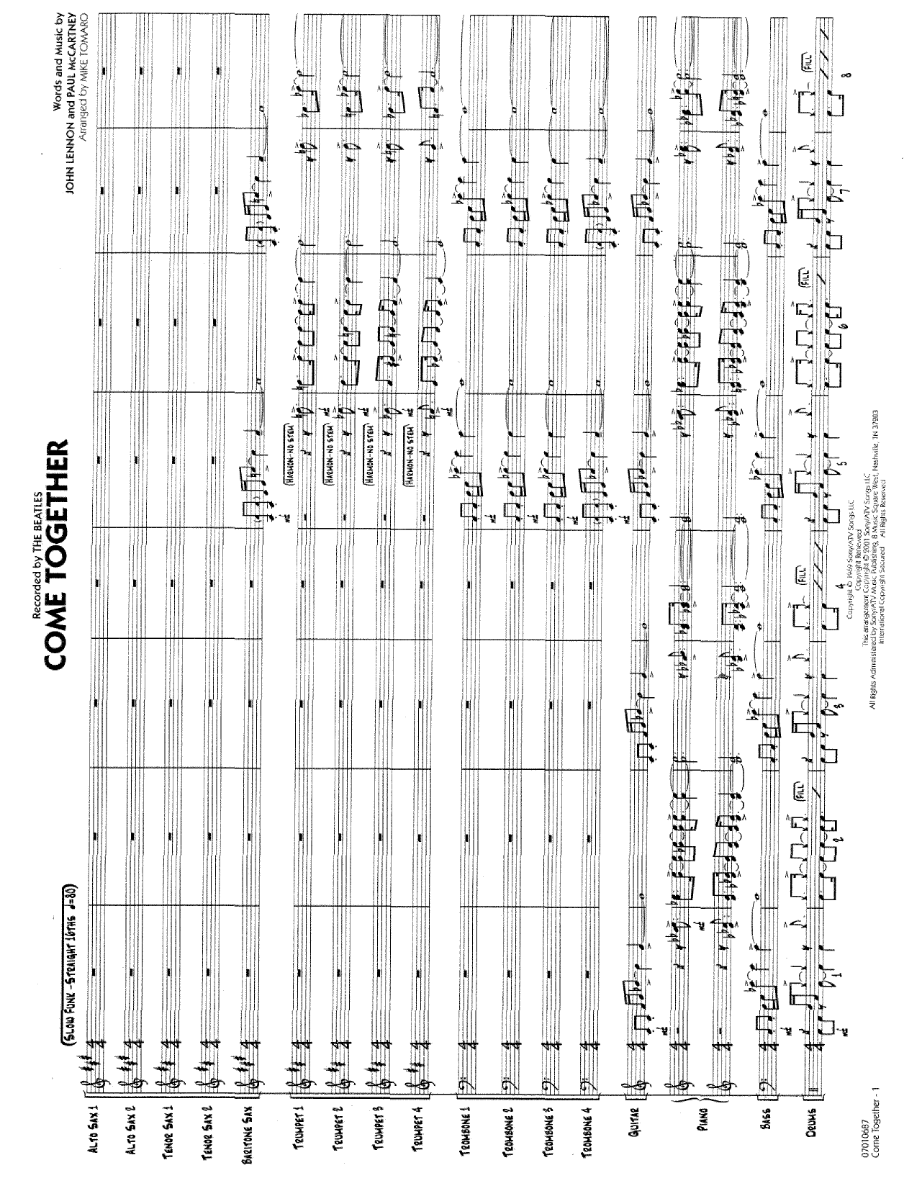
Come Together (M.Tomaro) sheet music preview

Come Together (M.Tomaro)

Composed by Lennon-McCartney

Arranged by Beatles

  • Ensemble: Big Band
  • Style: Jazz Standard
  • Pages: 47
  • Instruments (17): Alto Saxophone 1, Alto Saxophone 2, Tenor Saxophone 1, Tenor Saxophone 2, Baritone Saxophone, Trumpet 1, Trumpet 2, Trumpet 3, Trumpet 4, Trombone 1, Trombone 2, Trombone 3, Trombone 4, Guitar, Piano, Bass, Drum Set
  • Difficulty: easy
  • Content: Individual Parts
  • Format: PDF Download (Instant)
  • Price: $24.99

Originally penned by Lennon-McCartney, "Come Together" emerged in 1969 as the opening track to The Beatles' iconic album, *Abbey Road*. While firmly rooted in rock and roll, its distinctive, slinky bassline, blues-infused vocal melody, and psychedelic overtones have long made it a fertile ground for reinterpretation across genres. This particular arrangement, credited to M. Tomaro, elevates the classic rock anthem into a sophisticated big band jazz standard, bridging the gap between its rock origins and the expansive harmonic and rhythmic possibilities of a modern jazz orchestra. The original's gritty, almost menacing vibe is meticulously preserved and re-contextualized within a medium-groove framework, offering a fresh perspective on a universally recognized tune. M. Tomaro's treatment of "Come Together" masterfully transforms the original's driving rock feel into a compelling medium-tempo swing. The arrangement is primarily in a minor key, maintaining the song's inherent moodiness, but injects a vibrant energy through intricate voicings and dynamic contrasts. The opening, true to the original, features a prominent, almost hypnotic bassline, which quickly gives way to a full ensemble statement of the melody. Tomaro's signature is evident in the rich, often dense harmonic structures, utilizing extended chords and subtle reharmonizations that add depth without sacrificing the song's recognizable melodic contours. Expect carefully crafted soli sections for the saxophones and brass, showcasing the ensemble's precision and blend, punctuated by powerful full-band shout choruses that build tension and excitement. The arrangement features the melody primarily carried by the alto saxophone and trumpet sections in unison or octaves, often supported by lush trombone pads. A significant highlight is the extended solo section, typically featuring an improvisational spot for tenor saxophone, followed by a trumpet solo, allowing skilled soloists ample space to explore the tune's modal possibilities. Technically, the piece demands strong rhythmic accuracy and articulation from all sections, particularly in the syncopated figures and tight ensemble hits. Brass players will need good control over dynamics and blend, while the saxophones navigate intricate lines with precision. The rewarding aspect lies in the arrangement's ability to maintain the original's cool, slightly edgy character while presenting it with the power and sophistication only a big band can deliver. This arrangement is ideally suited for advanced high school, collegiate, community, or professional jazz ensembles. Its demands on ensemble blend, dynamic control, and rhythmic precision make it an excellent vehicle for developing sophisticated musicality. While challenging, the clear structure, engaging solos, and the sheer familiarity of the source material make it highly accessible and enjoyable for both performers and audiences. It serves as an excellent showcase piece, demonstrating a band's ability to interpret contemporary material with jazz sensibility and technical prowess. "Come Together" by M. Tomaro should be approached with a medium swing feel, maintaining a consistent, relaxed groove around quarter note = 120-132 BPM. The iconic bassline at the opening must be solid and unwavering, setting the foundational pulse for the entire piece. Articulation is paramount; pay close attention to the specified staccatos, tenutos, and slurs, as they define the arrangement's characteristic swagger. Brass sections should focus on precise attacks and releases, particularly in the punchy soli figures and shout choruses, ensuring a unified, impactful sound. The saxophone soli sections require meticulous attention to balance and blend, with inner voices clearly articulated but not overpowering the lead. Dynamics play a crucial role in building the narrative; conductors should emphasize the contrasts between the subtle, grooving sections and the powerful, full-ensemble moments. Soloists should be encouraged to embrace the bluesy, slightly modal character of the tune, utilizing the provided chord changes as a springboard for creative improvisation. Rehearsal time should be dedicated to locking in the rhythmic interplay between the rhythm section and the horns, ensuring the "push and pull" of the swing is natural and cohesive. Q: What instruments and parts are included in this arrangement? A: This arrangement is scored for a standard 17-piece big band: Alto Saxophone 1 & 2, Tenor Saxophone 1 & 2, Baritone Saxophone, Trumpet 1-4, Trombone 1-4, Piano, Bass, Guitar, and Drums. All 47 pages of individual parts and the conductor's score are included. Q: What is the difficulty level of M. Tomaro's "Come Together" arrangement? A: This arrangement is considered advanced, suitable for college, community, or professional jazz ensembles. It demands strong rhythmic precision, advanced ensemble blend, dynamic control, and proficient soloists. Q: How does this arrangement honor the original "Come Together" while transforming it into a jazz standard? A: M. Tomaro's arrangement retains the original's iconic bassline, minor key, and bluesy melodic character but reinterprets it with a medium swing feel, sophisticated jazz harmonies, intricate voicings, and extended solo sections, effectively bridging rock and big band jazz. Q: What makes M. Tomaro's approach to "Come Together" unique? A: Tomaro's arrangement is distinguished by its rich, often dense harmonic structures, carefully crafted soli sections for both saxophones and brass, and dynamic contrasts that build excitement while preserving the original's cool, slightly edgy mood within a big band context. Q: What is the typical performance duration and tempo for this arrangement? A: The typical performance duration for this arrangement is approximately 4-5 minutes, depending on the length of the improvised solos. It is designed to be performed at a medium swing tempo, ideally around quarter note = 120-132 BPM.

Musicians Also Search For

Come Together Beatles PDFCome Together Beatles sheet musicCome Together arranged by BeatlesBeatles big band chartsBeatles jazz arrangements PDFCome Together Lennon-McCartney sheet musicCome Together Lennon-McCartney big band arrangementLennon-McCartney big band chartsCome Together big band arrangementCome Together big band PDF downloadCome Together jazz ensemble sheet musicbig band sheet music instant downloadCome Together individual parts downloadCome Together sheet music with partsCome Together Jazz Standard chartJazz Standard big band arrangementsbuy Come Together sheet music onlinedownload Come Together PDFCome Together jazz chartbest Beatles big band arrangementsLennon-McCartney songs arranged by BeatlesCome Together printable sheet musicbig band repertoire PDF

All arrangements by Beatles All Lennon-McCartney sheet music