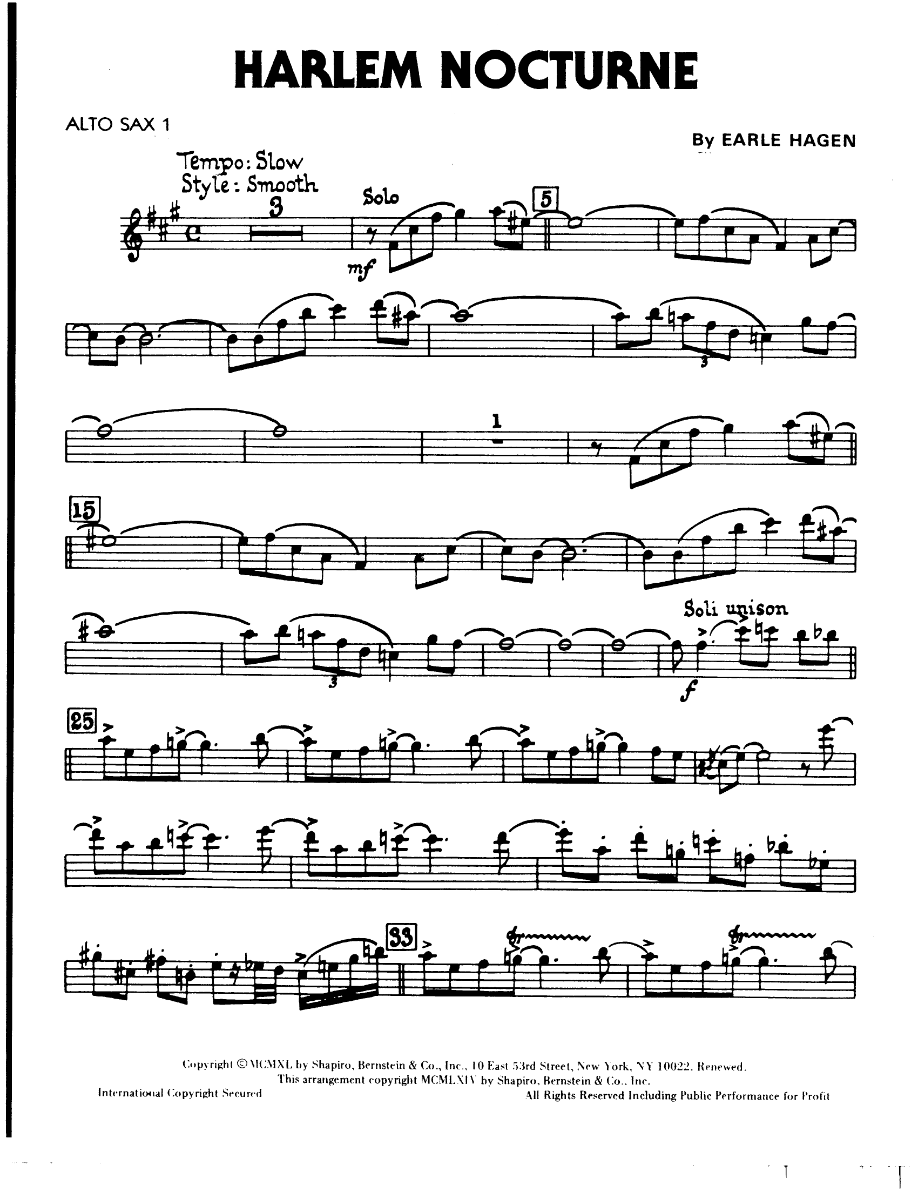
Harlem Nocturne (E.Hagen) sheet music preview

Harlem Nocturne (E.Hagen)

Composed by Earle Hagen

Arranged by E. Hagen

  • Ensemble: Big Band
  • Style: Foxtrot
  • Pages: 29
  • Instruments (15): 1st Saxophone Eb Alto, 2nd Saxophone Bb Tenor, 3rd Saxophone Eb Alto, 4th Saxophone Bb Tenor, 5th Sax bari, 1st Trombone, 2nd Trombone, 1st Trumpet in Bb, 2nd Trumpet in Bb, 3rd Trumpet in Bb, Piano (Accordion), Guitar, Bass, Drums, Violin
  • Difficulty: medium
  • Content: Individual Parts
  • Format: PDF Download (Instant)
  • Price: $24.99

Earle Hagen's iconic "Harlem Nocturne," originally penned in 1939, stands as a quintessential foxtrot and a enduring jazz standard, forever etched into the American musical landscape. While initially conceived as a mood-setting piece for film noir and radio dramas, it gained widespread recognition and cemented its place in popular culture through Randy Brooks' 1946 big band recording, featuring a haunting saxophone melody. The piece evokes a distinct era of late-night sophistication, smoky clubs, and a touch of melancholic mystery, making it instantly recognizable and deeply atmospheric. Its enduring appeal lies in its deceptively simple yet profoundly expressive melodic line, often carried by a tenor saxophone, which has made it a favorite for soloists across various genres, from jazz to R&B. This particular arrangement, crafted by the original composer E. Hagen himself, presents "Harlem Nocturne" as a medium-slow foxtrot in the key of C minor, maintaining the piece's signature brooding and sultry mood. The arrangement opens with the familiar, sinuous melody primarily voiced in the lead tenor saxophone, often doubled or harmonized by other saxophones, creating a rich, dark timbre. Hagen’s genius lies in his ability to maintain the original's emotional core while expanding it into a full big band tapestry. Expect lush, close-voiced harmonies in the saxophone section, particularly during the melodic statements, which contribute to the piece's evocative character. The brass sections provide subtle, sustained pads and occasional punctuations, never overpowering the central melodic narrative. The arrangement features a prominent tenor saxophone solo, offering ample space for a skilled improviser to explore the piece's minor key harmonies and blues-inflected phrases. Following the solo, the arrangement builds gently, incorporating a classic big band soli section where the saxophones weave intricate lines, showcasing the ensemble's blend and precision. While there isn't a traditional "shout chorus" in the high-energy sense, the arrangement does feature moments of collective ensemble playing that swell with intensity before returning to the piece's more subdued character. The overall dynamic range is carefully controlled, emphasizing the piece's intimate and reflective qualities rather than explosive power. Performing this arrangement is a rewarding experience, particularly for ensembles capable of achieving a refined balance and expressive phrasing. The primary technical challenge lies in maintaining the consistent, medium-slow foxtrot groove with precision, ensuring the rhythmic integrity without rushing or dragging. Expressive dynamic control and nuanced articulation are paramount, especially for the lead tenor saxophone and the saxophone section soli. This arrangement is ideally suited for college-level big bands, advanced community ensembles, and professional groups seeking to add a timeless, atmospheric classic to their repertoire. It provides an excellent vehicle for developing ensemble blend, dynamic sensitivity, and a deep understanding of jazz ballad interpretation within a classic big band context. Conductors should emphasize a consistent, medium-slow foxtrot feel, maintaining a steady pulse without rigidity. The tempo should allow for ample space in the melodic lines and harmonic voicings. Key technical challenges include achieving a seamless legato in the saxophone section, particularly during the main melody and soli passages, and ensuring precise dynamic control throughout, especially in the softer sections. Encourage the lead tenor saxophonist to play with a warm, expressive tone, utilizing subtle vibrato and dynamic shaping. Brass players should focus on sustained, well-tuned chords and precise attacks on punctuating figures, avoiding any harshness that might disrupt the piece's mood. Rehearsal time should be dedicated to balancing the saxophone section's blend and ensuring the rhythm section provides a solid, yet understated, foundation that supports the melodic content without becoming overly busy. No special techniques like plunger mutes or doits are explicitly required, but expressive falls at the end of phrases can enhance the authentic foxtrot style. Q: What instruments and parts are included in this arrangement? A: This arrangement is scored for a standard 17-piece big band, including Alto Saxophone 1 & 2, Tenor Saxophone 1 & 2, Baritone Saxophone, Trumpet 1-4, Trombone 1-4, Piano, Bass, Guitar, and Drums. Q: What is the difficulty level of this "Harlem Nocturne" arrangement? A: This arrangement is rated as Medium-Advanced (Grade 4), suitable for college-level ensembles, advanced community bands, and professional groups due to its demands on expressive phrasing, dynamic control, and ensemble blend. Q: What is the musical style and historical context of this piece? A: "Harlem Nocturne" is presented as a medium-slow foxtrot, originally composed in 1939 by Earle Hagen. It embodies the moody, atmospheric style of that era, often associated with film noir and classic big band jazz. Q: What makes E. Hagen's arrangement of "Harlem Nocturne" unique? A: This arrangement, by the original composer E. Hagen, features lush, close-voiced saxophone harmonies, a prominent tenor saxophone solo opportunity, and a focus on maintaining the piece's signature melancholic and sophisticated mood within a full big band setting. Q: What is the typical performance duration and tempo for this arrangement? A: The typical performance duration for this arrangement is approximately 3-4 minutes, performed at a medium-slow foxtrot tempo, usually around 80-90 beats per minute.

Questions and answers

What is included in the Harlem Nocturne (E.Hagen) PDF?
The verified current file contains individual parts across 29 pages.
How many instruments or parts are listed for Harlem Nocturne (E.Hagen)?
The verified instrumentation list contains 15 entries for this Big Band arrangement.
Who is credited for Harlem Nocturne (E.Hagen)?
Composer: Earle Hagen. Arranger: E. Hagen.
What difficulty is listed for Harlem Nocturne (E.Hagen)?
The verified difficulty level is medium.
What style is listed for Harlem Nocturne (E.Hagen)?
The catalog lists the style as Foxtrot.
Can I preview Harlem Nocturne (E.Hagen) before buying?
Yes. The product page provides a preview generated from the current PDF file.
How is Harlem Nocturne (E.Hagen) delivered?
After successful payment, the digital PDF is made available for download. The displayed price is $24.99.

Musicians Also Search For

Harlem Nocturne E. Hagen PDFHarlem Nocturne E. Hagen sheet musicHarlem Nocturne arranged by E. HagenE. Hagen big band chartsE. Hagen jazz arrangements PDFHarlem Nocturne Earle Hagen sheet musicHarlem Nocturne Earle Hagen big band arrangementsEarle Hagen big band chartsHarlem Nocturne big band arrangementsHarlem Nocturne big band PDF downloadHarlem Nocturne jazz sheet musicbig band sheet music downloadHarlem Nocturne individual parts downloadHarlem Nocturne sheet music PDFHarlem Nocturne Foxtrot chartsFoxtrot big band arrangementsbuy Harlem Nocturne sheet musicdownload Harlem Nocturne PDFHarlem Nocturne jazz chartsbest E. Hagen big band arrangementsEarle Hagen arranged by E. HagenHarlem Nocturne printable sheet musicbig band repertoire PDF

All arrangements by E. Hagen All Earle Hagen sheet music