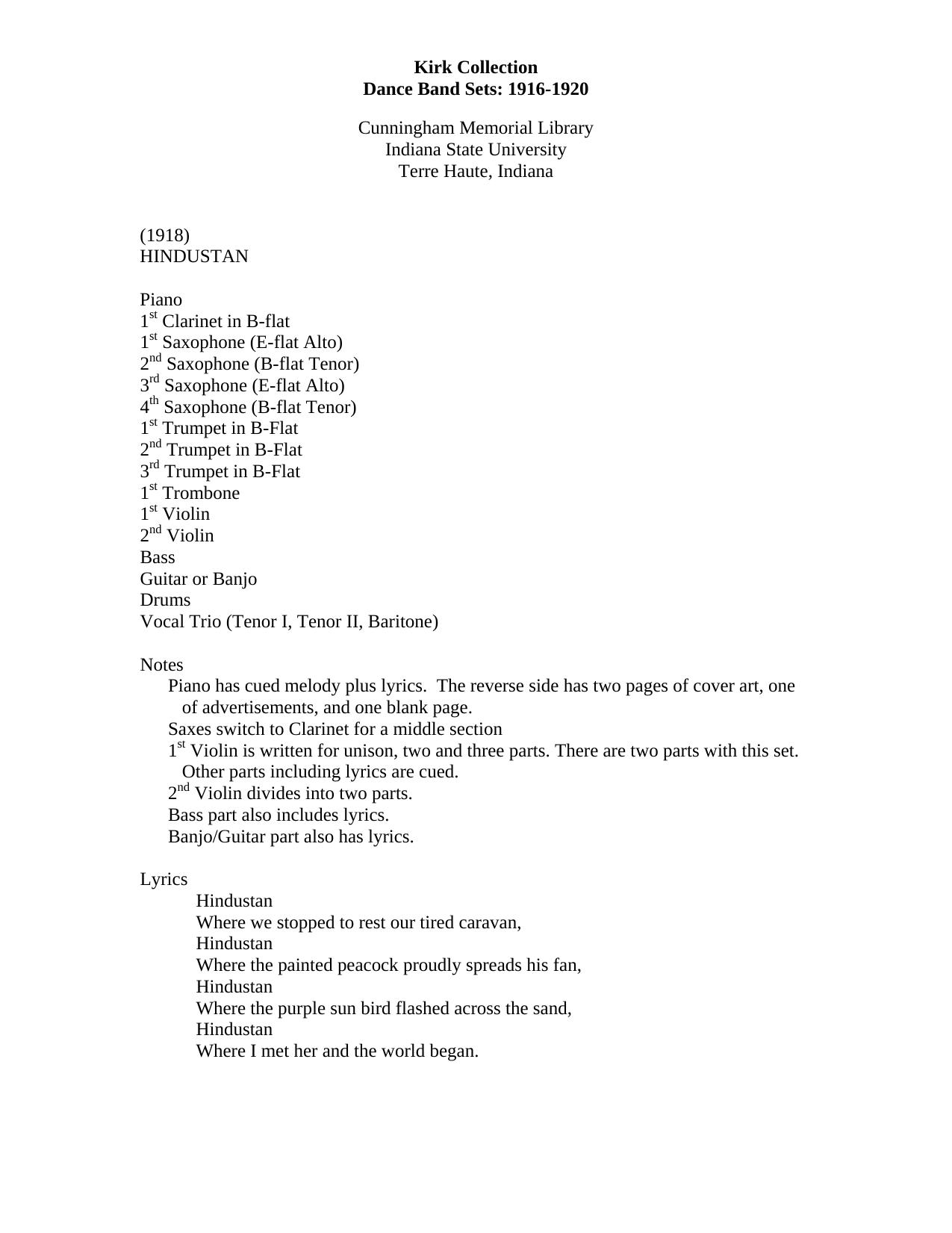
Hindustan (F.Skinner) sheet music preview

Hindustan (F.Skinner)

Composed by John Skinner

Arranged by Frank Skinner

  • Ensemble: Big Band
  • Pages: 34
  • Instruments (17): Piano, 1st Clarinet in Bb, 1st Saxophone (Eb Alto), 2d Saxophone (Bb Tenor), 3d Saxophone (Eb Alto), 4th Saxophone (Bb Tenor), 1st Trumpet in Bb, 2d Trumpet in Bb, 3rd Trumpet in Bb, 1st Trombone, 2nd Trombone, 1st Violin, 2d Violin, Bass, Guitar or Banjo, Drums, Vocal Trio
  • Difficulty: medium
  • Content: Individual Parts
  • Format: PDF Download (Instant)
  • Price: $24.99

Originally composed in 1918 by Oliver Wallace and Harold Weeks, "Hindustan" emerged during the twilight of the ragtime era to become an enduring early jazz and traditional jazz standard. Popularized initially by landmark dance orchestras like Joseph C. Smith's, the tune captured the public imagination with its exotic, narrative-driven melodic contour and steady rhythmic drive, eventually finding a permanent home in the repertoire of New Orleans revivalists and swing bands alike. Its distinct 32-bar structure lends itself naturally to inventive harmonic reimagining, bridging the gap between turn-of-the-century novelty numbers and the sophisticated idioms of the golden age of big bands. Master arranger Frank Skinner approaches this classic material with the dramatic flair and textural clarity characteristic of his celebrated orchestrational style. The chart unfolds at a bouncy, medium-tempo swing feel that emphasizes forward momentum while preserving the evocative, romantic allure of the original theme. Skinner balances rich, warm chordal structures across the ensemble with crisp punctuations, utilizing clever counter-melodies and tight chromatic passing tones. The mood shifts effortlessly from sultry, muted brass statements to exuberant, high-energy ensemble passages that evoke the grandeur of a cinematic travelogue without losing its core jazz grit. Distributed across a compact yet robust instrumentation of seven core parts—encompassing alto saxophone, tenor saxophone, trumpet, trombone, and a driving piano-led rhythm section across 34 meticulously copied pages—this arrangement punches well above its weight class in sonic density. The melodic burden is shared fluidly between the saxophone and brass voices, creating a dynamic interplay that prevents texture fatigue. Featured solo spaces allow individual players to stretch out over traditional changes, while structured soli sections demand tight rhythmic unison and precise articulation. Performers will find particular delight in the clever transitions and the satisfying build toward the final shout chorus. College, advanced high school, and community jazz ensembles looking to inject historical depth and stylistic variety into their programs will find this chart exceptionally rewarding. Because it requires careful balance and stylistic dexterity rather than sheer pyrotechnic endurance, it serves as an ideal vehicle for teaching early swing phrasing, section blend, and narrative pacing. Directors will appreciate how effectively the 34 pages of parts communicate Skinner's precise articulative intent, making it a standout selection for concert settings and festival adjudication alike. Achieving the authentic stylistic flavor of this Frank Skinner arrangement requires careful attention to articulation and tempo control. Aim for a comfortable, driving medium-swing feel (around 120–126 BPM), ensuring the rhythm section lays down a steady, unhurried pulse that anchors the syncopated melodic figures. The primary technical challenge lies in balancing the lightweight 7-instrument texture so that inner voices and counter-melodies remain audible beneath the primary line. Horn players should utilize subtle vibrato and appropriate mutes (such as cup or straight mutes where indicated) during the introductory statements to establish the piece's exotic atmosphere before opening up for the fuller ensemble sections. Rehearsals should initially focus on the tight rhythmic unisons in the soli passages; isolate these measures and practice them slowly with a metronome clicking on beats two and four to lock in the swing subdivision. Pay close attention to dynamic markings, ensuring that crescendo wedges lead naturally to structural arrival points rather than forcing the tone prematurely. Q: What instruments and parts are included in this arrangement? A: This chart is scored for a 7-instrument ensemble featuring Alto Saxophone, Tenor Saxophone, Trumpet, Trombone, Piano, and rhythm section support spanning a comprehensive 34 pages of music. Q: What is the difficulty level of this arrangement? A: It is well-suited for advanced high school, collegiate, and community jazz bands, focusing primarily on ensemble blend, swing phrasing, and stylistic balance rather than extreme technical range. Q: What is the historical style and background of the piece? A: Based on Wallace and Weeks's 1918 composition, this arrangement captures the transition from early ragtime-era novelty tunes into the sophisticated swing and jazz standard repertoire. Q: What makes Frank Skinner’s treatment unique? A: Skinner applies his signature cinematic orchestrational approach, blending lush harmonic voicings, dynamic textural shifts, and clever conversational interplay between the horns. Q: What is the recommended performance tempo and duration? A: The arrangement is designed for a medium swing tempo around 120–126 BPM, yielding a performance duration of approximately 3 to 4 minutes depending on solo extensions.

Questions and answers

What is included in the Hindustan (F.Skinner) PDF?
The verified current file contains individual parts across 34 pages.
How many instruments or parts are listed for Hindustan (F.Skinner)?
The verified instrumentation list contains 17 entries for this Big Band arrangement.
Who is credited for Hindustan (F.Skinner)?
Composer: John Skinner. Arranger: Frank Skinner.
What difficulty is listed for Hindustan (F.Skinner)?
The verified difficulty level is medium.
Can I preview Hindustan (F.Skinner) before buying?
Yes. The product page provides a preview generated from the current PDF file.
How is Hindustan (F.Skinner) delivered?
After successful payment, the digital PDF is made available for download. The displayed price is $24.99.

Musicians Also Search For

Hindustan Frank Skinner PDFHindustan Frank Skinner sheet musicHindustan arranged by Frank SkinnerFrank Skinner big band chartsFrank Skinner jazz arrangements PDFHindustan John Skinner sheet musicHindustan John Skinner big band arrangementsJohn Skinner big band chartsHindustan big band arrangementsHindustan big band PDF downloadHindustan jazz sheet musicbig band sheet music downloadHindustan individual parts downloadHindustan sheet music PDFbuy Hindustan sheet musicdownload Hindustan PDFHindustan jazz chartsbest Frank Skinner big band arrangementsJohn Skinner arranged by Frank SkinnerHindustan printable sheet musicbig band repertoire PDF

All arrangements by Frank Skinner All John Skinner sheet music