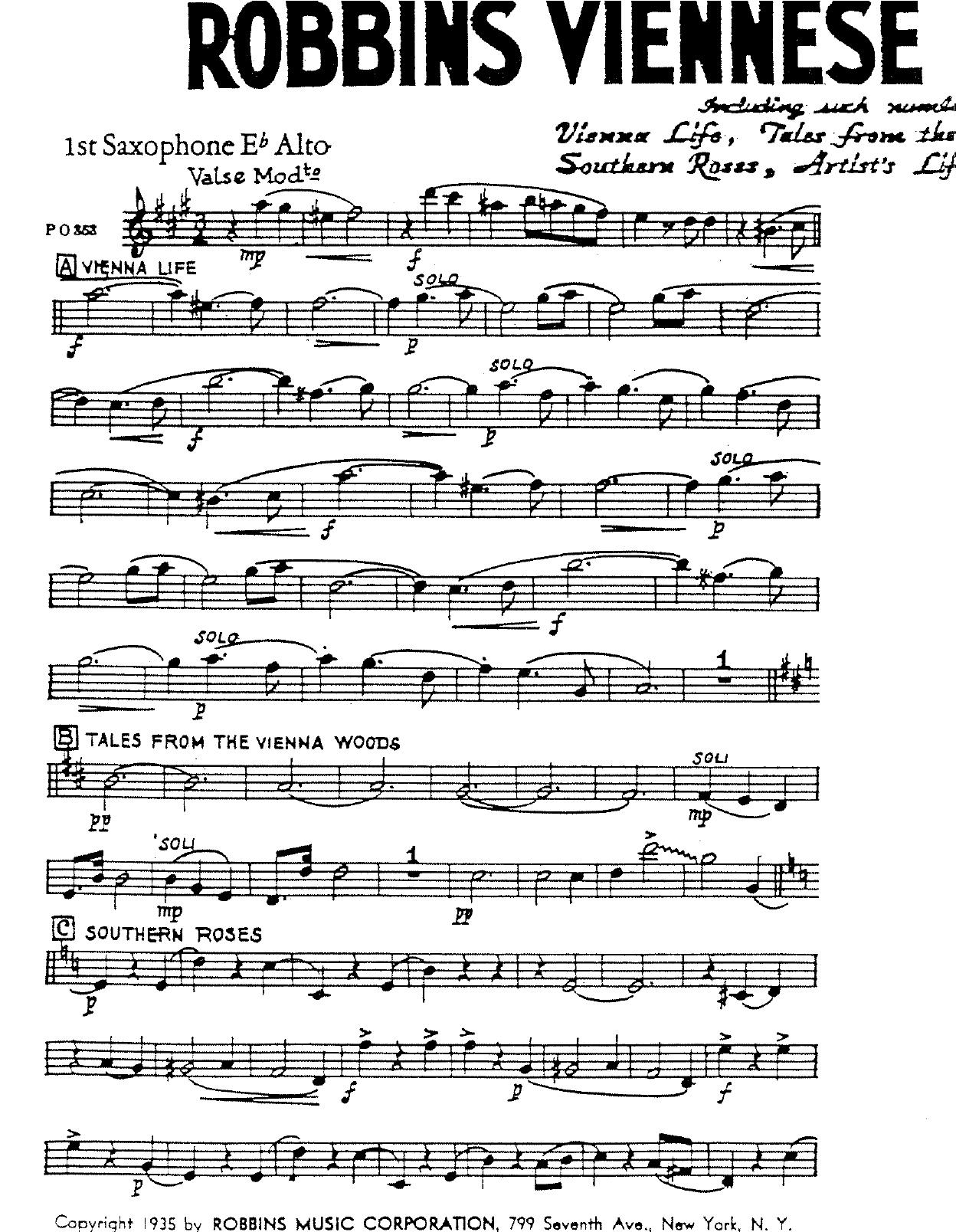
Robbins Viennese Waltz Meddley (F.Skinner)
Composed by John Skinner
Arranged by Frank Skinner
- Ensemble: Big Band
- Pages: 32
- Instruments (15): 1st Saxophone Eb Alto, 2nd Saxophone Bb Tenor, 3rd Saxophone Eb Alto, 4th Saxophone Bb Tenor, 5th Eb Baritone Sax, 1st Trumpet in Bb, 2nd Trumpet in Bb, 3rd Trumpet in Bb, 1st Trombone, 2nd Trombone, 3rd Trombone, Piano, Bass, Drums, Guitar
- Difficulty: medium
- Content: Individual Parts
- Format: PDF Download (Instant)
- Price: $24.99
Golden-era Hollywood orchestration meets the rhythmic pulse of mid-century dance bands in this fascinating publication from the Robbins Music catalog. Emerging from an era when classical melodies were frequently re-imagined for modern syncopated ensembles, the "Robbins Viennese Waltz Meddley" bridges the gap between traditional European triple-meter elegance and the sophisticated arranging idioms of the 1930s. Arranger Frank Skinner—renowned for his extensive contributions to golden-age cinema scores and masterclasses in orchestration—infuses standard waltz themes with unexpected harmonic color, lush woodwind counterlines, and a distinctly theatrical progression. Rather than playing the source material straight, Skinner treats each thematic pivot with cinematic flair, creating a continuous, flowing tapestry that shifts seamlessly between romantic European lyricism and breezy American dancehall swing. The musical character of the chart is defined by its graceful 3/4 waltz momentum, buoyant rubato transitions, and rich, tertian harmonies that elevate simple folk-like melodies into sophisticated orchestral statements. Opening with an inviting, atmospheric introduction, the arrangement moves fluidly through dynamic peaks and valleys, utilizing shimmering brass pads and cascading saxophone runs to evoke a sophisticated ballroom atmosphere. The mood shifts effortlessly from nostalgic and tender to bright and high-spirited, demanding a flexible approach to tempo and phrasing. Performers must navigate smooth, connected legato lines alongside crisp, dance-oriented articulation, balancing the romantic rubato typical of Viennese traditions with the crisp precision required of an 8-instrument jazz-adjacent ensemble. Skinner’s arrangement showcases a masterclass in economy of scoring, utilizing a tight 8-instrument instrumentation (comprising Alto Sax, Tenor Sax, Baritone Sax, Trumpet, Trombone, and rhythm components) to achieve a remarkably full, symphonic texture. Instead of relying on a massive big band wall of sound, Skinner splits the harmonic weight inventively across the saxophone and brass sections, giving individual voices prominent countermelodies while keeping the core waltz theme clearly centered. The woodwinds frequently carry the primary melodic weight with warm, chorale-like voicing, while the brass interject with rounded, warm-toned punctuation rather than aggressive stabs. Technical challenges center primarily on intonation across shifting key centers, seamless blend within the reed section during rapid modulations, and maintaining a consistent, floating 3/4 pulse without feeling heavy-handed on the downbeats. Advanced high school ensembles, collegiate chamber jazz groups, and professional theater or nostalgic dance orchestras will find this 32-page score to be a rewarding, highly engaging addition to their libraries. The piece offers students and professionals alike an invaluable lesson in vintage arranging techniques, requiring stylistic versatility, acute listening across sectional boundaries, and a refined sense of rubato. Reviving this archival gem provides audiences with a rare glimpse into how mid-century arrangers successfully synthesized Old World classical charm with contemporary popular dance orchestration. Navigating this arrangement successfully requires careful attention to stylistic balance and dynamic control within the compact 8-instrument configuration. Because the texture is transparent compared to a standard 17-piece big band, every player must treat their part like a chamber music voice, prioritizing blend and intonation over raw volume. The primary technical hurdle lies in the frequent modulations and shifting accidental pathways embedded within the waltz transitions. Conductors should rehearse the ensemble a cappella on key modulatory passages to lock in pitch centers before adding full instrumentation. Establish a light, floating 3/4 feel right from the downbeat; avoid over-accentuating the first beat of every bar, which can cause the waltz momentum to sound clunky or marching-band-like. Instead, aim for a continuous, swirling circular motion characteristic of classic Viennese styling, while respecting any written ritardandos and a tempos that Skinner employs to transition between themes. Mutes are optional depending on the desired acoustic environment, but warm cup or straight mutes in the brass can help emulate the velvety studio-orchestra sound of the 1930s radio era. Ensure that the saxophone section maintains a cohesive, warm vibrato profile to match the lush cinematic aesthetic demanded by the arranger. Q: What instruments and parts are included in this arrangement? A: The arrangement is scored for an 8-instrument ensemble, specifically including parts for Alto Saxophone, Tenor Saxophone, Baritone Saxophone, Trumpet, Trombone, and supportive rhythm section elements across a comprehensive 32-page manuscript. Q: What is the difficulty level of this arrangement? A: It is best suited for advanced high school, collegiate, and professional instrumentalists who possess strong sight-reading skills, solid intonation across shifting key centers, and a refined sense of chamber music balance. Q: What is the historical context and musical style of the piece? A: Arranged by Frank Skinner and published during the 1930s golden era of dance orchestras, this piece stylistically merges traditional European triple-meter Viennese waltzes with sophisticated American cinematic arranging techniques. Q: What makes this specific arrangement unique? A: Unlike standard big band charts built on a 4/4 swing beat, this arrangement uniquely applies jazz-era harmonic color, counterlines, and compact 8-voice orchestration to classical waltz themes, creating a rare bridge between two distinct musical worlds. Q: What is the performance duration and tempo approach for the piece? A: While performance duration varies slightly based on the conductor's interpretation of rubato and transitional pauses, the piece typically runs around 3 to 4 minutes, anchored by a graceful, flowing 3/4 waltz tempo that requires flexible push-and-pull phrasing.
Questions and answers
- What is included in the Robbins Viennese Waltz Meddley (F.Skinner) PDF?
- The verified current file contains individual parts across 32 pages.
- How many instruments or parts are listed for Robbins Viennese Waltz Meddley (F.Skinner)?
- The verified instrumentation list contains 15 entries for this Big Band arrangement.
- Who is credited for Robbins Viennese Waltz Meddley (F.Skinner)?
- Composer: John Skinner. Arranger: Frank Skinner.
- What difficulty is listed for Robbins Viennese Waltz Meddley (F.Skinner)?
- The verified difficulty level is medium.
- Can I preview Robbins Viennese Waltz Meddley (F.Skinner) before buying?
- Yes. The product page provides a preview generated from the current PDF file.
- How is Robbins Viennese Waltz Meddley (F.Skinner) delivered?
- After successful payment, the digital PDF is made available for download. The displayed price is $24.99.
Musicians Also Search For
Robbins Viennese Waltz Meddley Frank Skinner PDF • Robbins Viennese Waltz Meddley Frank Skinner sheet music • Robbins Viennese Waltz Meddley arranged by Frank Skinner • Frank Skinner big band charts • Frank Skinner jazz arrangements PDF • Robbins Viennese Waltz Meddley John Skinner sheet music • Robbins Viennese Waltz Meddley John Skinner big band arrangements • John Skinner big band charts • Robbins Viennese Waltz Meddley big band arrangements • Robbins Viennese Waltz Meddley big band PDF download • Robbins Viennese Waltz Meddley jazz sheet music • big band sheet music download • Robbins Viennese Waltz Meddley individual parts download • Robbins Viennese Waltz Meddley sheet music PDF • buy Robbins Viennese Waltz Meddley sheet music • download Robbins Viennese Waltz Meddley PDF • Robbins Viennese Waltz Meddley jazz charts • best Frank Skinner big band arrangements • John Skinner arranged by Frank Skinner • Robbins Viennese Waltz Meddley printable sheet music • big band repertoire PDF