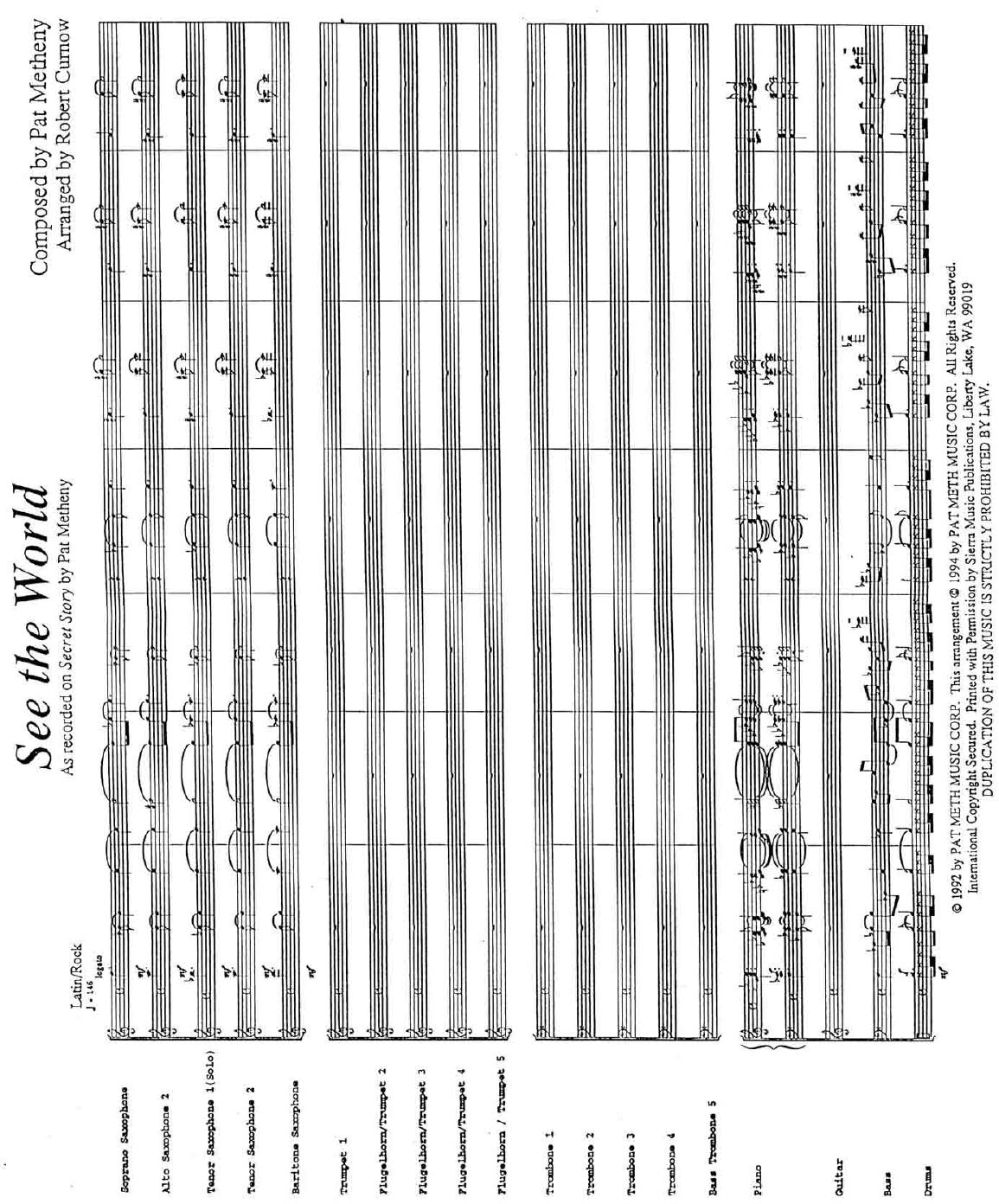
See The World (B.Curnow)
Composed by Bob Curnow
Arranged by Bob Curnow
- Ensemble: Big Band
- Pages: 19
- Instruments (19): Soprano Saxophone, Alto Saxophone 2, Tenor Saxophone 1 (Solo), Tenor Saxophone 2, Baritone Saxophone, Trumpet 1, Flugelhorn/Trumpet 2, Flugelhorn/Trumpet 3, Flugelhorn/Trumpet 4, Flugelhorn/Trumpet 5, Trombone 1, Trombone 2, Trombone 3, Trombone 4, Bass Trombone 5, Piano, Guitar, Bass, Drums
- Difficulty: easy
- Content: Individual Parts
- Format: PDF Download (Instant)
- Price: $24.99
Bob Curnow’s masterful big band composition "See The World" stands as a brilliant testament to contemporary large-ensemble jazz writing, capturing the sophisticated harmonic language and soaring melodic inventiveness that defined his work with the legendary L.A. Jazz Choir and his own acclaimed big band projects. Drawing inspiration from the rich West Coast modern jazz tradition—where textural clarity, intricate counterpoint, and lush, extended voicings reign supreme—this piece bridges the gap between classic big band swing and modern compositional depth. Curnow, widely celebrated for his definitive big band adaptations of Pat Metheny’s music, brings that same orchestral brilliance and emotional resonance to his original writing, creating an expansive sonic landscape that invites listeners on an unforgettable musical journey. Stylistically, "See The World" unfolds at a driving, infectious medium-up tempo, propelled by an energetic rhythmic groove that balances sophisticated rhythmic displacement with an underlying warmth and optimism. The harmonic palette is rich with major-seventh extensions, suspended chords, and chromatic mediant modulations that evoke a sense of vast open spaces and global exploration. The mood shifts fluidly from introspective, harmonically dense sectional interludes to explosive, high-energy outbursts. Curnow’s signature arranging approach is immediately evident in the way he treats the 19-piece ensemble: rather than relying solely on traditional block-voicing shout choruses, he utilizes transparent, woodwind-heavy textures—featuring a crucial double on soprano saxophone—and intricate counterpoint where every horn has an active, meaningful voice. Melodic responsibilities are shared gracefully across the ensemble, opening with evocative statements in the saxophones before expanding into full brass counter-lines. The arrangement features substantial solo space for capable improvisers, supported by dynamic background figures that build relentless tension. Technical challenges lie primarily in the sophisticated rhythmic unisons, demanding intonation within extended chord structures, and the stamina required to maintain a buoyant, driving feel over a relatively extended duration. The woodwind doubling, particularly for the second alto and soprano player, requires agility and a seamless blend. Advanced high school, collegiate, and professional jazz orchestras will find this chart to be an exceptionally rewarding centerpiece for festival performance or formal concerts. The sophisticated interplay between sections demands a mature ensemble with strong section cohesion, refined dynamic control, and an ear for modern jazz harmonies. Performing "See The World" challenges musicians to elevate their listening skills, offering audiences a thrilling, multi-dimensional big band experience that highlights the pinnacle of contemporary jazz composition and arrangement. Conductors tackling "See The World" must prioritize rhythmic precision and balance, particularly during complex transitional sections where the meter and subdivision feel fluid. Establish a rock-solid, driving medium-up tempo early with the rhythm section, ensuring the drummer locks in a supportive yet interactive groove that avoids heavy-handed backbeats. The saxophones, especially when utilizing the soprano saxophone on lead or inner parts, need meticulous blend rehearsals to voice Curnow’s dense chord clusters cleanly against the brass. Pay close attention to dynamic markings: the contrast between the delicate, transparent sub-tones and the roaring, wide-open shout choruses is what gives the chart its narrative arc. Horn players should approach stylistic articulations—such as accented short notes and controlled falls—with restraint, keeping the modern jazz aesthetic clean rather than overly retro. Rehearsal time is best spent isolating the intricate background figures behind the soloists to ensure they never obscure the featured improviser. Q: What specific instruments and parts are included in this big band arrangement? A: This arrangement is scored for a 19-instrument standard contemporary big band, including a full reed section (Soprano Saxophone, Alto Saxophone 2, Tenor Saxophone 1, Tenor Saxophone 2, Baritone Saxophone), four trumpets, four trombones, guitar, piano, bass, and drums, along with a comprehensive conductor score. Q: What is the difficulty level of Bob Curnow's "See The World"? A: This chart is graded as advanced, making it ideal for high-level college jazz ensembles, community big bands, and professional orchestras that are comfortable with complex modern harmonies and demanding ensemble unisons. Q: What is the musical style and historical context of this piece? A: Written by renowned arranger and composer Bob Curnow, the piece represents the sophisticated West Coast contemporary big band style, blending elements of modern jazz, ECM-esque atmospheric expansiveness, and traditional swing orchestration. Q: What makes this specific arrangement unique compared to standard big band charts? A: It is distinguished by Curnow's signature transparent voicings, intricate counterpoint, sophisticated woodwind doubling (including soprano saxophone), and an expansive harmonic language that treats the 19-piece ensemble as a unified chamber orchestra. Q: What is the performance duration and tempo feel of the arrangement? A: "See The World" is a substantial concert work featuring an energetic, driving medium-up tempo feel that requires strong rhythmic stamina and sustained concentration across its extended duration.
Questions and answers
- What is included in the See The World (B.Curnow) PDF?
- The verified current file contains a conductor score across 19 pages.
- How many instruments or parts are listed for See The World (B.Curnow)?
- The verified instrumentation list contains 19 entries for this Big Band arrangement.
- Who is credited for See The World (B.Curnow)?
- Composer: Bob Curnow. Arranger: Bob Curnow.
- What difficulty is listed for See The World (B.Curnow)?
- The verified difficulty level is easy.
- Can I preview See The World (B.Curnow) before buying?
- Yes. The product page provides a preview generated from the current PDF file.
- How is See The World (B.Curnow) delivered?
- After successful payment, the digital PDF is made available for download. The displayed price is $24.99.
Musicians Also Search For
See The World Bob Curnow PDF • See The World Bob Curnow sheet music • See The World arranged by Bob Curnow • Bob Curnow big band charts • Bob Curnow jazz arrangements PDF • See The World Bob Curnow big band arrangements • See The World big band arrangements • See The World big band PDF download • See The World jazz sheet music • big band sheet music download • See The World conductor score PDF • See The World sheet music PDF • buy See The World sheet music • download See The World PDF • See The World jazz charts • best Bob Curnow big band arrangements • See The World printable sheet music • big band repertoire PDF