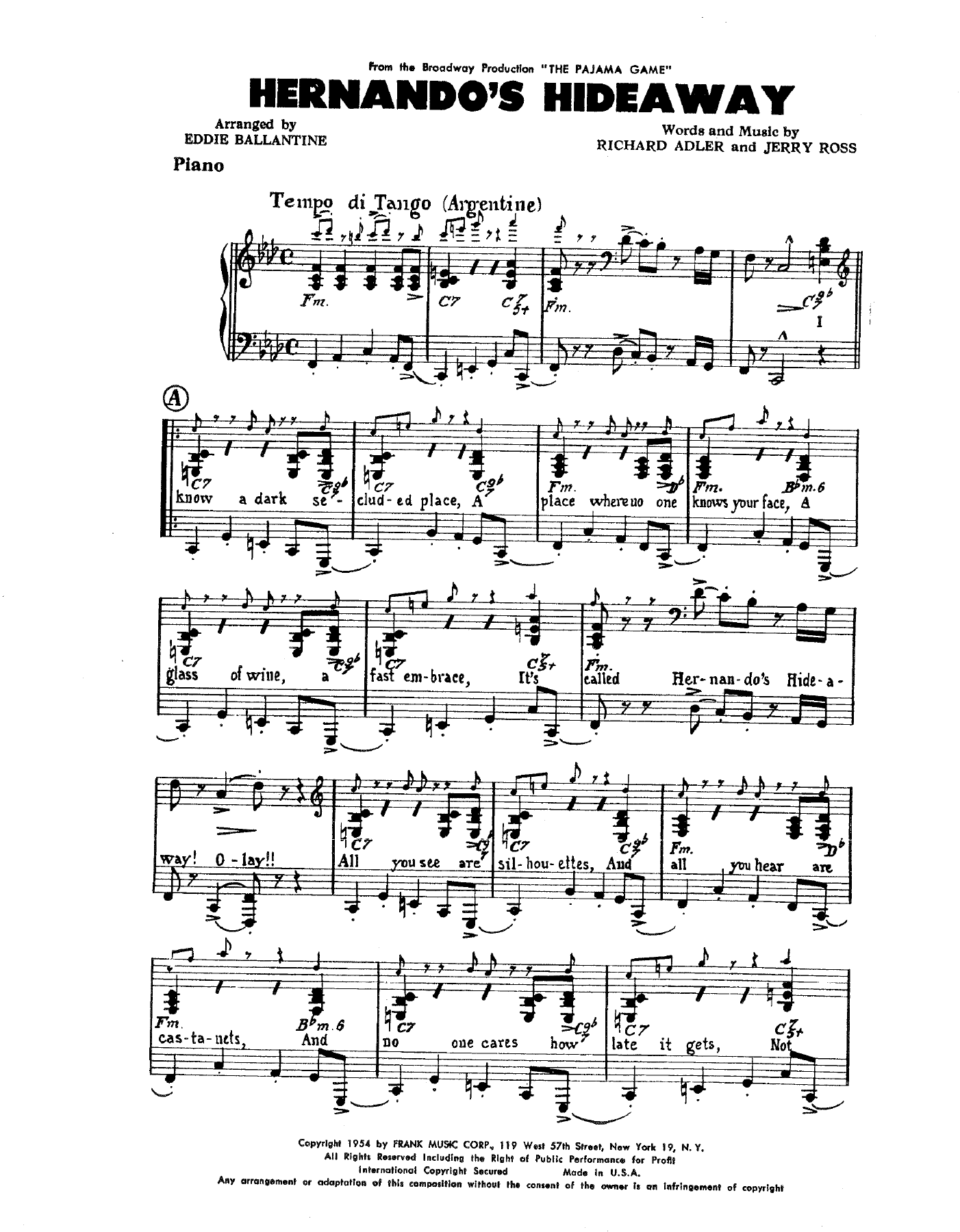
Hernandos Hideaway (E.Ballantine)
Composed by Jerry Ross, Richard Adler
Arranged by E. Ballantine
- Ensemble: Big Band
- Style: Tango
- Pages: 32
- Instruments (15): Piano, Violins A-B C, Bass, Guitar, Drums, 1st Eb Alto Sax., 3rd Eb Alto Sax., 2nd Bb Tenor Sax., 4th Bb Tenor Sax., 5th Eb Baritone Sax., 1st Trombone, 2nd Trombone, 1st Trumpet, 2nd Trumpet, 3rd Trumpet
- Difficulty: medium
- Content: Individual Parts
- Format: PDF Download (Instant)
- Price: $24.99
"Hernando's Hideaway," originally penned by the prolific songwriting duo Jerry Ross and Richard Adler for their 1954 Broadway smash "The Pajama Game," quickly transcended its theatrical origins to become a cultural touchstone. This iconic tango, steeped in the dramatic flair and seductive mystery of mid-20th-century Latin dance music, perfectly captures the clandestine allure of a hidden rendezvous. While the original stage production introduced it, numerous interpretations by artists like Archie Bleyer and Johnnie Ray cemented its place in popular music, making it instantly recognizable for its distinctive, brooding melody and insistent rhythmic drive. It evokes an era of sophisticated romance and a touch of danger, characterized by its minor key tonality and a rhythm that compels movement. E. Ballantine's big band arrangement masterfully reinterprets this classic, transforming it into a compelling showcase for a 17-instrument ensemble. Ballantine's approach respects the original's inherent tango character, maintaining a strict 4/4 meter with a driving, sensual Latin feel, but infuses it with the rich harmonic and dynamic possibilities of a full jazz orchestra. The arrangement is set in the original key of A minor, preserving the song's dark, evocative mood. Ballantine employs sophisticated voicings throughout, particularly in the brass and saxophone sections, to create a lush, full sound that is both authentic to the tango style and distinctly big band. Expect dynamic contrasts, from hushed, conspiratorial passages to powerful, full-ensemble statements, all contributing to the narrative of the "hideaway." The piece opens with the instantly recognizable melody, initially presented by the lead alto saxophone, establishing the sultry atmosphere before being developed through various sections of the band. Ballantine skillfully utilizes call-and-response figures between brass and reeds, building tension and excitement. There are no extended improvised solos, keeping the focus on the ensemble's tight execution and the arranger's intricate scoring. However, there are numerous opportunities for individual section leaders to shine through exposed melodic lines and powerful soli sections, particularly for the saxophones and trombones. The technical challenges lie in maintaining the precise rhythmic integrity of the tango, achieving seamless dynamic shifts, and executing the complex ensemble voicings with clarity and balance. The arrangement culminates in a dramatic, full-band shout chorus that brings the piece to a thrilling and definitive close, leaving a lasting impression of sophisticated energy. This arrangement is ideally suited for college, advanced high school, or community jazz ensembles looking to explore Latin big band repertoire with a touch of theatricality. Its demands on ensemble precision, dynamic control, and rhythmic accuracy make it an excellent teaching tool for developing sophisticated musicality. The rewarding experience comes from mastering the nuanced tango feel and presenting a cohesive, dramatic performance that captivates the audience with its timeless allure and Ballantine's clever big band treatment. Conductors should emphasize a consistent, driving 4/4 Latin tango feel from the outset, ensuring the rhythm section lays down a solid, unyielding foundation. The bass line should be strong and articulate, while the drums maintain a crisp, insistent rhythmic pulse without overpowering the melodic content. Key technical challenges include achieving precise ensemble attacks and releases, particularly in the brass, and maintaining balance within the dense chord voicings in the saxophone soli sections. Dynamic contrasts are crucial; guide the band through the marked crescendos and decrescendos to build and release tension effectively, especially in the dramatic full-ensemble passages. Ensure the lead alto saxophone clearly articulates the initial melody, setting the mood. Rehearsal time should focus on rhythmic accuracy in the unison and harmonized lines, ensuring the characteristic tango syncopation is felt, not just played. Pay close attention to the articulation markings, as they are integral to conveying the piece's stylistic authenticity. No special techniques like mutes or falls are explicitly required, allowing the focus to remain on core ensemble performance. Q: What instruments are included in this arrangement? A: This arrangement is scored for a standard 17-instrument big band, including Alto Saxophone 1, Alto Saxophone 2, Tenor Saxophone 1, Tenor Saxophone 2, Baritone Saxophone, Trumpet 1, Trumpet 2, Trumpet 3, Trumpet 4, Trombone 1, Trombone 2, Trombone 3, Bass Trombone, Piano, Bass, Drums, and Guitar. Q: What is the difficulty level of this arrangement? A: This arrangement is rated as medium-advanced. It requires strong ensemble precision, dynamic control, and rhythmic accuracy, making it suitable for college, advanced high school, or experienced community jazz bands. Q: What is the musical style and historical context of "Hernando's Hideaway"? A: "Hernando's Hideaway" is a classic tango from the 1954 Broadway musical "The Pajama Game." This arrangement maintains the original's dramatic, sultry Latin feel, reinterpreting it for a big band ensemble with a nod to mid-20th-century popular music. Q: What makes E. Ballantine's arrangement of "Hernando's Hideaway" unique? A: Ballantine's arrangement stands out for its sophisticated big band voicings, dynamic contrasts, and faithful yet fresh interpretation of the original tango character. It focuses on ensemble performance rather than improvisation, creating a cohesive and dramatic musical narrative. Q: What is the typical performance duration and tempo for this piece? A: While exact duration can vary with interpretation, this arrangement typically performs at approximately 3-4 minutes. The tempo should be a consistent 4/4 Latin tango feel, maintaining a steady, driving pulse throughout.
Questions and answers
- What is included in the Hernandos Hideaway (E.Ballantine) PDF?
- The verified current file contains individual parts across 32 pages.
- How many instruments or parts are listed for Hernandos Hideaway (E.Ballantine)?
- The verified instrumentation list contains 15 entries for this Big Band arrangement.
- Who is credited for Hernandos Hideaway (E.Ballantine)?
- Composer: Jerry Ross, Richard Adler. Arranger: E. Ballantine.
- What difficulty is listed for Hernandos Hideaway (E.Ballantine)?
- The verified difficulty level is medium.
- What style is listed for Hernandos Hideaway (E.Ballantine)?
- The catalog lists the style as Tango.
- Can I preview Hernandos Hideaway (E.Ballantine) before buying?
- Yes. The product page provides a preview generated from the current PDF file.
- How is Hernandos Hideaway (E.Ballantine) delivered?
- After successful payment, the digital PDF is made available for download. The displayed price is $24.99.
Musicians Also Search For
Hernandos Hideaway E. Ballantine PDF • Hernandos Hideaway E. Ballantine sheet music • Hernandos Hideaway arranged by E. Ballantine • E. Ballantine big band charts • E. Ballantine jazz arrangements PDF • Hernandos Hideaway Jerry Ross, Richard Adler sheet music • Hernandos Hideaway Jerry Ross, Richard Adler big band arrangements • Jerry Ross, Richard Adler big band charts • Hernandos Hideaway big band arrangements • Hernandos Hideaway big band PDF download • Hernandos Hideaway jazz sheet music • big band sheet music download • Hernandos Hideaway individual parts download • Hernandos Hideaway sheet music PDF • Hernandos Hideaway Tango charts • Tango big band arrangements • buy Hernandos Hideaway sheet music • download Hernandos Hideaway PDF • Hernandos Hideaway jazz charts • best E. Ballantine big band arrangements • Jerry Ross, Richard Adler arranged by E. Ballantine • Hernandos Hideaway printable sheet music • big band repertoire PDF