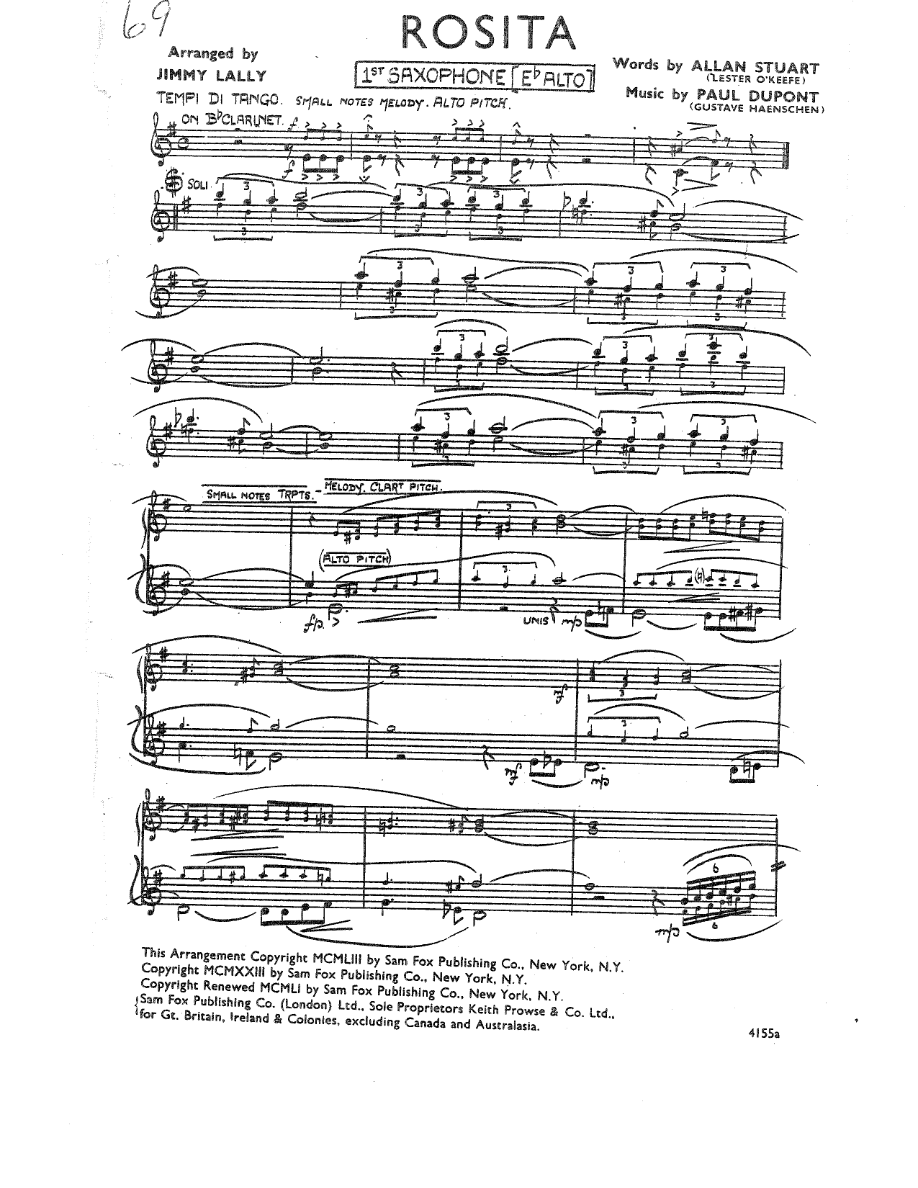
Rosita (J.Lally) sheet music preview

Rosita (J.Lally)

Composed by Paul Dupont

Arranged by J. Lally

  • Ensemble: Big Band
  • Style: Tango
  • Pages: 26
  • Instruments (13): Alto Saxophone 1, Tenor Saxophone 2, Alto Saxophone 3, Tenor Saxophone 4, Baritone Saxophone, Trumpet 1, Trumpet 2, Trumpet 3, Trombone 1, Trombone 2, Bass, Guitar, Drum Set
  • Difficulty: medium
  • Content: Individual Parts
  • Format: PDF Download (Instant)
  • Price: $24.99

Paul Dupont's "Rosita" emerges from the golden age of tango, a captivating genre that swept through dance halls and concert stages in the early 20th century. While not a traditional jazz standard, its enduring melodic charm and rhythmic sophistication have made it a compelling canvas for jazz interpretation, much like other Latin American compositions that found their way into the big band repertoire. Dupont's original composition likely dates to the 1920s or 30s, embodying the romanticism and dramatic flair characteristic of the era's popular dance music, often featuring lush string arrangements and a melancholic yet passionate core. Its transition into a big band setting highlights the versatility of its themes, allowing for a fusion of its inherent tango passion with the expansive harmonic and rhythmic possibilities of a jazz orchestra. J. Lally's big band arrangement of "Rosita (J.Lally)" masterfully reinterprets this classic tango, transforming its intimate pathos into a vibrant, swinging Latin-jazz excursion. The piece is set at a medium-slow tempo, maintaining the original's romantic essence but infusing it with a subtle, driving Latin groove rather than a traditional swing feel. The primary key is A minor, which perfectly captures the melancholic yet passionate mood, allowing for rich, often extended harmonies that add depth and complexity. Lally's signature approach is evident in the sophisticated voicings, particularly in the saxophone section, which frequently carries the melody with a warm, blended sound, punctuated by brass interjections. The arrangement evokes a mood of sophisticated allure and understated drama, making it ideal for a concert opener or a featured ballad with a rhythmic twist. The arrangement opens with the full ensemble presenting the main theme, immediately establishing the piece's distinctive Latin character. The melody is initially carried by the saxophones, showcasing Lally's characteristic smooth, interwoven voicings, before being passed to the brass for a more assertive statement. A notable feature is the extended trombone soli, which provides a rich, dark timbre, contrasting beautifully with the brighter saxophone sections. While there are no explicit written solos, the arrangement offers ample opportunity for a lead alto or tenor saxophone to interpret the melodic lines with expressive freedom, particularly during the more lyrical passages. Technical challenges include precise rhythmic articulation in the Latin feel, maintaining blend and balance within the dense voicings, and achieving the nuanced dynamic shifts that underscore the piece's dramatic arc. The rewarding aspect lies in the ensemble's ability to convey both the original tango's passion and the big band's powerful, yet controlled, energy. "Rosita (J.Lally)" is an excellent choice for college, community, and professional big bands seeking a piece that offers both musical depth and audience appeal. Its blend of familiar melodicism with an engaging Latin groove makes it accessible, while the intricate voicings and dynamic demands provide significant educational and performance challenges. High school bands with strong lead players and a solid understanding of Latin rhythms could also tackle this piece, particularly with focused rehearsal on articulation and ensemble precision. The arrangement's unique character ensures it will stand out in any program, showcasing the band's versatility and musicality. "Rosita (J.Lally)" should be approached with a clear understanding of its medium-slow Latin groove, emphasizing a relaxed yet precise rhythmic feel rather than a strict swing. The tempo marking of quarter note = 96-104 is crucial; avoid rushing the tempo, allowing the rich harmonies and melodic lines to breathe. Articulation is paramount: ensure all eighth notes are played with a slight legato, while quarter notes and longer values sustain fully. The trombone soli requires careful attention to blend and intonation, aiming for a unified, warm sound. Dynamics play a key role in shaping the narrative; conductors should emphasize the subtle crescendos and decrescendos, particularly in the melodic passages and during the full ensemble sections. Rehearsal should focus on rhythmic precision in the percussion section to establish a consistent Latin pulse, and on balancing the intricate saxophone voicings against the brass interjections to maintain clarity and blend. Q: What specific instruments and parts are included in this arrangement? A: This arrangement is scored for a standard 17-piece big band: Alto Saxophone 1 & 2, Tenor Saxophone 1 & 2, Baritone Saxophone, Trumpet 1-4, Trombone 1-4, Piano, Bass, Drums, and Guitar. Q: What is the difficulty level of "Rosita (J.Lally)"? A: This arrangement is rated as medium-advanced, suitable for college, community, and professional big bands. It presents challenges in rhythmic precision, blend, and nuanced dynamics, requiring experienced players. Q: What is the musical style and historical context of "Rosita (J.Lally)"? A: "Rosita (J.Lally)" is a big band arrangement of a classic tango by Paul Dupont, reinterpreted with a Latin-jazz groove. It blends the romantic, melancholic character of early 20th-century tango with sophisticated jazz voicings and rhythmic elements. Q: What makes J. Lally's arrangement of "Rosita" unique? A: J. Lally's arrangement is distinguished by its sophisticated Latin groove, rich extended harmonies, intricate saxophone voicings that often carry the melody, and a prominent, expressive trombone soli, transforming the original tango into a compelling big band piece. Q: What is the approximate performance duration and recommended tempo for this piece? A: The approximate performance duration for "Rosita (J.Lally)" is 4 minutes and 30 seconds. The recommended tempo is a medium-slow Latin groove, with a quarter note around 96-104 BPM.

Musicians Also Search For

Rosita J. Lally PDFRosita J. Lally sheet musicRosita arranged by J. LallyJ. Lally big band chartsJ. Lally jazz arrangements PDFRosita Paul Dupont sheet musicRosita Paul Dupont big band arrangementPaul Dupont big band chartsRosita big band arrangementRosita big band PDF downloadRosita jazz ensemble sheet musicbig band sheet music instant downloadRosita conductor score PDFRosita individual parts downloadRosita sheet music with partsRosita Tango chartTango big band arrangementsbuy Rosita sheet music onlinedownload Rosita PDFRosita jazz chartbest J. Lally big band arrangementsPaul Dupont songs arranged by J. LallyRosita printable sheet musicbig band repertoire PDF

All arrangements by J. Lally All Paul Dupont sheet music