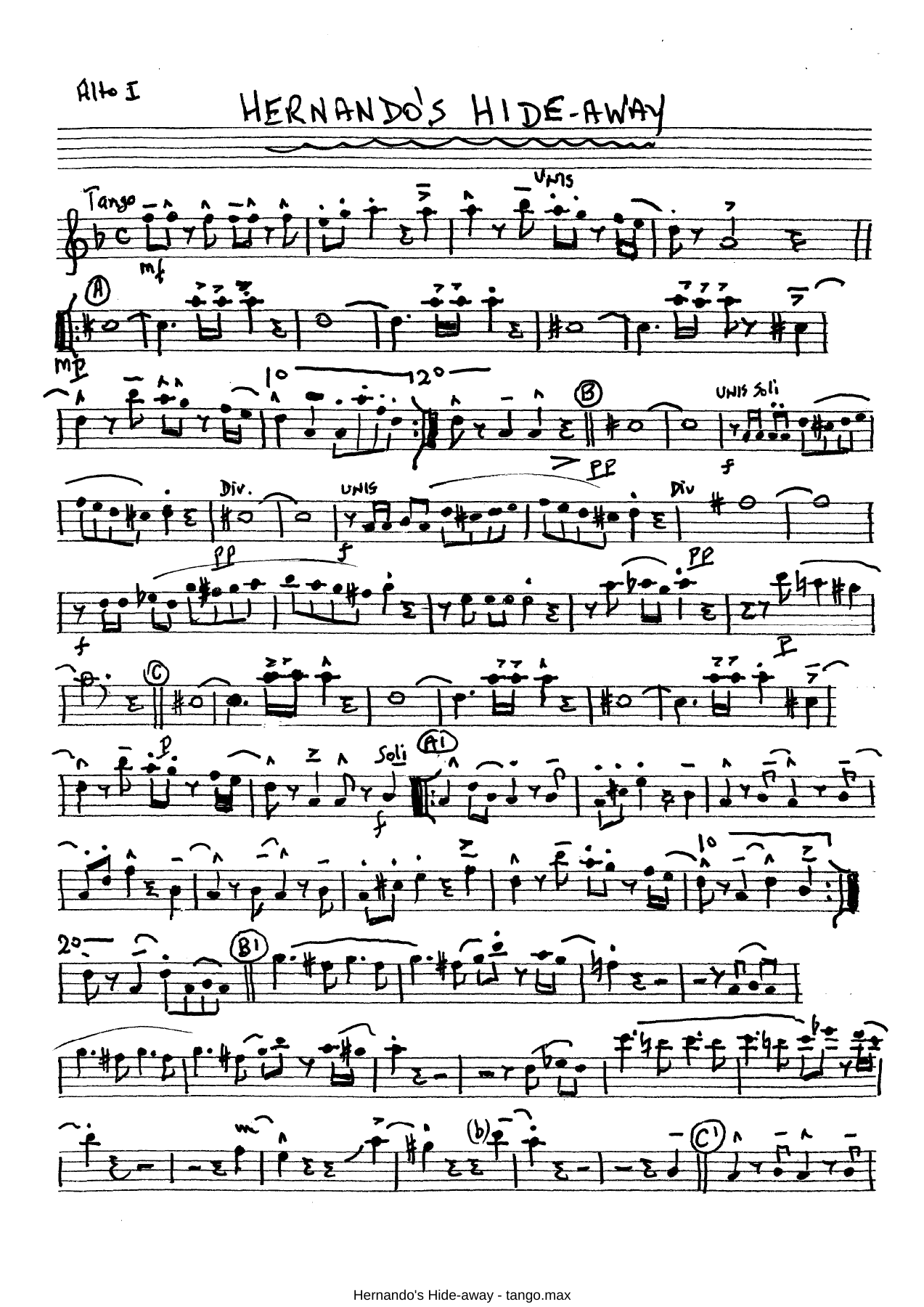
Hernandos's Hideaway (Tango) sheet music preview

Hernandos's Hideaway (Tango)

Composed by Jerry Ross, Richard Adler

Arranged by Tango

  • Ensemble: Big Band Dance
  • Style: Tango
  • Pages: 29
  • Instruments (17): Alto Saxophone 1, Alto Saxophone 2, Tenor Saxophone 1, Tenor Saxophone 2, Baritone Saxophone, Trumpet 1, Trumpet 2, Trumpet 3, Trumpet 4, Trombone 1, Trombone 2, Trombone 3, Trombone 4, Piano, Guitar, Bass, Drum Set
  • Difficulty: medium
  • Content: Individual Parts
  • Format: PDF Download (Instant)
  • Price: $24.99

"Hernando's Hideaway (Tango)" emerged from the vibrant Broadway scene of the mid-1950s, a standout number from the 1954 musical *The Pajama Game* by the prolific songwriting duo Jerry Ross and Richard Adler. This iconic tango quickly transcended its theatrical origins, becoming a popular standard synonymous with sophisticated, dramatic Latin dance. Its allure lies in its seductive, mysterious melody and its distinctive tango rhythm, which evokes images of dimly lit dance halls and passionate encounters. The piece's enduring popularity is a testament to its strong melodic hooks and its ability to capture the essence of the tango, making it a staple in both popular music and, increasingly, instrumental jazz and dance band repertoires. This arrangement by Tango masterfully captures the original's dramatic flair while re-imagining it for a contemporary big band dance ensemble. Set in a compelling minor key, the arrangement maintains a medium-slow tango tempo, emphasizing the characteristic 2/4 feel with its strong downbeats and syncopated melodic lines. The mood is one of sultry intrigue and romantic tension, building from an understated opening to a powerful, full-ensemble climax. Tango’s distinctive approach is evident in the rich, often close voicings across the saxophone and brass sections, creating a lush harmonic tapestry that supports the iconic melody. Expect intricate counter-melodies and carefully orchestrated soli sections that highlight the ensemble's various choirs, particularly the saxophones, which often carry the melodic interest with a smooth, blended sound. The arrangement opens with the melody introduced by the tenor saxophones, establishing the piece's signature seductive character. Throughout, the melody is passed between sections, ensuring dynamic interest and showcasing the full breadth of the big band's timbre. While this arrangement does not feature extended open solos, there are strategically placed melodic breaks and counter-lines that allow individual players to shine within the ensemble context. The technical challenges lie primarily in maintaining the precise tango rhythm and articulation, ensuring a unified ensemble sound, and executing the nuanced dynamics that are crucial to the piece's dramatic arc. The brass sections, particularly the trumpets, will need to articulate clearly and play with controlled power, especially during the climactic shout chorus where the full ensemble delivers the melody with thrilling intensity. This arrangement is rewarding to perform for its dramatic impact and the opportunity it provides for an ensemble to delve into a classic piece with a sophisticated Latin flair. This arrangement is ideally suited for college-level big bands, advanced community jazz ensembles, and professional dance orchestras. Its demands for precise ensemble playing, dynamic control, and a solid understanding of the tango aesthetic make it an excellent vehicle for developing musical maturity and stylistic authenticity. High school bands with strong lead players and a dedicated rhythm section could also tackle this with focused rehearsal, gaining valuable experience in Latin-influenced big band repertoire. Conductors should emphasize a consistent, medium-slow tango feel, ensuring the rhythm section lays down a solid, driving foundation without rushing. The characteristic 2/4 pulse, though often notated in 4/4, requires a strong emphasis on beats one and three, with a slight, almost imperceptible lift on the syncopated figures. Articulation is paramount: encourage a legato approach for melodic lines, contrasted with crisp, short notes for rhythmic accents. Dynamics are crucial for conveying the piece's dramatic narrative; practice the crescendos and decrescendos carefully, especially leading into and out of the full ensemble sections. No special mutes or extended techniques are required beyond standard big band articulation. Rehearsal time should focus on blending the saxophone soli passages, ensuring precise brass attacks, and maintaining rhythmic unity, particularly in the sections where the melody is passed between different instrumental groups. Pay close attention to the subtle tempo fluctuations that enhance the tango's expressive quality. Q: What instruments are included in this arrangement? A: This arrangement is scored for a standard 17-piece big band dance ensemble, including Alto Saxophone 1, Alto Saxophone 2, Tenor Saxophone 1, Tenor Saxophone 2, Baritone Saxophone, Trumpet 1, Trumpet 2, Trumpet 3, Trumpet 4, Trombone 1, Trombone 2, Trombone 3, Bass Trombone, Piano, Bass, Drums, and Guitar. Q: What is the difficulty level of "Hernando's Hideaway (Tango)" by Tango? A: This arrangement is rated as medium-advanced. It requires strong ensemble playing, precise rhythmic articulation, and dynamic control, making it suitable for college-level big bands, advanced community ensembles, and professional dance orchestras. Q: What is the musical style and historical context of this piece? A: This piece is a classic tango, originating from the 1954 Broadway musical *The Pajama Game* by Jerry Ross and Richard Adler. It embodies the sophisticated, dramatic Latin dance style popular in the mid-20th century. Q: What makes Tango's arrangement of "Hernando's Hideaway" unique? A: Tango's arrangement is distinguished by its rich, often close voicings, intricate counter-melodies, and carefully orchestrated soli sections that highlight different instrument choirs. It captures the original's dramatic flair while re-imagining it for a contemporary big band dance ensemble. Q: What is the approximate performance duration and tempo of this arrangement? A: The arrangement is written at a medium-slow tango tempo, typically around 100-110 beats per minute. The approximate performance duration is between 3:00 and 3:30 minutes, depending on the chosen tempo and any optional repeats.

Musicians Also Search For

Hernandos's Hideaway Tango PDFHernandos's Hideaway Tango sheet musicHernandos's Hideaway arranged by TangoTango big band dance chartsTango jazz arrangements PDFHernandos's Hideaway Jerry Ross, Richard Adler sheet musicHernandos's Hideaway Jerry Ross, Richard Adler big band dance arrangementJerry Ross, Richard Adler big band dance chartsHernandos's Hideaway big band dance arrangementHernandos's Hideaway big band dance PDF downloadHernandos's Hideaway jazz ensemble sheet musicbig band dance sheet music instant downloadHernandos's Hideaway individual parts downloadHernandos's Hideaway sheet music with partsHernandos's Hideaway Tango chartTango big band dance arrangementsbuy Hernandos's Hideaway sheet music onlinedownload Hernandos's Hideaway PDFHernandos's Hideaway jazz chartbest Tango big band dance arrangementsJerry Ross, Richard Adler songs arranged by TangoHernandos's Hideaway printable sheet musicbig band dance repertoire PDF

All arrangements by Tango All Jerry Ross, Richard Adler sheet music