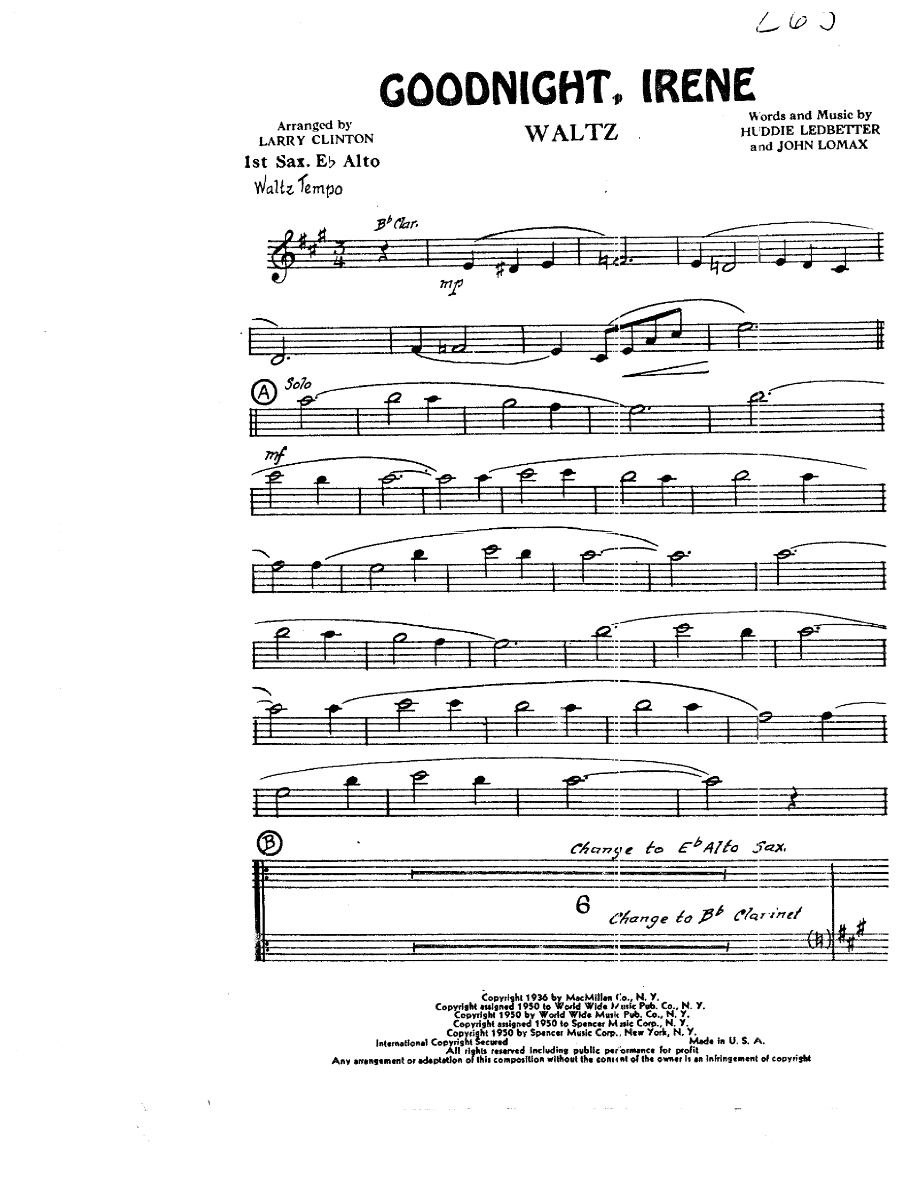
Goodnight Irene (L.Clinton)
Composed by Huddie Ledbetter
Arranged by L. Clinton
- Ensemble: Big Band
- Style: Waltz
- Pages: 24
- Instruments (15): 1st Sax. Eb Alto, 2nd Sax. Bb Tenor, 3rd Sax. Eb Alto, 4th Sax. Bb Tenor, 5th Sax. Eb Baritone, 1st Bb Trumpet, 2nd Bb Trumpet, 3rd Bb Trumpet, 1st Trombone, 2nd Trombone, 3rd Trombone, Guitar, Bass, Drums, Piano
- Difficulty: medium
- Content: Individual Parts
- Format: PDF Download (Instant)
- Price: $24.99
Huddie Ledbetter's "Goodnight Irene" emerged from the American folk tradition, gaining widespread recognition in the mid-20th century. Though Lead Belly's 1933 recording brought it to prominence, it was The Weavers' 1950 rendition that catapulted the song to mainstream success, topping charts and becoming an enduring symbol of American popular music. While not inherently a jazz standard in its original form, its simple, memorable melody and chord progression have made it a fertile ground for interpretation across genres. L. Clinton's arrangement reimagines this beloved waltz, infusing it with the sophisticated harmonies and dynamic interplay characteristic of the big band era, transforming a folk classic into a compelling jazz statement. This particular arrangement by L. Clinton presents "Goodnight Irene" as a medium-tempo jazz waltz, firmly rooted in 3/4 time. The mood is one of gentle nostalgia, yet punctuated by moments of vibrant ensemble energy. The key of F major provides a warm, accessible sonic landscape, allowing the melody to unfold naturally. Clinton's signature approach to big band scoring is evident throughout, characterized by rich, close-voiced harmonies in the saxophone section and brass, creating a lush texture that supports the familiar tune while adding layers of jazz sophistication. The arrangement maintains a delicate balance between reverence for the original melody and an inventive harmonic palette, making it both recognizable and fresh. L. Clinton's distinctive arranging style shines through in the treatment of this piece. The melody is initially carried by the lead alto saxophone, often doubled an octave lower by the tenor saxophones, creating a full-bodied sound. Subsequent melodic statements feature intricate soli sections for the saxophones, showcasing Clinton's masterful voicings that are both challenging and highly rewarding to execute. The brass sections contribute with powerful, yet controlled, punctuation and counter-melodies. While there isn't an extended open solo section, Clinton cleverly integrates short, lyrical improvisatory moments within the ensemble passages, allowing individual players to contribute without disrupting the overall flow. The arrangement builds to a dynamic shout chorus, where the full band engages in a powerful, harmonically rich statement before returning to a more reflective closing. Performing this arrangement offers a rewarding experience for a variety of ensembles. The technical demands are moderate, making it suitable for advanced high school, collegiate, community, and professional big bands. The primary challenges lie in achieving precise articulation in the soli sections, maintaining a consistent, flowing waltz feel, and balancing the intricate voicings. The rewarding aspect comes from the opportunity to explore nuanced dynamics and blend, bringing Clinton's sophisticated harmonic language to life. Specific musical moments, such as the interwoven brass figures against the saxophone soli and the climactic, yet controlled, full ensemble passages, are particularly gratifying to perform. This arrangement of "Goodnight Irene" should be approached with a focus on establishing a consistent, flowing medium jazz waltz feel at approximately quarter note = 132-140 BPM. The 3/4 meter requires a strong internal pulse from all musicians, emphasizing the "one" without becoming rigid. Key technical challenges include the precise execution of the saxophone soli passages, which demand careful attention to blend, intonation, and rhythmic accuracy. Conductors should rehearse these sections slowly, focusing on matching articulations and dynamics. Brass players should aim for a warm, controlled tone, particularly in sustained chords, and execute falls and scoops with stylistic intent, avoiding over-exaggeration. No special mutes are explicitly required, but plunger mutes could be tastefully employed in certain brass fills for added color if desired. Encourage musicians to listen across sections to achieve the rich harmonic balance inherent in Clinton's voicings. Q: What instruments are included in this arrangement? A: This arrangement is scored for a standard 17-piece big band: Alto Saxophone 1, Alto Saxophone 2, Tenor Saxophone 1, Tenor Saxophone 2, Baritone Saxophone, Trumpet 1, Trumpet 2, Trumpet 3, Trumpet 4, Trombone 1, Trombone 2, Trombone 3, Bass Trombone, Piano, Bass, Drums, and Guitar. Q: What is the difficulty level of L. Clinton's "Goodnight Irene" arrangement? A: This arrangement is rated as medium-advanced. It requires solid ensemble playing, good sight-reading skills, and an understanding of jazz articulation and phrasing, making it suitable for advanced high school, collegiate, community, and professional jazz ensembles. Q: What is the musical style and historical context of this arrangement? A: This is a big band jazz waltz arrangement of Huddie Ledbetter's folk classic "Goodnight Irene." It reimagines the original tune through the lens of mid-20th century big band jazz, featuring sophisticated harmonies and dynamic ensemble writing. Q: What makes L. Clinton's arrangement of "Goodnight Irene" unique? A: L. Clinton's distinctive approach transforms the simple folk melody into a rich jazz waltz through intricate saxophone soli voicings, dynamic brass punctuation, and a sophisticated harmonic palette, while maintaining the song's inherent charm. Q: What is the approximate performance duration and recommended tempo for this piece? A: The approximate performance duration is 3:30 to 4:00 minutes. The recommended tempo is a medium jazz waltz, around quarter note = 132-140 BPM, emphasizing a flowing, lyrical feel.
Questions and answers
- What is included in the Goodnight Irene (L.Clinton) PDF?
- The verified current file contains individual parts across 24 pages.
- How many instruments or parts are listed for Goodnight Irene (L.Clinton)?
- The verified instrumentation list contains 15 entries for this Big Band arrangement.
- Who is credited for Goodnight Irene (L.Clinton)?
- Composer: Huddie Ledbetter. Arranger: L. Clinton.
- What difficulty is listed for Goodnight Irene (L.Clinton)?
- The verified difficulty level is medium.
- What style is listed for Goodnight Irene (L.Clinton)?
- The catalog lists the style as Waltz.
- Can I preview Goodnight Irene (L.Clinton) before buying?
- Yes. The product page provides a preview generated from the current PDF file.
- How is Goodnight Irene (L.Clinton) delivered?
- After successful payment, the digital PDF is made available for download. The displayed price is $24.99.
Musicians Also Search For
Goodnight Irene L. Clinton PDF • Goodnight Irene L. Clinton sheet music • Goodnight Irene arranged by L. Clinton • L. Clinton big band charts • L. Clinton jazz arrangements PDF • Goodnight Irene Huddie Ledbetter sheet music • Goodnight Irene Huddie Ledbetter big band arrangements • Huddie Ledbetter big band charts • Goodnight Irene big band arrangements • Goodnight Irene big band PDF download • Goodnight Irene jazz sheet music • big band sheet music download • Goodnight Irene individual parts download • Goodnight Irene sheet music PDF • Goodnight Irene Waltz charts • Waltz big band arrangements • buy Goodnight Irene sheet music • download Goodnight Irene PDF • Goodnight Irene jazz charts • best L. Clinton big band arrangements • Huddie Ledbetter arranged by L. Clinton • Goodnight Irene printable sheet music • big band repertoire PDF