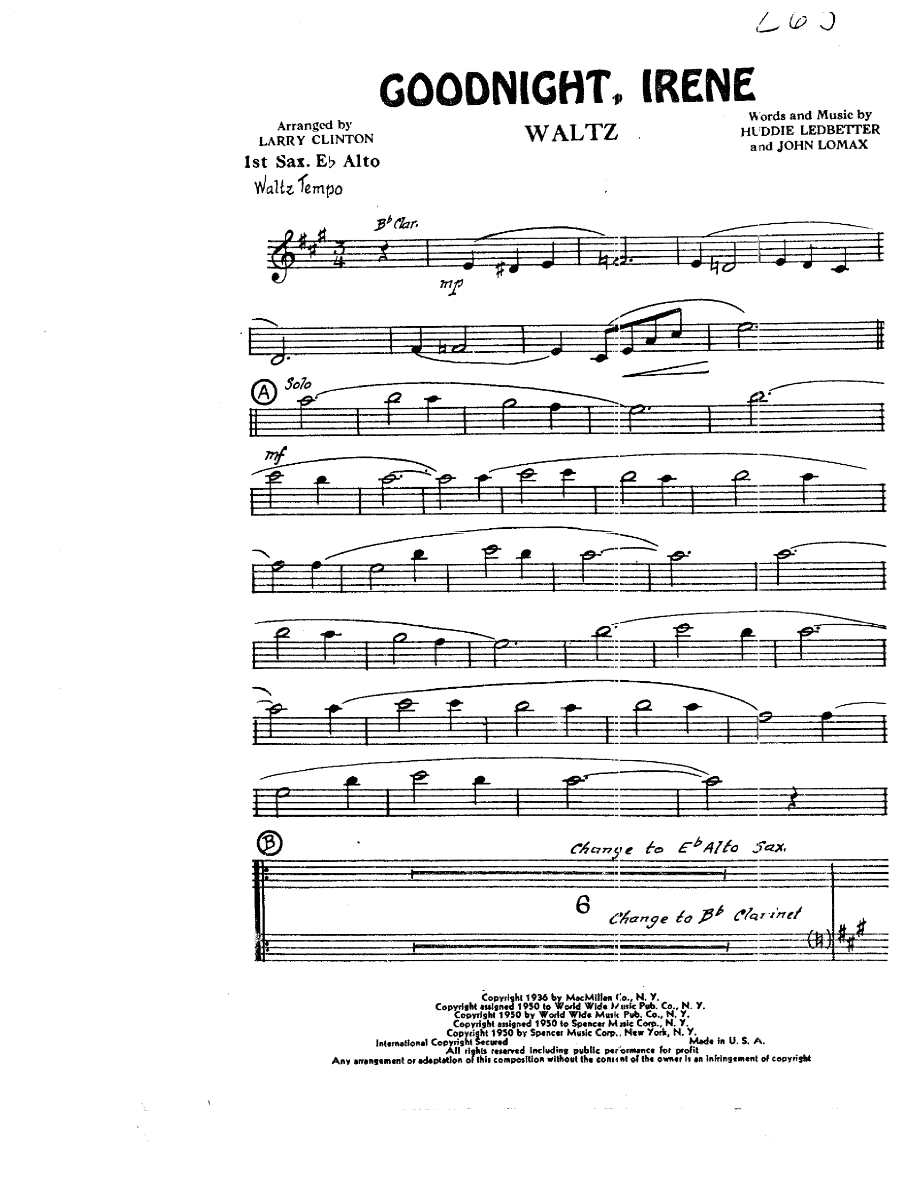
Goodnight Irene (L.Clinton) sheet music preview

Goodnight Irene (L.Clinton)

Composed by Huddie Ledbetter

Arranged by L.Clinton

  • Ensemble: Big Band Dance
  • Style: Big Band Dance
  • Pages: 24
  • Instruments (15): 1st Sax. Eb Alto, 2nd Sax. Bb Tenor, 3rd Sax Eb Alto, 4th Sax. Bb Tenor, 5th Sax. Eb Baritone, 1st Bb Trumpet, 2nd Bb Trumpet, 3rd Bb Trumpet, 1st Trombone, 2nd Trombone, 3rd Trombone, Guitar, Bass, Drums, Piano
  • Difficulty: medium
  • Content: Individual Parts
  • Format: PDF Download (Instant)
  • Price: $24.99

Huddie Ledbetter's timeless folk song, "Goodnight Irene," transcends genres, and L. Clinton's big band dance arrangement masterfully reinterprets this American classic for the swing era. Originally a traditional folk tune, Lead Belly's 1933 recording, and later his 1940 Library of Congress recording, brought it to national prominence. However, it was The Weavers' 1950 rendition that truly propelled "Goodnight Irene" into the mainstream as a pop sensation, topping charts and becoming a cultural touchstone. Clinton's arrangement harkens back to the golden age of big band, capturing the sophisticated yet danceable essence of the 1940s and early 1950s, a period when popular songs were frequently given lush, swinging orchestral treatments for dance halls and radio broadcasts. This piece isn't just a jazz standard; it's a bridge between American folk roots and the vibrant big band tradition. L. Clinton's "Goodnight Irene" is presented as a medium swing, dance-oriented arrangement, typically set in a comfortable 4/4 time signature. The mood is one of nostalgic warmth, tinged with a gentle melancholy that is inherent to the original melody, yet uplifted by the infectious swing rhythm. The arrangement is characterized by its smooth, flowing lines and rich, often close-voiced harmonies, typical of the big band dance style. It evokes the feeling of a classic ballroom or a sophisticated supper club, perfectly balancing the song's inherent sentimentality with an undeniable urge to dance. The energy is consistent and inviting, designed to keep toes tapping without overwhelming the listener, making it an excellent choice for social functions or concert programs requiring a touch of elegance and tradition. The arranger's approach to "Goodnight Irene" is distinctly L. Clinton, known for crafting arrangements that are both accessible and musically satisfying. This particular chart features a prominent melody statement, often shared or traded between the saxophone and brass sections, ensuring the familiar tune is always at the forefront. Clinton employs classic big band voicings, utilizing the full spectrum of the ensemble to create a rich, layered sound. Expect well-crafted soli sections, particularly in the saxophones, which provide a unified and polished sound. While there are no extended improvisational solos, the arrangement allows for expressive phrasing and dynamic shaping from all sections. The chart builds subtly, often incorporating call-and-response figures between brass and reeds, leading to a satisfying, understated climax rather than an explosive shout chorus. This careful construction highlights Clinton's dedication to melodic integrity and danceability. This arrangement is ideally suited for high school and college jazz ensembles, as well as community big bands seeking a polished, classic big band dance number. The technical demands are moderate, focusing more on blend, balance, and rhythmic precision than on extreme ranges or rapid-fire improvisation. The rewarding aspects include the opportunity to develop a cohesive ensemble sound, practice nuanced swing feel, and present a beloved melody in a historically authentic and engaging big band context. The clear melodic lines and structured form make it an excellent teaching tool for understanding big band conventions, while its inherent musicality ensures an enjoyable performance experience for both musicians and audience alike. "Goodnight Irene (L. Clinton)" should be approached with a relaxed, medium swing feel, emphasizing a smooth, legato articulation rather than overly detached notes. The tempo should be steady, around 120-130 BPM, maintaining a consistent pulse for danceability. Key technical challenges include achieving precise ensemble blend, particularly in the saxophone soli sections, and ensuring accurate rhythmic placement of sustained chords in the brass. Conductors should encourage a warm, rounded tone from all sections. Pay close attention to dynamic contrasts, using subtle swells and decays to enhance the melodic contour without disrupting the overall flow. There are no specific extended techniques like plungers or doits required, allowing the focus to remain on fundamental big band execution. Rehearsal time should be dedicated to balancing the melody against accompaniment figures and establishing a unified swing eighth-note feel across the ensemble. Q: What instruments/parts are included in this arrangement? A: This arrangement includes parts for Alto Saxophone, Tenor Saxophone, Trumpet, Trombone, Piano, Bass, and Drums, totaling 7 instrumental parts. Q: What is the difficulty level of "Goodnight Irene (L. Clinton)"? A: This arrangement is considered to be of moderate difficulty, suitable for high school, college, and community big bands. It focuses on ensemble blend and swing feel rather than extreme technical demands. Q: What musical style and historical context does this arrangement represent? A: This is a Big Band Dance arrangement in a medium swing style, reminiscent of the 1940s and early 1950s. It reinterprets Huddie Ledbetter's classic folk song through the lens of a classic dance orchestra. Q: What makes L. Clinton's arrangement of "Goodnight Irene" unique? A: Clinton's approach is characterized by smooth, close-voiced harmonies, prominent melodic statements, and well-crafted saxophone soli sections, all designed for a sophisticated yet accessible dance band sound. Q: What is the typical performance duration and tempo for this piece? A: The typical performance duration is approximately 3-4 minutes. It should be performed at a medium swing tempo, generally between 120-130 beats per minute.

Questions and answers

What is included in the Goodnight Irene (L.Clinton) PDF?
The verified current file contains individual parts across 24 pages.
How many instruments or parts are listed for Goodnight Irene (L.Clinton)?
The verified instrumentation list contains 15 entries for this Big Band Dance arrangement.
Who is credited for Goodnight Irene (L.Clinton)?
Composer: Huddie Ledbetter. Arranger: L.Clinton.
What difficulty is listed for Goodnight Irene (L.Clinton)?
The verified difficulty level is medium.
What style is listed for Goodnight Irene (L.Clinton)?
The catalog lists the style as Big Band Dance.
Can I preview Goodnight Irene (L.Clinton) before buying?
Yes. The product page provides a preview generated from the current PDF file.
How is Goodnight Irene (L.Clinton) delivered?
After successful payment, the digital PDF is made available for download. The displayed price is $24.99.

Musicians Also Search For

Goodnight Irene L.Clinton PDFGoodnight Irene L.Clinton sheet musicGoodnight Irene arranged by L.ClintonL.Clinton big band dance chartsL.Clinton jazz arrangements PDFGoodnight Irene Huddie Ledbetter sheet musicGoodnight Irene Huddie Ledbetter big band dance arrangementsHuddie Ledbetter big band dance chartsGoodnight Irene big band dance arrangementsGoodnight Irene big band dance PDF downloadGoodnight Irene jazz sheet musicbig band dance sheet music downloadGoodnight Irene individual parts downloadGoodnight Irene sheet music PDFGoodnight Irene Big Band Dance chartsBig Band Dance big band dance arrangementsbuy Goodnight Irene sheet musicdownload Goodnight Irene PDFGoodnight Irene jazz chartsbest L.Clinton big band dance arrangementsHuddie Ledbetter arranged by L.ClintonGoodnight Irene printable sheet musicbig band dance repertoire PDF

All arrangements by L.Clinton All Huddie Ledbetter sheet music