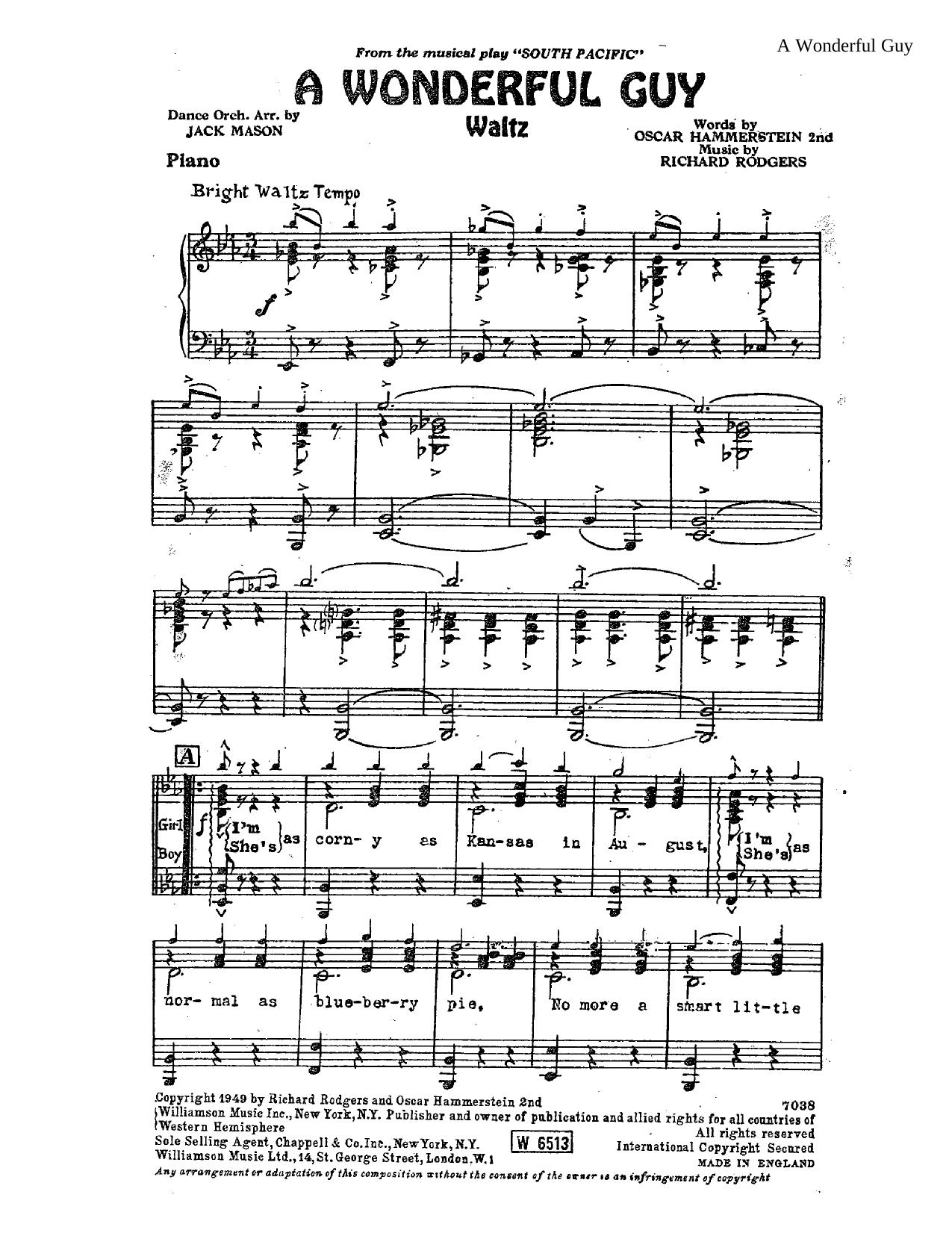
A Wonderful Guy (J.Mason) sheet music preview

A Wonderful Guy (J.Mason)

Composed by Richard Rodgers

Arranged by Jack Mason

  • Ensemble: Big Band
  • Pages: 26
  • Instruments (13): Piano, Bass, Guitar, 1st Trombone, 2nd Trombone, 1st Eb Alto Saxophone, 2nd Eb Alto Saxophone, 1st Bb Tenor Saxophone, 2nd Bb Tenor Saxophone, Eb Baritone Saxophone, 1st Trumpet in Bb, 2nd Trumpet in Bb, 3rd Trumpet in Bb
  • Difficulty: medium
  • Content: Individual Parts
  • Format: PDF Download (Instant)
  • Price: $24.99

Richard Rodgers and Oscar Hammerstein II originally introduced "A Wonderful Guy" in their celebrated 1949 Broadway masterpiece, *South Pacific*, where it was famously premiered by Nurse Nellie Forbush (Mary Martin). While conceived as an exuberant theatrical show tune, its infectious melody, optimistic lyrical cadence, and sophisticated AABA song form naturally caught the attention of jazz interpreters. Over the decades, the tune transitioned seamlessly from the Great American Songbook into the broader jazz canon, inviting instrumentalists to reframe its buoyant optimism through swing idioms, crisp articulation, and harmonically rich reharmonizations. Jack Mason’s masterful big band treatment infuses this classic with a vibrant, mid-tempo swing feel that radiates warmth, high spirits, and sophisticated harmonic color. Driven by a crisp, walking bassline and a steady, conversational ride cymbal pattern, the arrangement opens with an inviting, playful vamp before introducing the primary melody. The emotional landscape is unapologetically joyful and effervescent, shifting dynamically between lush, full-ensemble block-chord passages and sparse, punchy horn interjections that give the rhythm section plenty of room to breathe. Mason avoids heavy-handed sentimentality, opting instead for a bright, brass-forward energy reminiscent of classic mid-century studio recordings, yet updated with contemporary color tones and fresh harmonic extensions. The structural architecture of the chart showcases classic big band arranging techniques, balancing collective firepower with transparent textures. The lead trumpet and alto saxophone share primary melodic duties early on, supported by warm, harmonized sax solis that highlight Mason's gift for linear voice-leading. A dynamic shout chorus near the final third builds relentless tension through syncopated cross-rhythms and rising brass figures, before resolving satisfyingly into a triumphant final head. Featured solo space—typically allocated to the piano or tenor saxophone—allows individual improvisers to stretch out over standard changes that retain the optimistic, major-mode harmonic framework of the original composition. Advanced high school ensembles, collegiate jazz orchestras, and professional community big bands will find this arrangement to be an ideal repertoire choice. It strikes an optimal balance between accessibility and artistic fulfillment; while the rhythms are clean and idiomatic, the chart demands precise ensemble articulation, dynamic control, and a strong internal sense of swing to truly sparkle. Directors will appreciate how the chart naturally addresses section blend and balance, making it a standout selection for festival performance or as an engaging, crowd-pleasing centerpiece for any standard concert program. Success with this Jack Mason arrangement hinges on maintaining a relaxed, buoyant medium-swing feel without letting the tempo drag or rush. The rhythm section is the engine: the pianist should use sparse, comping chord voicings that emphasize seventh and ninth intervals without cluttering the texture, while the bassist drives a steady, acoustic-style quarter-note pulse. Brass players must pay close attention to marked articulations—short, clipped staccatos on off-beat accents should contrast sharply with smooth, connected legato lines in the saxophones. Ensure that the dynamic ceiling is respected during the softer ensemble passages so that the subsequent shout chorus delivers maximum impact. If utilizing mutes in the trumpets or trombones during the transitional background figures, ensure they are blended evenly across the section to maintain proper intonation and balance against the lead melodic voices. Q: What instruments and parts are included in this arrangement? A: Scored for a standard 13-instrument big band instrumentation, the package includes full rhythm section parts (Piano, Bass, Guitar) alongside horn voicings featuring 1st and 2nd Trombones, plus supplementary wind and brass parts across 26 total pages of comprehensive sheet music. Q: What is the difficulty level of this chart? A: This arrangement is graded as medium-easy to medium, making it exceptionally well-suited for advanced high school ensembles, college lab bands, and professional community big bands seeking a polished, swinging chart that comes together quickly. Q: What is the historical style and context of this piece? A: Originating as a jubilant 1949 Broadway show tune by Richard Rodgers from *South Pacific*, this arrangement reframes the composition within a classic mid-tempo jazz swing tradition, honoring its Great American Songbook origins. Q: What makes Jack Mason's arrangement unique? A: Mason successfully bridges theatrical charm and jazz sophistication by utilizing clever dynamic contrasts, lush saxophone solis, and a driving shout chorus that transforms a vocal theater tune into an engaging instrumental big band showcase. Q: What is the recommended tempo and performance duration? A: The chart is designed to be played at a comfortable, swinging medium tempo—typically around 120 to 126 beats per minute—resulting in a performance duration of approximately 3 to 4 minutes depending on solo rotations.

Questions and answers

What is included in the A Wonderful Guy (J.Mason) PDF?
The verified current file contains individual parts across 26 pages.
How many instruments or parts are listed for A Wonderful Guy (J.Mason)?
The verified instrumentation list contains 13 entries for this Big Band arrangement.
Who is credited for A Wonderful Guy (J.Mason)?
Composer: Richard Rodgers. Arranger: Jack Mason.
What difficulty is listed for A Wonderful Guy (J.Mason)?
The verified difficulty level is medium.
Can I preview A Wonderful Guy (J.Mason) before buying?
Yes. The product page provides a preview generated from the current PDF file.
How is A Wonderful Guy (J.Mason) delivered?
After successful payment, the digital PDF is made available for download. The displayed price is $24.99.

Musicians Also Search For

A Wonderful Guy Jack Mason PDFA Wonderful Guy Jack Mason sheet musicA Wonderful Guy arranged by Jack MasonJack Mason big band chartsJack Mason jazz arrangements PDFA Wonderful Guy Richard Rodgers sheet musicA Wonderful Guy Richard Rodgers big band arrangementsRichard Rodgers big band chartsA Wonderful Guy big band arrangementsA Wonderful Guy big band PDF downloadA Wonderful Guy jazz sheet musicbig band sheet music downloadA Wonderful Guy individual parts downloadA Wonderful Guy sheet music PDFbuy A Wonderful Guy sheet musicdownload A Wonderful Guy PDFA Wonderful Guy jazz chartsbest Jack Mason big band arrangementsRichard Rodgers arranged by Jack MasonA Wonderful Guy printable sheet musicbig band repertoire PDF

All arrangements by Jack Mason All Richard Rodgers sheet music