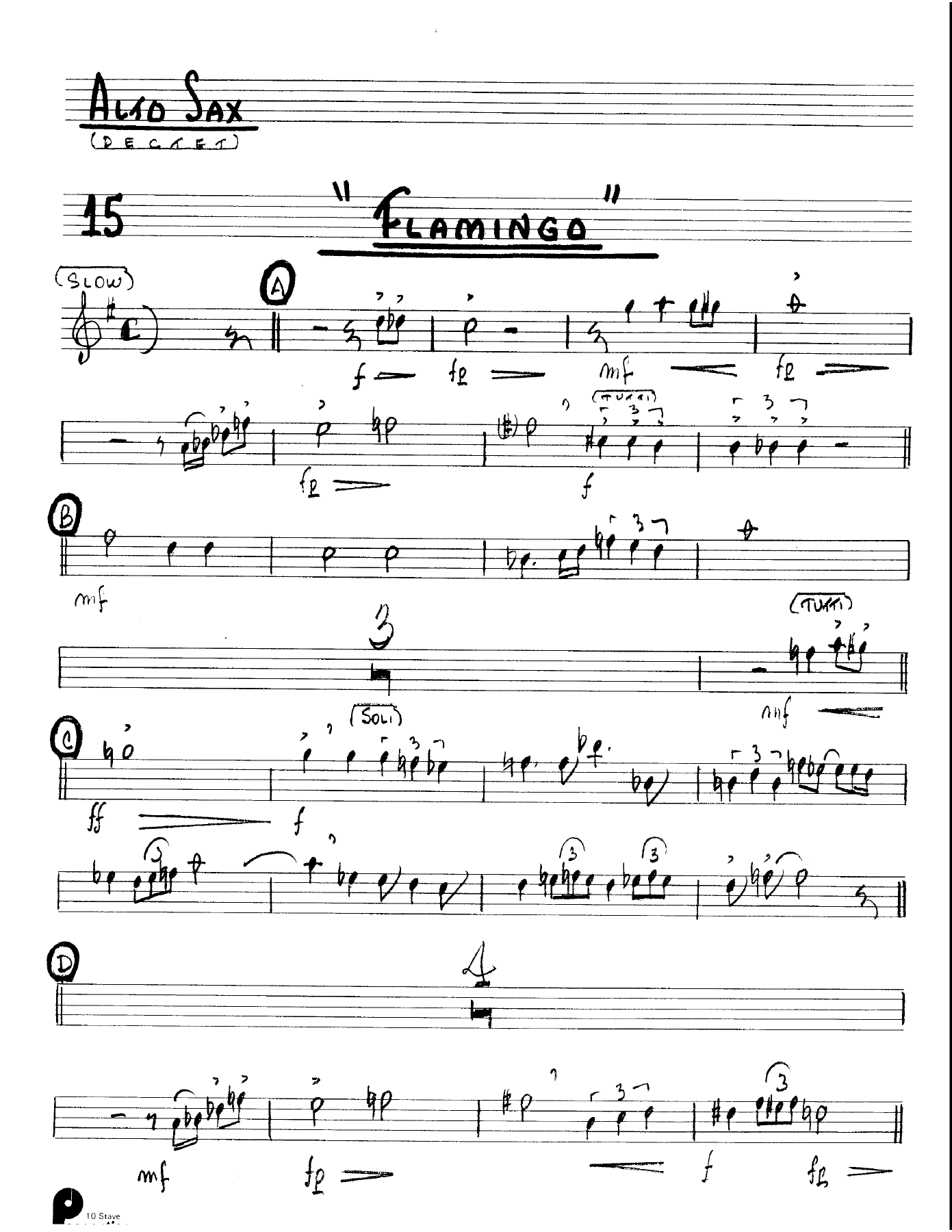
Flamingo (Kenton Dectet #015) sheet music preview

Flamingo (Kenton Dectet #015)

Composed by Ted Grouya

Arranged by Stan Kenton Dected 176

  • Ensemble: Small Ensemble
  • Style: Jazz Standard
  • Pages: 17
  • Instruments (9): Alto Sax, Tenor Sax, Baritone Sax, Trumpet 1, Trumpet 2, Trombone, Piano, Bass, Drums
  • Difficulty: easy
  • Content: Individual Parts
  • Format: PDF Download (Instant)
  • Price: $12.99

"Flamingo," a timeless jazz standard, emerged from the vibrant big band era, first captivating audiences with its debut recording by Herb Jeffries and the Duke Ellington Orchestra on December 28, 1940. Composed by Ted Grouya with lyrics by Edmund Anderson, this piece quickly ascended the charts in 1941, solidifying its place in the jazz canon. It represents a classic example of the sophisticated popular songs that were embraced and reinterpreted by jazz musicians, known for its elegant melody and compelling harmonic structure. The song's enduring appeal lies in its ability to evoke a sense of romantic longing and wistful beauty, making it a favorite for vocalists and instrumentalists alike across generations. This Stan Kenton Dectet 176 arrangement of "Flamingo" transforms the beloved standard into a medium-swing ballad, imbued with the distinctive harmonic richness and orchestral color characteristic of the Kenton sound, even within a small ensemble format. While the original often features a melancholic or dreamy quality, this rendition elevates its inherent elegance through carefully crafted voicings and a nuanced dynamic palette. The arrangement maintains a contemplative mood, allowing the lyrical melody to unfold with grace, while subtle harmonic extensions add a layer of sophisticated tension and release, typical of Kenton's "progressive jazz" approach. The chosen key facilitates a warm and resonant sound across the small ensemble, enhancing the ballad's expressive potential. Stan Kenton Dectet 176's treatment of "Flamingo" showcases a master arranger's ability to create a full, expansive sound with a reduced instrumentation. Expect intricate contrapuntal lines and lush, often dense, harmonies that are hallmarks of Kenton's style, even in a dectet setting. The arrangement likely features the melody initially carried by a lead instrument, perhaps a trumpet or saxophone, supported by richly voiced chords from the other horns. Soli sections will highlight the interplay between the instrumental voices, building on the melody with inventive counter-melodies and interwoven textures. While not a "shout chorus" in the traditional big band sense, there will be moments of collective ensemble power that provide dynamic contrast. Technical challenges include precise intonation within complex voicings and maintaining a consistent, flowing medium-swing feel throughout. The reward for performers lies in navigating these sophisticated harmonic landscapes and contributing to a cohesive, expressive interpretation of a jazz classic. This arrangement is ideally suited for advanced high school, college, community, and professional small jazz ensembles. Its demands for mature musicianship, including strong sight-reading skills, excellent intonation, and an understanding of advanced jazz harmony, make it a valuable educational tool and a rewarding performance piece. The smaller ensemble size fosters individual responsibility and allows each musician's contribution to shine, while the Kenton-esque voicings offer a unique exploration of jazz arranging for a chamber setting. Performing this chart provides an excellent opportunity to delve into the nuanced world of progressive jazz harmony and ensemble blending. Approaching this arrangement of "Flamingo" requires meticulous attention to blend, balance, and harmonic precision. The primary technical challenge lies in executing the dense, often extended voicings with impeccable intonation, particularly in slower tempos where imperfections are more apparent. Encourage musicians to listen across the ensemble, tuning to the lowest voice in each chord. The tempo should be a consistent, unhurried medium swing, approximately quarter note = 80-90 BPM, emphasizing a smooth, legato feel rather than a driving pulse. Articulations are crucial; observe subtle dynamic shifts and phrase markings to convey the ballad's inherent lyricism. While specific techniques like plunger mutes are not indicated for this piece, expressive vibrato and careful note releases will enhance the emotional depth. Rehearsal should focus on isolating challenging harmonic passages, using slow, sustained playing to ensure every note locks into place, then gradually increasing tempo while maintaining ensemble cohesion. Q: What instruments are included in this arrangement? A: This arrangement is for a small ensemble, specifically a dectet, which typically includes a rhythm section (piano, bass, drums) and seven horn players. The exact horn instrumentation (e.g., specific saxophones, trumpets, trombones) would be detailed on the score. Q: What is the difficulty level of "Flamingo (Kenton Dectet #015)"? A: This arrangement is considered advanced, suitable for college, community, or professional small jazz ensembles. It requires strong technical proficiency, advanced harmonic understanding, and mature ensemble playing. Q: What is the musical style and historical context of this piece? A: "Flamingo" is a classic jazz standard from the big band era, originally composed by Ted Grouya in 1940. This arrangement by Stan Kenton Dectet 176 places it within the "progressive jazz" style, characterized by sophisticated harmonies and innovative voicings. Q: What makes this Stan Kenton Dectet 176 arrangement unique? A: This arrangement stands out for its ability to create a rich, full sound with a smaller ensemble, utilizing Stan Kenton's signature harmonic language and intricate voicings. It offers a sophisticated, contemplative interpretation of the standard, emphasizing ensemble blend and harmonic depth. Q: What is the typical performance duration and tempo for this arrangement? A: As a medium-swing ballad, the performance duration will vary slightly based on interpretation and solo lengths, but typically falls within 4-6 minutes. The recommended tempo is a consistent medium swing, around quarter note = 80-90 BPM.

Questions and answers

What is included in the Flamingo (Kenton Dectet #015) PDF?
The verified current file contains individual parts across 17 pages.
How many instruments or parts are listed for Flamingo (Kenton Dectet #015)?
The verified instrumentation list contains 9 entries for this Small Ensemble arrangement.
Who is credited for Flamingo (Kenton Dectet #015)?
Composer: Ted Grouya. Arranger: Stan Kenton Dected 176.
What difficulty is listed for Flamingo (Kenton Dectet #015)?
The verified difficulty level is easy.
What style is listed for Flamingo (Kenton Dectet #015)?
The catalog lists the style as Jazz Standard.
Can I preview Flamingo (Kenton Dectet #015) before buying?
Yes. The product page provides a preview generated from the current PDF file.
How is Flamingo (Kenton Dectet #015) delivered?
After successful payment, the digital PDF is made available for download. The displayed price is $12.99.

Musicians Also Search For

Flamingo Stan Kenton Dected 176 PDFFlamingo Stan Kenton Dected 176 sheet musicFlamingo arranged by Stan Kenton Dected 176Stan Kenton Dected 176 small ensemble chartsStan Kenton Dected 176 jazz arrangements PDFFlamingo Ted Grouya sheet musicFlamingo Ted Grouya small ensemble arrangementsTed Grouya small ensemble chartsFlamingo small ensemble arrangementsFlamingo small ensemble PDF downloadFlamingo jazz sheet musicsmall ensemble sheet music downloadFlamingo individual parts downloadFlamingo sheet music PDFFlamingo Jazz Standard chartsJazz Standard small ensemble arrangementsbuy Flamingo sheet musicdownload Flamingo PDFFlamingo jazz chartsbest Stan Kenton Dected 176 small ensemble arrangementsTed Grouya arranged by Stan Kenton Dected 176Flamingo printable sheet musicsmall ensemble repertoire PDF

All arrangements by Stan Kenton Dected 176 All Ted Grouya sheet music