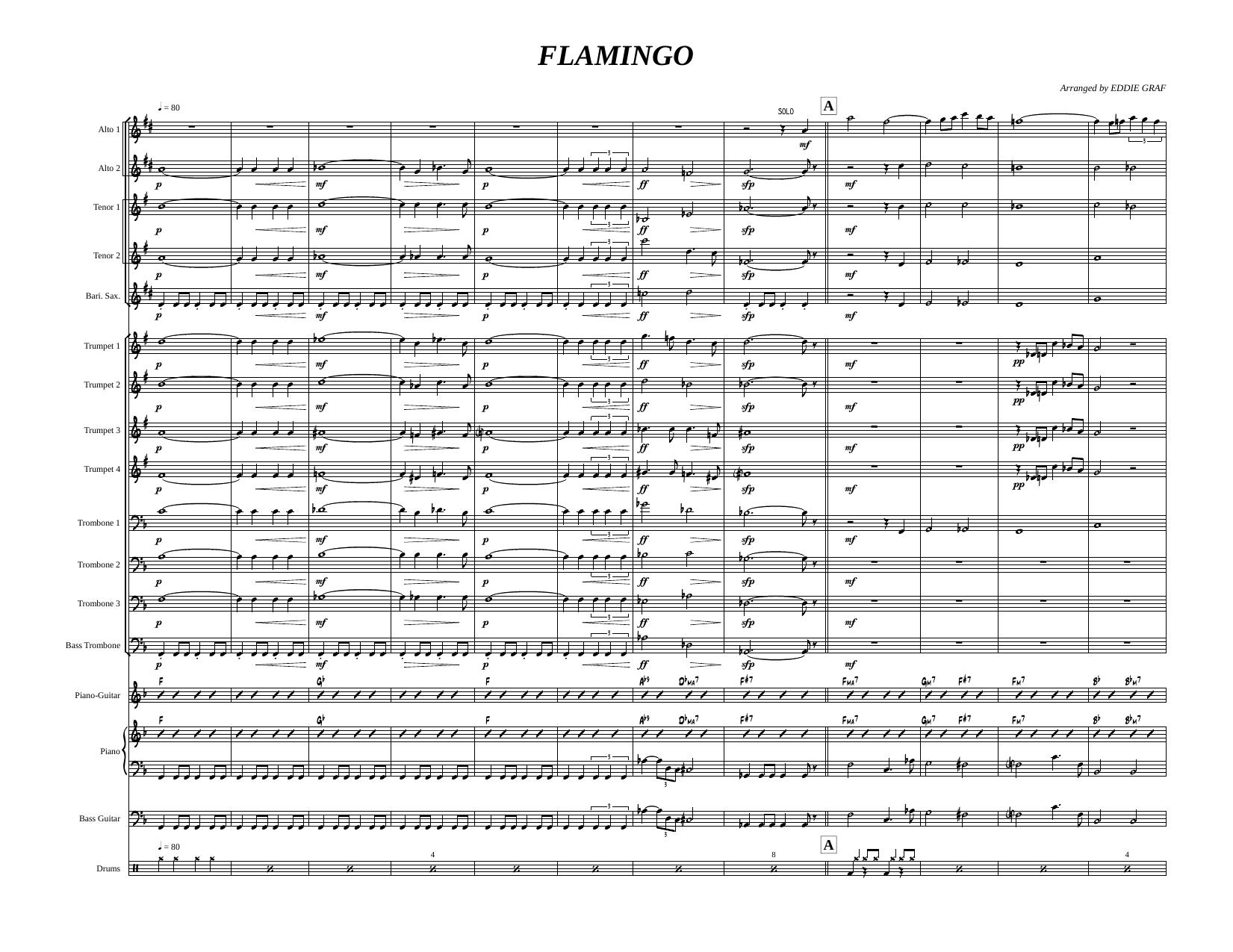
Flamingo (E.Gilbert)
Composed by Ted Grouya
Arranged by E.Gilbert
- Ensemble: Big Band
- Style: Jazz Standard
- Pages: 30
- Instruments (18): Alto Saxophone 1, Alto Saxophone 2, Tenor Saxophone 1, Tenor Saxophone 2, Baritone Saxophone, Trumpet 1, Trumpet 2, Trumpet 3, Trumpet 4, Trombone 1, Trombone 2, Trombone 3, Bass Trombone, Piano-Guitar, Piano, Guitar, Bass Guitar, Drums
- Difficulty: medium
- Content: Individual Parts
- Format: PDF Download (Instant)
- Price: $24.99
"Flamingo," originally composed by Ted Grouya, stands as a quintessential jazz standard, first gaining widespread popularity in the late 1930s and early 1940s. Its melodic elegance and harmonic sophistication quickly cemented its place in the repertoire of countless jazz luminaries, perhaps most notably through Duke Ellington's iconic 1940 recording featuring Herb Jeffries' smooth vocal delivery. The piece embodies the lush, romantic aesthetic of the Swing Era, characterized by its flowing lines and rich harmonic movement, often serving as a vehicle for expressive improvisation. Its enduring appeal lies in its timeless melody and the inherent flexibility it offers to arrangers and performers, allowing for diverse interpretations while retaining its core identity. This arrangement by E.Gilbert masterfully captures the essence of this classic, presenting it in a fresh yet respectful big band setting. E.Gilbert’s treatment of "Flamingo" unfolds as a medium-slow swing ballad, set comfortably in the key of F major. The arrangement immediately establishes a sophisticated mood, evoking a sense of nostalgic romance and refined melancholy. Gilbert’s signature approach to big band writing is evident throughout, characterized by meticulously crafted voicings that highlight the rich textures of the full ensemble. Expect lush saxophone soli sections that weave intricate melodic counterpoints, supported by warm brass pads. The overall energy is one of controlled passion, building gracefully from a tender opening to moments of soaring ensemble power, before returning to a reflective close. This arrangement showcases Gilbert's ability to blend traditional big band sounds with contemporary harmonic sensibilities, ensuring both classic appeal and modern relevance. The arrangement features the melody primarily in the alto saxophone, offering a lyrical and expressive showcase for the lead voice. A dedicated solo section is provided for tenor saxophone, allowing for creative improvisation over the standard’s well-loved changes. Gilbert’s arrangement introduces subtle harmonic reharmonizations that add depth and color without straying from the original's melodic integrity. The ensemble writing includes dynamic shout choruses that build intensity through layered brass figures and driving saxophone lines, culminating in powerful full-band statements. Technical challenges include precise articulation in the saxophone soli, controlled brass dynamics, and maintaining a consistent, flowing medium-slow swing feel throughout. The reward for performers lies in the sheer beauty of the ensemble sound and the opportunity to convey profound emotion through a truly classic jazz piece. This arrangement is ideally suited for advanced high school, college, community, and professional jazz ensembles. Its sophisticated voicings and nuanced dynamics demand a mature understanding of ensemble balance and phrasing, making it an excellent vehicle for developing musicality and expressive performance. While the solo section offers a challenge for an improviser, the well-notated ensemble parts are accessible enough for dedicated college and community bands to achieve a polished, professional sound. The arrangement's balance of melodic beauty, harmonic richness, and rhythmic integrity makes it a standout addition to any big band's repertoire, providing both an enjoyable performance experience and a captivating listening experience. "Flamingo" should be approached as a medium-slow swing ballad, with a consistent, flowing quarter-note feel at approximately quarter note = 80-88 bpm. The primary technical challenges involve achieving precise balance and blend within the saxophone soli sections, ensuring that the intricate inner voices are clear yet integrated. Brass players should focus on controlled dynamics, particularly in sustained chords, avoiding harsh attacks and maintaining a warm, resonant tone. Pay close attention to articulation markings; legato lines should be smooth and connected, while staccato figures require crispness without being overly aggressive. The tenor saxophone solo should be encouraged to be lyrical and expressive, utilizing the rich harmonic landscape. Rehearsal time should be dedicated to shaping the dynamic arc of the piece, particularly the gradual build into the shout chorus and the subsequent return to a more subdued texture, ensuring a cohesive and emotionally resonant performance. Q: What instruments and parts are included in this arrangement? A: This big band arrangement includes parts for Alto Saxophone 1, Alto Saxophone 2, Tenor Saxophone 1, Tenor Saxophone 2, Baritone Saxophone, Trumpet 1, Trumpet 2, Trumpet 3, Trumpet 4, Trombone 1, Trombone 2, Trombone 3, Bass Trombone, Piano, Bass, Drums, and Guitar, totaling 17 instruments, along with a full conductor score. Q: What is the difficulty level of this arrangement? A: This arrangement is rated as advanced high school, college, community, or professional level, requiring a mature understanding of ensemble playing, dynamics, and articulation to achieve a polished and expressive performance. Q: What is the musical style and historical context of "Flamingo"? A: "Flamingo" is a classic jazz standard from the Swing Era, originally composed by Ted Grouya, known for its romantic melody and lush harmonies, and famously recorded by artists like Duke Ellington in the early 1940s. Q: What makes E.Gilbert's arrangement of "Flamingo" unique? A: E.Gilbert's arrangement is distinguished by its sophisticated voicings, subtle harmonic reharmonizations, lyrical alto saxophone lead, and a well-crafted medium-slow swing ballad feel, showcasing a blend of traditional big band sounds with contemporary sensibilities. Q: What is the typical performance duration and recommended tempo for this piece? A: The typical performance duration for this arrangement is approximately 4-5 minutes, and it is intended to be performed as a medium-slow swing ballad at a tempo of quarter note = 80-88 bpm.
Questions and answers
- What is included in the Flamingo (E.Gilbert) PDF?
- The verified current file contains a conductor score and individual parts across 30 pages.
- How many instruments or parts are listed for Flamingo (E.Gilbert)?
- The verified instrumentation list contains 18 entries for this Big Band arrangement.
- Who is credited for Flamingo (E.Gilbert)?
- Composer: Ted Grouya. Arranger: E.Gilbert.
- What difficulty is listed for Flamingo (E.Gilbert)?
- The verified difficulty level is medium.
- What style is listed for Flamingo (E.Gilbert)?
- The catalog lists the style as Jazz Standard.
- Can I preview Flamingo (E.Gilbert) before buying?
- Yes. The product page provides a preview generated from the current PDF file.
- How is Flamingo (E.Gilbert) delivered?
- After successful payment, the digital PDF is made available for download. The displayed price is $24.99.
Musicians Also Search For
Flamingo E.Gilbert PDF • Flamingo E.Gilbert sheet music • Flamingo arranged by E.Gilbert • E.Gilbert big band charts • E.Gilbert jazz arrangements PDF • Flamingo Ted Grouya sheet music • Flamingo Ted Grouya big band arrangements • Ted Grouya big band charts • Flamingo big band arrangements • Flamingo big band PDF download • Flamingo jazz sheet music • big band sheet music download • Flamingo conductor score PDF • Flamingo individual parts download • Flamingo sheet music PDF • Flamingo Jazz Standard charts • Jazz Standard big band arrangements • buy Flamingo sheet music • download Flamingo PDF • Flamingo jazz charts • best E.Gilbert big band arrangements • Ted Grouya arranged by E.Gilbert • Flamingo printable sheet music • big band repertoire PDF