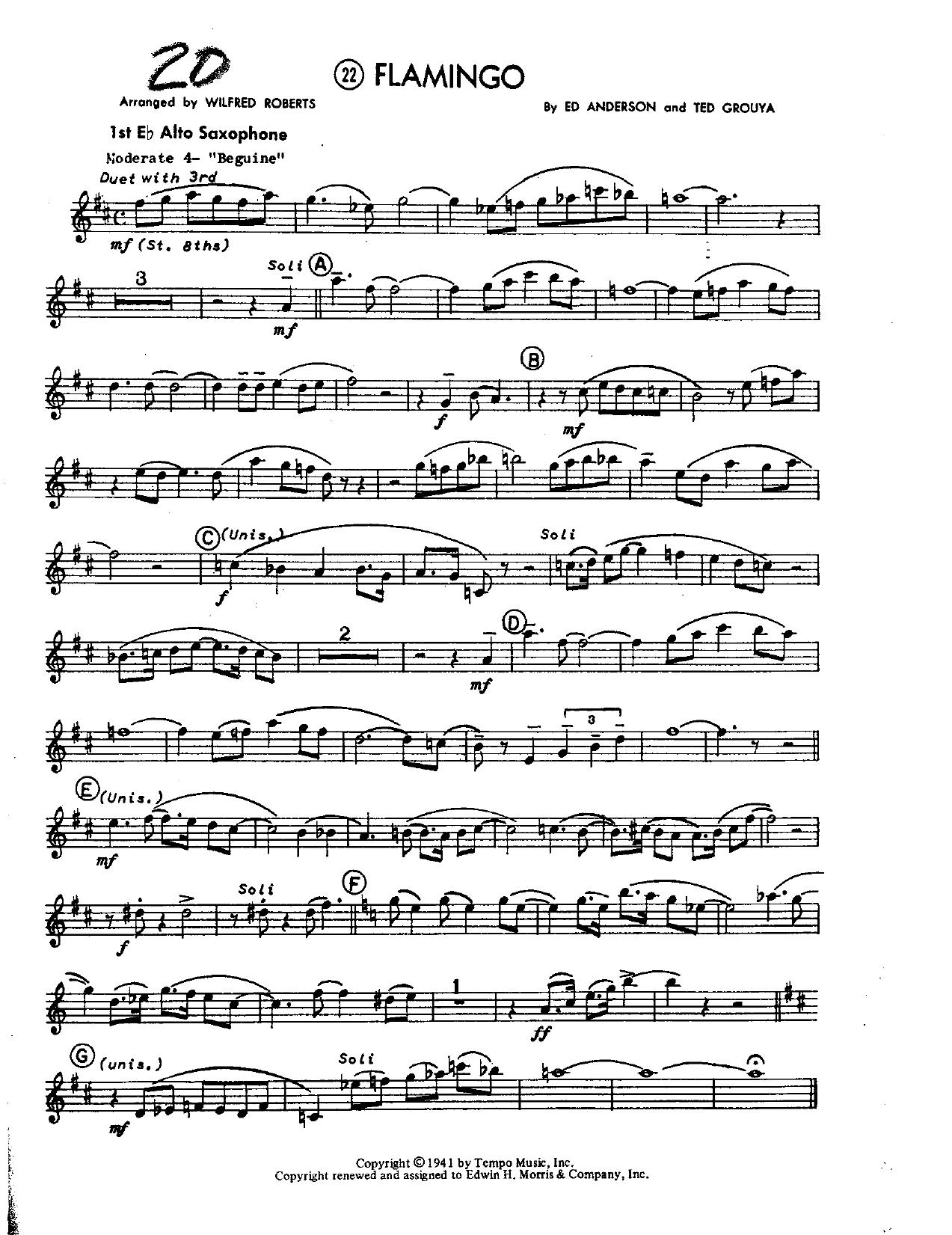
Flamingo (W.Roberts) sheet music preview

Flamingo (W.Roberts)

Composed by Ted Grouya

Arranged by W.Roberts

  • Ensemble: Big Band
  • Style: Jazz Standard
  • Pages: 19
  • Instruments (17): 1st Eb Alto Saxophone, 2nd Bb Tenor Saxophone, 3rd Eb Alto Saxophone, 4th Bb Tenor Saxophone, Eb Baritone Saxophone, 1st Bb Trumpet, 2nd Bb Trumpet, 3rd Bb Trumpet, 4th Bb Trumpet, 1st Trombone, 2nd Trombone, 3rd Trombone, 4th Trombone, Drums, Guitar, String Bass, Piano
  • Difficulty: easy
  • Content: Individual Parts
  • Format: PDF Download (Instant)
  • Price: $24.99

"Flamingo," originally composed by Ted Grouya with lyrics by Edmund Anderson in 1940, stands as a quintessential jazz standard, celebrated for its enduring melody and lush harmonic possibilities. First brought to prominence by Herb Jeffries and the Duke Ellington Orchestra with a recording on December 28, 1940, this piece quickly captivated audiences, even briefly charting in 1941. Its timeless appeal lies in its evocative mood, often interpreted as a romantic and dreamy ballad, allowing for profound emotional expression. Over the decades, "Flamingo" has been embraced by countless jazz luminaries, solidifying its place in the jazz canon and making it a staple for vocalists and instrumentalists alike. This arrangement by W.Roberts presents "Flamingo" as a medium-slow swing ballad, set in the key of F major, maintaining the original's tender and expressive character while infusing it with a rich big band palette. The mood is one of sophisticated romance and gentle reflection, evoking a sense of nostalgic elegance. Roberts's approach to this classic is marked by his signature blend of traditional big band voicings with subtly modern harmonic extensions, creating a sound that is both familiar and fresh. Expect meticulously crafted soli sections that allow the saxophone and brass sections to shine with interwoven lines, contributing to the arrangement's full and resonant texture. The orchestration emphasizes clarity and balance, ensuring that each instrumental voice contributes to the overall emotional landscape without overpowering the delicate melody. W.Roberts's arrangement skillfully navigates the melodic contours of "Flamingo," initially featuring the lead alto saxophone carrying the primary melody with a warm, lyrical tone. This is soon joined by other saxophone voices, creating a rich and flowing ensemble sound. The arrangement offers ample opportunity for featured solos, typically allocated to the tenor saxophone and trumpet, allowing soloists to explore the piece's harmonic depth with expressive improvisation. Technical challenges include precise intonation within the ballad tempo, especially in the sustained brass chords, and achieving a cohesive, flowing legato in the saxophone soli. The rewarding aspect of performing this chart lies in its capacity to transport both musicians and audience through its beautiful melodic lines and sophisticated harmonies, culminating in a gentle, yet powerful, shout chorus that builds to a heartfelt conclusion before a serene coda. This arrangement is ideally suited for college-level jazz ensembles, advanced community big bands, and professional groups. Its demands for nuanced phrasing, controlled dynamics, and expressive improvisation make it an excellent vehicle for developing musical maturity and ensemble cohesion. The intricate voicings and the opportunities for featured soloists provide a comprehensive educational experience, while its inherent beauty and established place in jazz history ensure it will be a crowd-pleaser. Bands capable of maintaining a consistent, relaxed swing feel at a slower tempo and executing precise ensemble playing will find this chart particularly rewarding. Conductors should establish a relaxed, medium-slow swing tempo (around quarter note = 76-84 BPM) to allow for expressive phrasing and rich harmonic resonance. Emphasize a smooth, legato articulation throughout, particularly in the saxophone and trombone sections, to maintain the ballad's flowing character. Trumpet players should focus on warm, sustained tones, avoiding any harshness, especially in the upper register. The lead alto saxophone should articulate the initial melody with a clear, lyrical quality, setting the emotional tone for the entire piece. Rehearsal time should be dedicated to balancing the intricate voicings in the soli sections, ensuring that inner voices are heard without obscuring the lead lines. Pay close attention to dynamic swells and decays, using them to shape the melodic phrases and enhance the overall mood. Solos should be encouraged to be melodic and expressive, focusing on storytelling rather than purely technical display. Q: What instruments and parts are included in this arrangement? A: This big band arrangement includes parts for 17 instruments: Alto Saxophone 1, Tenor Saxophone 2, Alto Saxophone 3, Tenor Saxophone 4, Baritone Saxophone, Trumpets 1-4, Trombones 1-4, Piano, Guitar, Bass, and Drums. Q: What is the difficulty level of this arrangement? A: This arrangement is rated as advanced intermediate to advanced, suitable for college-level jazz ensembles, advanced community bands, and professional groups due to its nuanced phrasing, intricate voicings, and expressive demands. Q: What is the musical style and historical context of "Flamingo"? A: "Flamingo" is a classic jazz standard composed by Ted Grouya in 1940, embodying the romantic ballad style of the Swing Era. It was famously introduced by Herb Jeffries and the Duke Ellington Orchestra. Q: What makes W.Roberts's arrangement of "Flamingo" unique? A: W.Roberts's arrangement combines traditional big band voicings with subtly modern harmonic extensions, featuring meticulously crafted soli sections, opportunities for expressive solos, and a focus on maintaining the piece's original romantic and dreamy character within a medium-slow swing ballad setting. Q: What is the approximate performance duration and tempo of this arrangement? A: The approximate performance duration for this arrangement is between 4 to 5 minutes, played at a medium-slow swing tempo, typically around 76-84 beats per minute.

Questions and answers

What is included in the Flamingo (W.Roberts) PDF?
The verified current file contains individual parts across 19 pages.
How many instruments or parts are listed for Flamingo (W.Roberts)?
The verified instrumentation list contains 17 entries for this Big Band arrangement.
Who is credited for Flamingo (W.Roberts)?
Composer: Ted Grouya. Arranger: W.Roberts.
What difficulty is listed for Flamingo (W.Roberts)?
The verified difficulty level is easy.
What style is listed for Flamingo (W.Roberts)?
The catalog lists the style as Jazz Standard.
Can I preview Flamingo (W.Roberts) before buying?
Yes. The product page provides a preview generated from the current PDF file.
How is Flamingo (W.Roberts) delivered?
After successful payment, the digital PDF is made available for download. The displayed price is $24.99.

Musicians Also Search For

Flamingo W.Roberts PDFFlamingo W.Roberts sheet musicFlamingo arranged by W.RobertsW.Roberts big band chartsW.Roberts jazz arrangements PDFFlamingo Ted Grouya sheet musicFlamingo Ted Grouya big band arrangementsTed Grouya big band chartsFlamingo big band arrangementsFlamingo big band PDF downloadFlamingo jazz sheet musicbig band sheet music downloadFlamingo individual parts downloadFlamingo sheet music PDFFlamingo Jazz Standard chartsJazz Standard big band arrangementsbuy Flamingo sheet musicdownload Flamingo PDFFlamingo jazz chartsbest W.Roberts big band arrangementsTed Grouya arranged by W.RobertsFlamingo printable sheet musicbig band repertoire PDF

All arrangements by W.Roberts All Ted Grouya sheet music