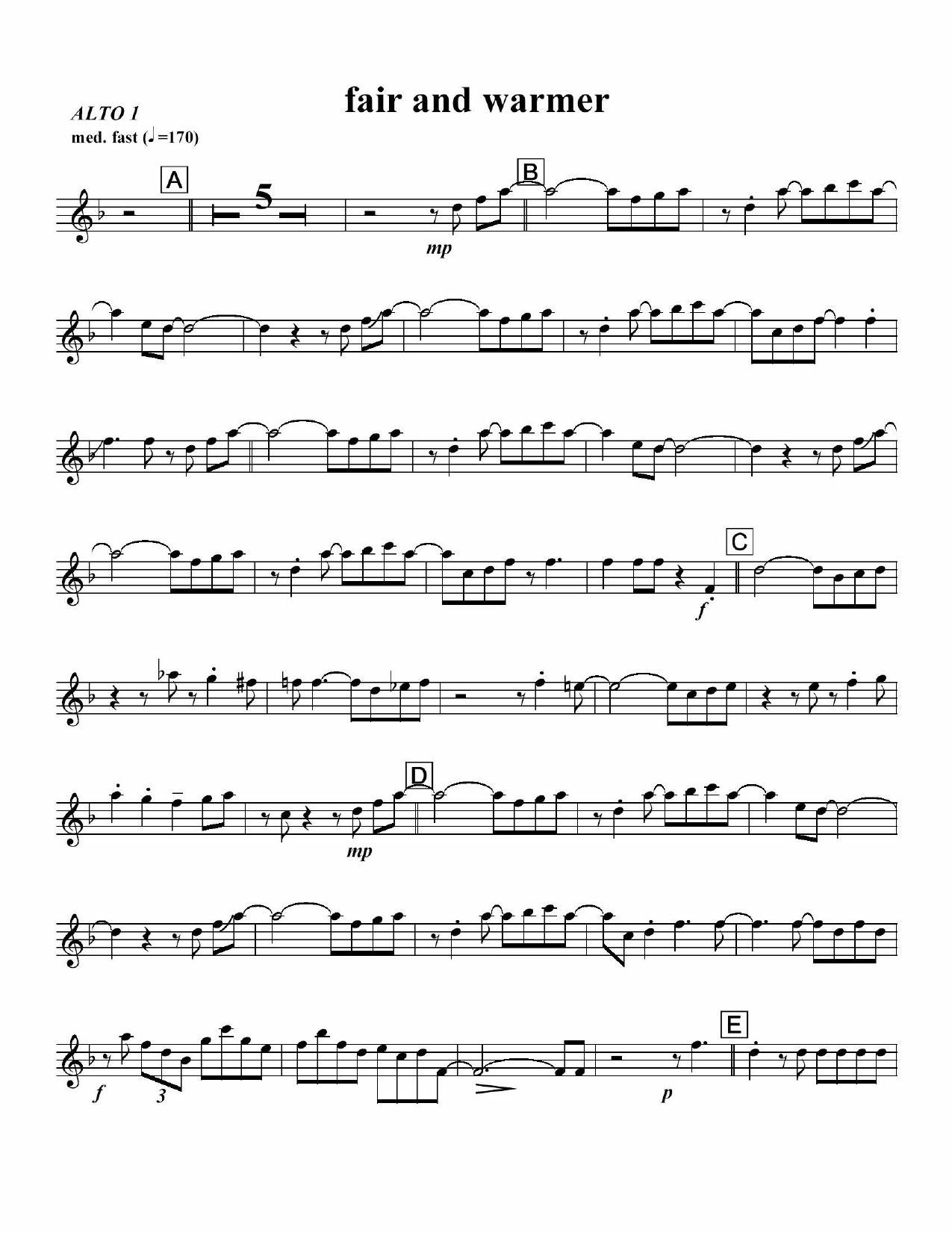
Fair And Warmer (E.Wilkins-H.James)
Composed by Ernie Wilkins
Arranged by Count Basie
- Ensemble: Big Band
- Pages: 40
- Instruments (16): Alto 1, Alto 2, Tenor 1, Tenor 2, Baritone Saxophone, Trumpet 1, Trumpet 2, Trumpet 3, Trumpet 4, Trombone 1, Trombone 2, Trombone 3, Trombone 4, Piano, Bass, Drums
- Difficulty: medium
- Content: Individual Parts
- Format: PDF Download (Instant)
- Price: $24.99
Ernie Wilkins penned "Fair and Warmer" during a golden era of collaboration with the legendary Count Basie Orchestra, solidifying a partnership that helped define the modern big band sound of the 1950s. Originally brought to prominence through high-profile recordings associated with Harry James and the Basie organization, this composition captures the sophisticated, driving momentum of post-war jazz. It stands as a brilliant exemplar of the Kansas City swing tradition meeting the polished, high-octane arranging sensibilities of the modern bebop era. The piece reflects the dynamic compositional voice of Wilkins, whose pen contributed heavily to the revitalized "New Testament" Basie band style—characterized by precision, relentless drive, and masterful economy of space. Propelled by an infectious, medium-up swing feel in 4/4 time, "Fair and Warmer" exudes an atmosphere of confident urban sophistication and restless energy. The harmonic landscape is anchored in crisp blues-infused changes and tight modal shifts that evoke the smoky ambiance of mid-century jazz clubs. The mood shifts effortlessly between breezy, conversational head arrangements and thunderous ensemble outbursts. Listeners are immediately drawn into its cinematic momentum, where every rhythmic hit and dynamic nuance feels like a calculated motion picture frame, evoking both the effortless cool of the cool jazz movement and the raw, foot-stomping urgency of traditional big band swing. Count Basie’s overarching approach to this arrangement emphasizes space, impeccable time, and the devastating impact of well-placed ensemble solis. Rather than cluttering the texture, the orchestration utilizes sparse, punchy brass voicings that leave plenty of air for the rhythm section to push the beat. The saxophone section functions as a unified vocal choir, executing intricate bebop-infused lines with a lightness of touch that belies their technical demand. The chart builds meticulously toward a classic, high-voltage shout chorus that showcases the signature Basie crescendo—starting from a whisper and expanding into a room-filling roar without ever rushing the tempo or sacrificing articulation clarity. Navigating the chart requires precision, particularly from the horn sections who share responsibilities in carrying the brisk, interlocking melodic motifs. Featured solo spaces allow standout improvisers in the saxophone and brass sections to stretch out over changes that favor blues vocabulary and modal exploration. Technical challenges center around maintaining a relaxed, driving swing eighth-note feel at faster tempos, ensuring that syncopated ensemble figures lock tightly with the rhythm section. Performers will find immense satisfaction in the economic writing, where every note serves the collective groove, and conductors will relish shaping the subtle dynamic contrasts that make this arrangement a masterclass in big band phrasing. Advanced high school ensembles, collegiate jazz orchestras, and professional big bands will find "Fair and Warmer" to be an ideal repertoire choice. Its demands on stamina, articulation uniformity, and stylistic awareness make it a premier educational tool for teaching section blend and swing subdivision, while its historical weight and sheer driving energy guarantee an unforgettable experience for audiences in professional concert settings. Unlocking the true potential of "Fair and Warmer" begins with establishing an unwavering, relaxed medium-up swing tempo. The primary technical hurdle lies in the precise execution of syncopated ensemble figures that fall on the upbeat; musicians must avoid rushing these accents. Conducers should rehearse the rhythm section first, ensuring the drummer locks in a crisp, feather-light ride cymbal pattern with a two-and-four hi-hat choke that drives the band without dragging. Horn players must pay close attention to dynamic markings, contrasting the lightweight, detached articulation of the head statements with the rich, sustained warmth required during background figures. Use natural tongue-stop techniques rather than harsh accents to define short notes. Section leaders should ensure uniform air support across all registers, particularly during the soaring shout chorus where brass high notes must blend rather than pierce. Encourage soloists to anchor their improvisations in the blues tradition while exploring the clever harmonic turnarounds embedded in Wilkins's chord progressions. Q: What instruments and parts are included in this arrangement? A: This arrangement is scored for an 8-instrument ensemble format featuring Alto Saxophone, Tenor Saxophone, Baritone Saxophone, Trumpet, and Trombone parts, alongside a complete rhythm section framework across its 40 pages of manuscript. Q: What is the difficulty level of this chart? A: This piece is best suited for advanced high school, collegiate, and professional jazz ensembles due to its demand for tight section blend, endurance at a brisk swing tempo, and sophisticated bebop phrasing. Q: What is the stylistic and historical context of "Fair and Warmer"? A: Composed by Ernie Wilkins and famously associated with Harry James and the Count Basie orbit, this piece represents the vibrant 1950s "New Testament" big band era, merging traditional Kansas City swing with modern post-war jazz complexity. Q: What makes this specific Count Basie arrangement unique? A: It features Count Basie’s signature economic approach to space and time, contrasted with intricate saxophone soli lines and a meticulously structured dynamic crescendo leading into a powerful shout chorus. Q: What is the performance duration and tempo feel of the piece? A: The arrangement is designed around a driving medium-up swing tempo in 4/4 time, typically clocking in at an energetic performance duration of approximately 3 to 4 minutes depending on solo rotations.
Questions and answers
- What is included in the Fair And Warmer (E.Wilkins-H.James) PDF?
- The verified current file contains individual parts across 40 pages.
- How many instruments or parts are listed for Fair And Warmer (E.Wilkins-H.James)?
- The verified instrumentation list contains 16 entries for this Big Band arrangement.
- Who is credited for Fair And Warmer (E.Wilkins-H.James)?
- Composer: Ernie Wilkins. Arranger: Count Basie.
- What difficulty is listed for Fair And Warmer (E.Wilkins-H.James)?
- The verified difficulty level is medium.
- Can I preview Fair And Warmer (E.Wilkins-H.James) before buying?
- Yes. The product page provides a preview generated from the current PDF file.
- How is Fair And Warmer (E.Wilkins-H.James) delivered?
- After successful payment, the digital PDF is made available for download. The displayed price is $24.99.
Musicians Also Search For
Fair And Warmer Count Basie PDF • Fair And Warmer Count Basie sheet music • Fair And Warmer arranged by Count Basie • Count Basie big band charts • Count Basie jazz arrangements PDF • Fair And Warmer Ernie Wilkins sheet music • Fair And Warmer Ernie Wilkins big band arrangements • Ernie Wilkins big band charts • Fair And Warmer big band arrangements • Fair And Warmer big band PDF download • Fair And Warmer jazz sheet music • big band sheet music download • Fair And Warmer individual parts download • Fair And Warmer sheet music PDF • buy Fair And Warmer sheet music • download Fair And Warmer PDF • Fair And Warmer jazz charts • best Count Basie big band arrangements • Ernie Wilkins arranged by Count Basie • Fair And Warmer printable sheet music • big band repertoire PDF