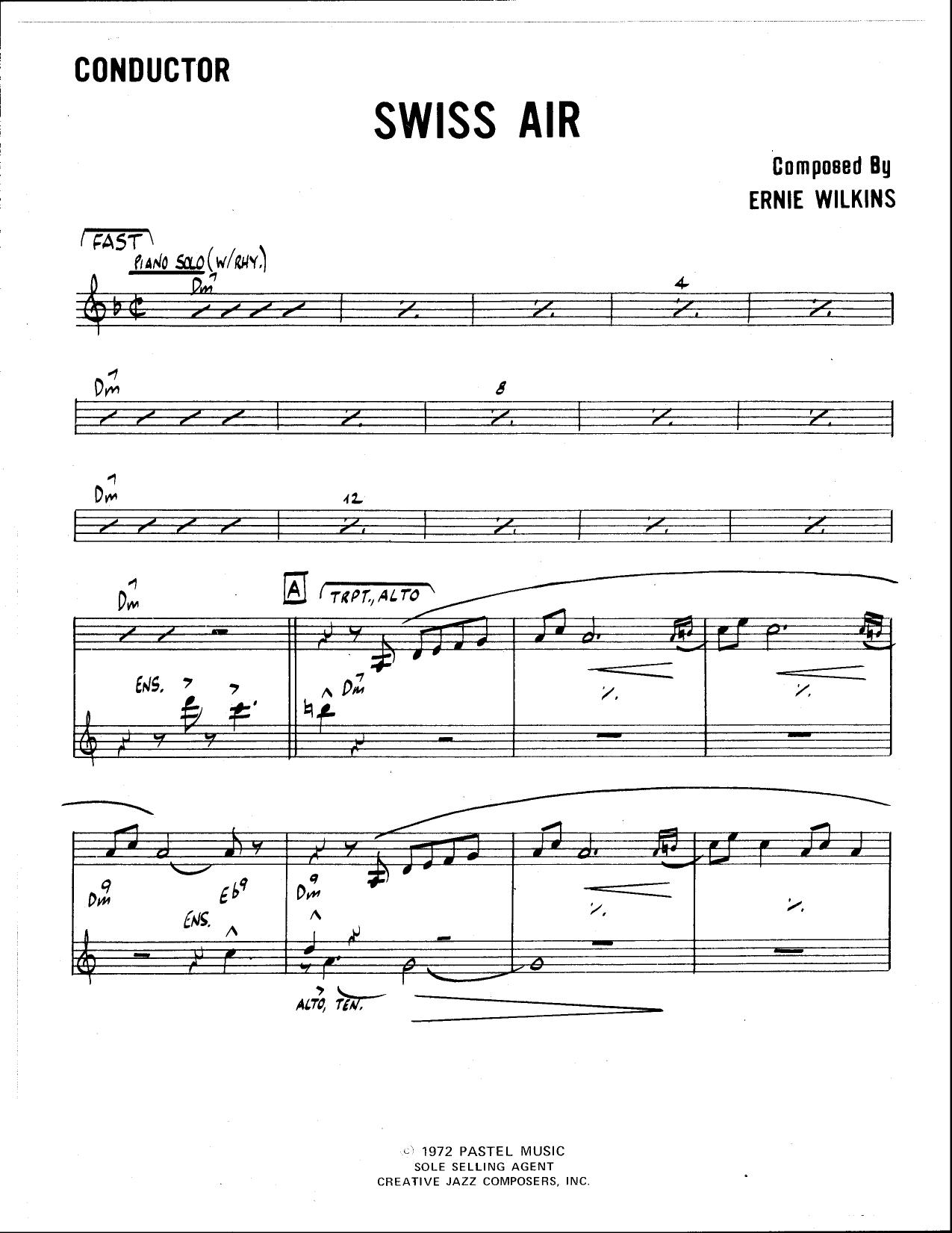
Swiss Air (E.Wilkins)
Composed by Ernie Wilkins
Arranged by Ernie Wilkins
- Ensemble: Big Band
- Pages: 41
- Instruments (19): Conductor, 1st Alto Sax, 2nd Alto Sax, 1st Tenor Sax, 2nd Tenor Sax, 5th Baritone Sax, Solo Trumpet, 1st Trumpet, 2nd Trumpet, 3rd Trumpet, 4th Trumpet, 1st Trombone, 2nd Trombone, 3rd Trombone, 4th Trombone, Bass, Drums, Piano, Guitar
- Difficulty: medium
- Content: Individual Parts
- Format: PDF Download (Instant)
- Price: $24.99
Ernie Wilkins’ brilliant composition and arrangement of "Swiss Air" stands as a quintessential masterpiece of mid-century big band jazz, capturing the dynamic energy, sophistication, and relentless swing of the post-bebop era. Originally written and recorded during Wilkins' prolific writing tenure—a period where his arrangements defined the powerhouse sound of the Count Basie Orchestra and various elite European and American jazz ensembles—this chart showcases his uncanny ability to balance intricate, harmonically rich counterpoint with an infectious, blues-drenched groove. The piece reflects the transatlantic exchange of jazz ideas in the 1950s and 60s, blending American swing foundations with modern, urbane tonal colors that elevate it far beyond a standard stock arrangement. Driven by an assertive, medium-up swing tempo in 4/4 time, "Swiss Air" opens with a high-octane brass figure that immediately establishes an atmosphere of urgency and sophistication. The mood is triumphant and urbane, evoking the kinetic energy of international travel and metropolitan nightlife. Wilkins builds the arrangement on a foundation of sharp dynamic contrasts, moving seamlessly from roaring, full-ensemble shout choruses to sparse, rhythm-section-driven interludes that allow the underlying groove to breathe. The harmonic language employs extended chords, clever chromatic leading tones, and punchy syncopated figures that demand absolute precision and rhythmic unity from the entire ensemble. As an arranger, Ernie Wilkins was a master of color and pacing, and "Swiss Air" exhibits his signature structural brilliance. The arrangement features tightly knit sax-soli passages that showcase the blend of the reed section, contrasted sharply with aggressive, brass-led counterlines. Wilkins avoids predictable phrase lengths, frequently utilizing asymmetric phrasing and unexpected resolution points that keep both the performers and the audience on edge. The transition into the primary solo sections provides an open canvas for improvisation, supported by clever, harmonized background figures from the ensemble that build in intensity organically, leading straight into a blistering, high-register shout chorus designed to bring a house down. Tailored for advanced college ensembles, professional repertory bands, and ambitious high school jazz orchestras possessing strong section leaders, "Swiss Air" is a rewarding tour de force that demands technical facility, endurance, and deep stylistic awareness. The primary challenges lie in maintaining a razor-sharp, lightweight swing feel at faster tempos and executing the intricate articulation markings uniformly across the sections. The reward for mastering this 41-page, 8-instrument chart is an authentic encounter with one of the most brilliant minds in big band history, offering an unforgettable concert or festival centerpiece that celebrates the pinnacle of swinging jazz orchestration. Conductors tackling "Swiss Air" must prioritize rhythmic crispness and stylistic uniformity, particularly in the short, accented eighth-note figures that define Ernie Wilkins’ writing style. The target tempo should be a bright medium-up swing (around quarter note = 208–216), ensuring the groove feels buoyant rather than rushed. Reeds should focus on achieving a seamless, homogenous blend during the soli sections, using light tongue-attacks and careful attention to the dynamic peaks of each phrase. Brass players need strong endurance and immaculate control over dynamic shading; avoid overblowing during ensemble passages to allow the intricate inner voicings to speak clearly. The rhythm section serves as the engine: the drummer should maintain a driving, conversational ride cymbal pattern with crisp hi-hat chicks on beats two and four, while the bassist keeps a steady, acoustic-style walking bass line free of excessive ornamentation. Rehearsal should begin slowly, isolating the syncopated ensemble hits to lock in the time before attempting the chart at performance velocity. Q: What instruments and parts are included in this arrangement? A: This arrangement features an 8-instrument core big band instrumentation, specifically scored for Alto Saxophone, Tenor Saxophone, Baritone Saxophone, Trumpet, Trombone, and accompanying rhythm section parts across a comprehensive 41-page manuscript. Q: What is the difficulty level of "Swiss Air"? A: This chart is graded as advanced, making it best suited for collegiate ensembles, professional big bands, and elite high school jazz orchestras with strong sight-readers and experienced section leaders. Q: What is the style and historical context of this piece? A: Composed and arranged by jazz luminary Ernie Wilkins, "Swiss Air" represents the sophisticated, hard-swinging aesthetic of the post-bebop and big band revival eras of the mid-20th century. Q: What makes this Ernie Wilkins arrangement unique? A: It is distinguished by Wilkins' signature writing style, which combines dense, modern harmonic voicings, intricate sax-soli sections, and dynamic shout choruses that seamlessly bridge classic swing with modern jazz sensibilities. Q: What is the approximate performance duration and tempo guideline? A: While performance time can vary based on the number and length of improvised solos, the piece is designed to run approximately 4 to 5 minutes at a bright, driving medium-up swing tempo.
Questions and answers
- What is included in the Swiss Air (E.Wilkins) PDF?
- The verified current file contains a conductor score and individual parts across 41 pages.
- How many instruments or parts are listed for Swiss Air (E.Wilkins)?
- The verified instrumentation list contains 19 entries for this Big Band arrangement.
- Who is credited for Swiss Air (E.Wilkins)?
- Composer: Ernie Wilkins. Arranger: Ernie Wilkins.
- What difficulty is listed for Swiss Air (E.Wilkins)?
- The verified difficulty level is medium.
- Can I preview Swiss Air (E.Wilkins) before buying?
- Yes. The product page provides a preview generated from the current PDF file.
- How is Swiss Air (E.Wilkins) delivered?
- After successful payment, the digital PDF is made available for download. The displayed price is $24.99.
Musicians Also Search For
Swiss Air Ernie Wilkins PDF • Swiss Air Ernie Wilkins sheet music • Swiss Air arranged by Ernie Wilkins • Ernie Wilkins big band charts • Ernie Wilkins jazz arrangements PDF • Swiss Air Ernie Wilkins big band arrangements • Swiss Air big band arrangements • Swiss Air big band PDF download • Swiss Air jazz sheet music • big band sheet music download • Swiss Air conductor score PDF • Swiss Air individual parts download • Swiss Air sheet music PDF • buy Swiss Air sheet music • download Swiss Air PDF • Swiss Air jazz charts • best Ernie Wilkins big band arrangements • Swiss Air printable sheet music • big band repertoire PDF