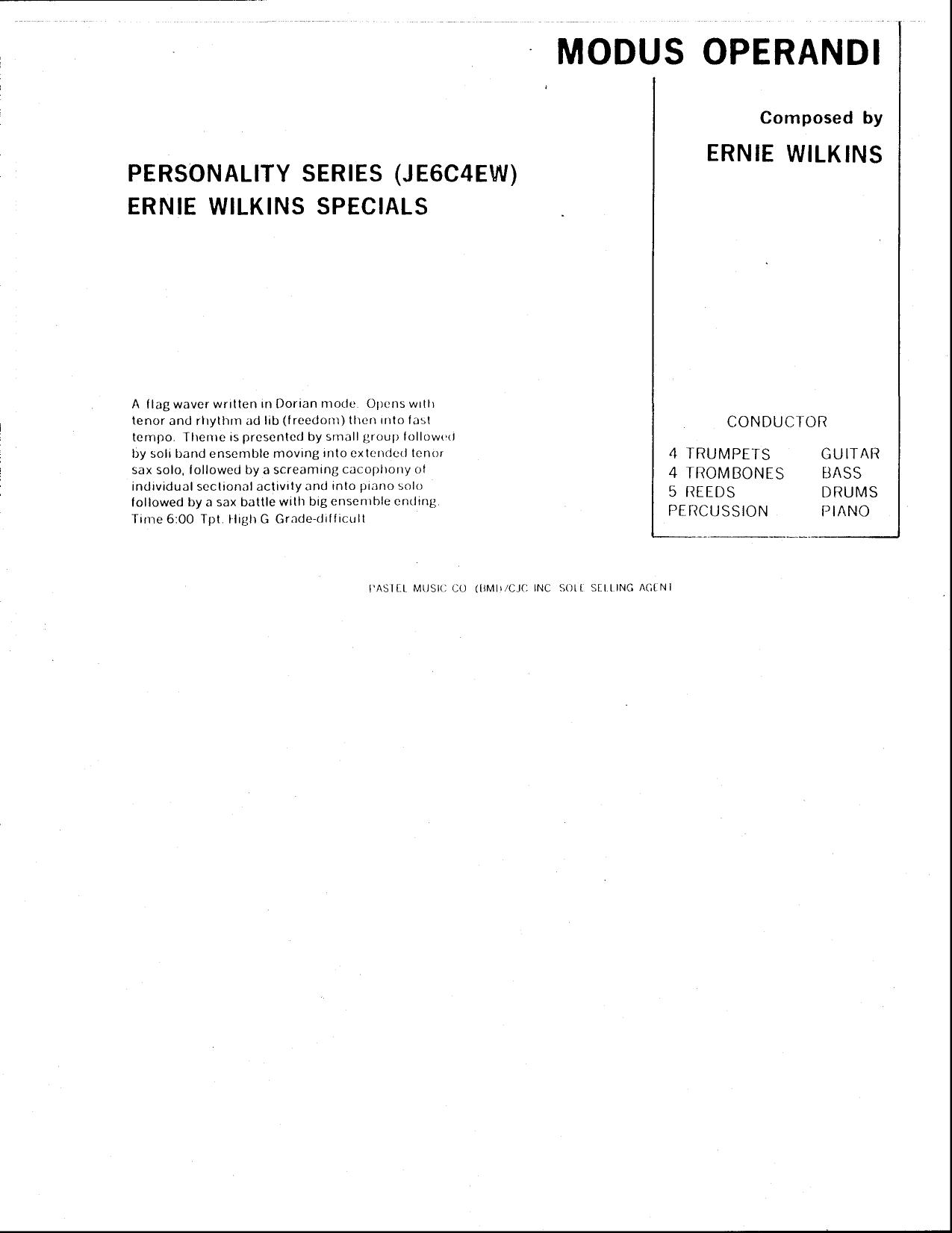
Modus Operandi (E.Wilkins) sheet music preview

Modus Operandi (E.Wilkins)

Composed by Ernie Wilkins

Arranged by Ernie Wilkins

  • Ensemble: Big Band
  • Pages: 97
  • Instruments (19): Conductor, 1st Alto Sax, 2nd Alto Sax, Solo Tenor Sax, 1st Tenor Sax, 2nd Tenor Sax, Baritone Sax, 1st Trumpet, 2nd Trumpet, 3rd Trumpet, 4th Trumpet, 1st Trombone, 2nd Trombone, 3rd Trombone, 4th Trombone, Bass, Drums, Piano, Guitar
  • Difficulty: advanced
  • Content: Individual Parts
  • Format: PDF Download (Instant)
  • Price: $24.99

Ernie Wilkins stands as one of the most formidable architects of the post-war big band sound, earning his legendary status through brilliant, muscular writing for the Count Basie Orchestra and his own international ensembles. "Modus Operandi" captures the quintessential mid-century modern jazz ethos, translating the raw, blues-soaked energy of Kansas City into sophisticated, harmonically rich arrangements tailored for advanced contemporary jazz orchestras. Composed and refined during an era when big bands had to evolve past the swing dance craze into concert jazz, this work reflects the hard-bop sensibilities and driving momentum that defined Wilkins’ career as both a saxophonist and a master orchestrator. Propelled by an infectious, driving medium-up swing tempo in 4/4, the piece crackles with an urbane, high-stakes cinematic tension. The harmonic landscape is built upon extended tertian structures, sharp chromatic passing chords, and sudden dynamic shifts that alternate between sultry, whispered saxophone backgrounds and roaring, brass-heavy proclamations. Wilkins constructs a mood that is simultaneously sophisticated and relentlessly swinging, evoking the smoky atmosphere of a 1950s Manhattan jazz club where precision and spontaneity collide. The emotional arc moves effortlessly from cool, calculated detachment during the head statements to unbridled, visceral excitement during the ensemble climaxes. Wilkins’ signature compositional fingerprint is stamped across the entire 97-page score, heavily featuring tight, harmonically dense sax solis and explosive shout choruses that test the mettle of every section. The arrangement relies on interlocking counterpoint between the brass and reeds rather than simple block-chord padding, giving every voice an independent, linear purpose. The melody is introduced with a swaggering confidence, shared dynamically across the horn sections before giving way to open solo spaces. Technical demands center on clean articulation, rapid-fire swing eighth-note subdivision, and absolute rhythmic synchronization across the ensemble, particularly during transitional modulations and syncopated punch figures. Advanced collegiate ensembles, professional repertory orchestras, and elite community big bands will find this chart an exhilarating centerpiece for a competitive festival program or a formal concert setting. The rewards of rehearsing "Modus Operandi" lie in its masterclass-level education in swing phrasing, dynamic balance, and stylistic authenticity. When executed with the requisite bite, flexibility, and drive, this chart delivers a powerhouse statement that honors the enduring legacy of one of jazz writing’s true titans. Conductors approaching "Modus Operandi" must prioritize razor-sharp articulation and an unwavering, driving macro-tempo. The swing feel must remain deeply anchored in the rhythm section, avoiding any tendency to rush during intense brass shout choruses. Pay meticulous attention to the dynamic contrast between the background figures and the primary melodic statements; the saxophones must maintain a translucent, floating quality beneath soloists while projecting with authority during solid ensemble solis. Brass players should utilize controlled, purposeful styling on accents and short notes—employing natural tongues rather than heavy dits to keep the rhythmic pocket buoyant. Rehearsal should begin at a reduced tempo to lock in the complex syncopated figures and chromatic line-intersections before pushing up to performance velocity. Ensure the rhythm section understands that the comping should be sparse and interactive, leaving ample breathing room for the forward momentum generated by Wilkins' meticulous horn voicings. Q: What instruments and parts are included in this arrangement? A: This arrangement is scored for an 8-instrument configuration featuring Alto Saxophone, Tenor Saxophone, Baritone Saxophone, Trumpet, Trombone, and standard rhythm section support, drawn from a comprehensive 97-page manuscript. Q: What is the difficulty level of "Modus Operandi"? A: This piece is graded as advanced, making it best suited for collegiate jazz ensembles, professional big bands, and elite community orchestras with strong readers and seasoned soloists. Q: What is the musical style and historical context of the piece? A: Written in the hard-bop and modern swing idioms, the arrangement reflects Ernie Wilkins' master-level contribution to mid-century jazz composition, echoing his sophisticated writing style popularized during the post-swing era. Q: What makes this Ernie Wilkins arrangement unique? A: It showcases Wilkins' signature compositional techniques, including intricate saxophone solis, dense harmonic voicings, and an interlocking counterpoint between brass and reeds that demands absolute precision. Q: What is the performance duration and tempo feel of the arrangement? A: The piece is driven by a high-energy medium-up swing feel in 4/4 time, typically clocking in at an exhilarating performance duration of approximately 5 to 6 minutes depending on the length of open solos.

Questions and answers

What is included in the Modus Operandi (E.Wilkins) PDF?
The verified current file contains a conductor score and individual parts across 97 pages.
How many instruments or parts are listed for Modus Operandi (E.Wilkins)?
The verified instrumentation list contains 19 entries for this Big Band arrangement.
Who is credited for Modus Operandi (E.Wilkins)?
Composer: Ernie Wilkins. Arranger: Ernie Wilkins.
What difficulty is listed for Modus Operandi (E.Wilkins)?
The verified difficulty level is advanced.
Can I preview Modus Operandi (E.Wilkins) before buying?
Yes. The product page provides a preview generated from the current PDF file.
How is Modus Operandi (E.Wilkins) delivered?
After successful payment, the digital PDF is made available for download. The displayed price is $24.99.

Musicians Also Search For

Modus Operandi Ernie Wilkins PDFModus Operandi Ernie Wilkins sheet musicModus Operandi arranged by Ernie WilkinsErnie Wilkins big band chartsErnie Wilkins jazz arrangements PDFModus Operandi Ernie Wilkins big band arrangementsModus Operandi big band arrangementsModus Operandi big band PDF downloadModus Operandi jazz sheet musicbig band sheet music downloadModus Operandi conductor score PDFModus Operandi individual parts downloadModus Operandi sheet music PDFbuy Modus Operandi sheet musicdownload Modus Operandi PDFModus Operandi jazz chartsbest Ernie Wilkins big band arrangementsModus Operandi printable sheet musicbig band repertoire PDF

All arrangements by Ernie Wilkins All Ernie Wilkins sheet music