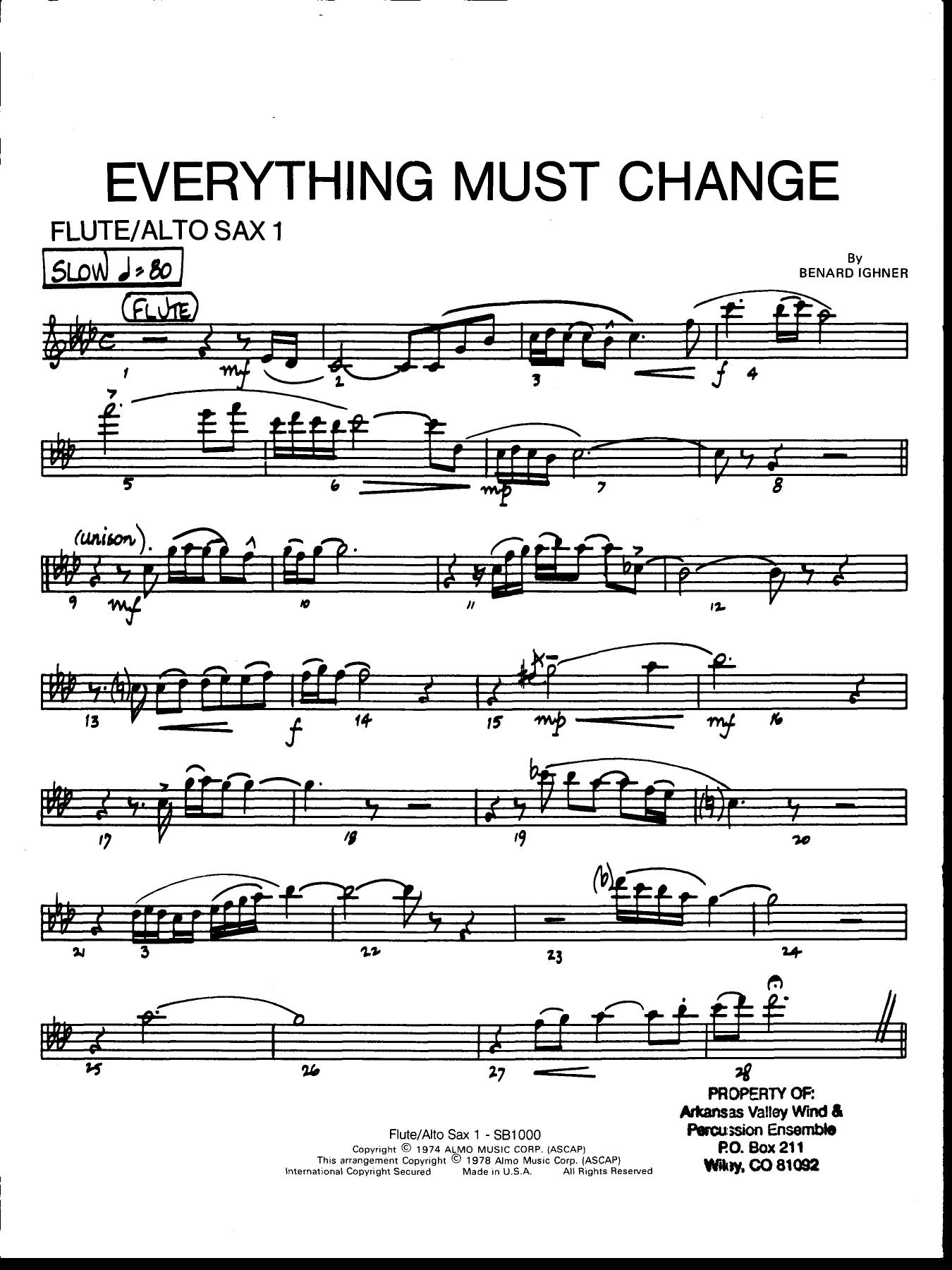
Everything Must Change (B.Ighner)
Composed by Bernard Ighner
Arranged by B.Ighner
- Ensemble: Big Band
- Pages: 51
- Instruments (17): Flute/Alto Sax 1, Flute/Alto Sax 2, Tenor Sax 1, Tenor Sax 2, Baritone Sax, Trumpet 1, Trumpet 2, Trumpet 3, Flügelhorn/Trumpet 4, Trombone 1, Trombone 2, Trombone 3, Trombone 4 (Bass), Electric Bass, Drums, Electric Piano, Guitar
- Difficulty: advanced
- Content: Individual Parts
- Format: PDF Download (Instant)
- Price: $24.99
Originally unveiled on Quincy Jones’s landmark 1974 fusion masterpiece *Body Heat*, Benard Ighner’s composition "Everything Must Change" quickly transcended its R&B roots to become a cornerstone modern jazz standard. Celebrated and recorded by vocal icons ranging from Nina Simone and George Benson to Carmen McRae and Oleta Adams, this poignant masterwork bridges contemplative introspection with profound emotional universality. The piece occupies a unique space in the twentieth-century vocal canon, functioning simultaneously as a melancholic meditation on the passage of time and a hopeful affirmation of life's constant evolution. Rooted in a lush, slow-tempo ballad feel characterized by sophisticated harmonic movement and a subtle, pulsing groove, this arrangement establishes an atmosphere of exquisite vulnerability. The chart opens with sparse, intimate textures that mirror the original recording's confessional mood, gradually expanding in scope and harmonic density. As the ensemble builds toward its emotional peak, the underlying groove transitions from delicate rubato-style phrasing into a steady, supportive pocket that allows the melody to breathe. Rich, extended chord voicings in the brass and warm saxophone solis evoke a deeply reflective emotional landscape, shifting seamlessly between quiet despair and soaring optimism. The arranger approaches this classic material with a keen respect for space, utilizing dynamic contrast and sophisticated voicing techniques rather than dense, overwrought counterpoint. Woodwinds—featuring dual flute doublings on the alto saxophones—weave shimmering textures around the vocal line, while the rhythm section anchors the progression with a hypnotic, recurrent unison riff. The arrangement avoids predictable scoring clichés by distributing melodic fragments across different sections, creating conversational interplay between the horns and the featured vocalist. A meticulously paced shout chorus serves as the structural centerpiece, opening up the harmonic spectrum before pulling back dynamically to frame a vulnerable, unaccompanied vocal suspension. Tailored specifically for advanced high school, collegiate, and professional jazz ensembles, this 51-page manuscript demands exceptional ensemble listening skills and profound stylistic maturity. While the technical execution of individual lines is accessible, the primary challenge lies in maintaining tone control, intonation, and a unified emotional arc across extremely wide dynamic ranges. The chart provides stellar feature opportunities for a lead vocalist, supported by expressive solo space for tenor saxophone and trumpet. Conductor and ensemble alike will find immense artistic fulfillment in exploring the subtle harmonic nuances and rich texturizing inherent in this definitive big band setting. Navigating this arrangement successfully requires exceptional restraint and precise control over dynamic shading. The tempo should remain relaxed and fluid, driven by a natural, unhurried pulse rather than a rigid click. * **Tempo & Feel:** Establish a slow, contemplative ballad tempo (around 68–72 BPM) with a relaxed, pulsing sub-division. The rhythm section must maintain an understated, breath-like groove, avoiding heavy backbeats early in the chart. * **Technical Challenges:** The primary hurdle involves executing long, sustained phrases with immaculate intonation, particularly during exposed woodwind and muted brass passages. Saxophone players doubling on flute must ensure seamless transitions and balanced blend within the upper register. * **Special Techniques:** Utilize warm, cup or harmon mutes in the brass section to achieve the velvety, intimate coloration required in the opening verses. Ensure all dynamic swells peak precisely where indicated to preserve the dramatic architecture of the arrangement. * **Rehearsal Strategy:** Rehearsals should initially focus on balance within the chord voicings, having the band practice passages at a *pianissimo* level to develop collective listening before layering in the vocal soloist. Q: What instruments and parts are included in this big band arrangement? A: This 51-page publication is scored for a standard 17-instrument jazz orchestra: vocal soloist, 2 alto saxophones (both doubling on flute), 2 tenor saxophones, baritone saxophone, 4 trumpets, 4 trombones, piano, guitar, bass, and drums. Q: What is the difficulty level of this chart? A: This arrangement is graded as Level 3 (medium-advanced), making it ideal for accomplished high school, collegiate, and professional big bands that possess strong stylistic maturity and blend. Q: What is the historical style and background of the piece? A: Composed by Benard Ighner and popularized on Quincy Jones's 1974 album *Body Heat*, the piece is a legendary soul-jazz ballad that has since become an essential modern standard interpreted by countless vocalists. Q: What makes this specific arrangement unique? A: It features a signature recurrent rhythm section riff, exquisite woodwind doublings, and a masterfully paced dynamic arc that builds from an intimate, fragile introduction into a powerful emotional climax before subsiding to a delicate conclusion. Q: What is the recommended performance duration and tempo feel? A: The piece is performed at a slow, expressive ballad tempo (roughly 68–72 BPM) with a flexible, breathing groove, running approximately 4 to 5 minutes depending on the length of the improvised solos.
Questions and answers
- What is included in the Everything Must Change (B.Ighner) PDF?
- The verified current file contains individual parts across 51 pages.
- How many instruments or parts are listed for Everything Must Change (B.Ighner)?
- The verified instrumentation list contains 17 entries for this Big Band arrangement.
- Who is credited for Everything Must Change (B.Ighner)?
- Composer: Bernard Ighner. Arranger: B.Ighner.
- What difficulty is listed for Everything Must Change (B.Ighner)?
- The verified difficulty level is advanced.
- Can I preview Everything Must Change (B.Ighner) before buying?
- Yes. The product page provides a preview generated from the current PDF file.
- How is Everything Must Change (B.Ighner) delivered?
- After successful payment, the digital PDF is made available for download. The displayed price is $24.99.
Musicians Also Search For
Everything Must Change B.Ighner PDF • Everything Must Change B.Ighner sheet music • Everything Must Change arranged by B.Ighner • B.Ighner big band charts • B.Ighner jazz arrangements PDF • Everything Must Change Bernard Ighner sheet music • Everything Must Change Bernard Ighner big band arrangements • Bernard Ighner big band charts • Everything Must Change big band arrangements • Everything Must Change big band PDF download • Everything Must Change jazz sheet music • big band sheet music download • Everything Must Change individual parts download • Everything Must Change sheet music PDF • buy Everything Must Change sheet music • download Everything Must Change PDF • Everything Must Change jazz charts • best B.Ighner big band arrangements • Bernard Ighner arranged by B.Ighner • Everything Must Change printable sheet music • big band repertoire PDF