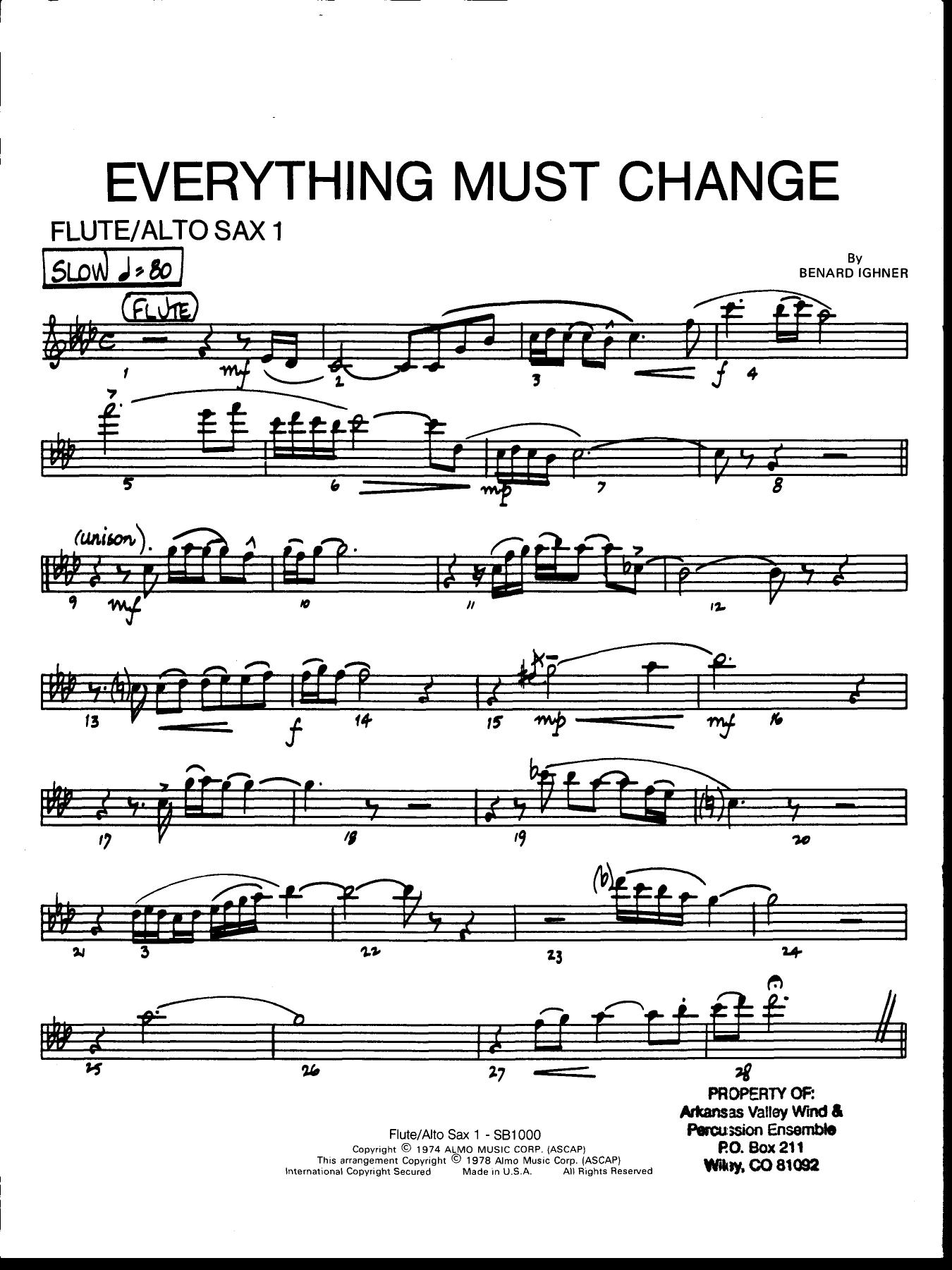
Everything Must Change (B.Ighner)
Composed by Bernard Ighner
Arranged by B.Ighner
- Ensemble: Big Band
- Style: Jazz Standard
- Pages: 51
- Instruments (17): Flute/Alto Sax 1, Flute/Alto Sax 2, Tenor Sax 1, Tenor Sax 2, Baritone Sax, Trumpet 1, Trumpet 2, Trumpet 3, Flügelhorn/Trumpet 4, Trombone 1, Trombone 2, Trombone 3, Trombone 4 (Bass), Electric Bass, Drums, Electric Piano, Guitar
- Difficulty: advanced
- Content: Individual Parts
- Format: PDF Download (Instant)
- Price: $24.99
Bernard Ighner's enduring composition, "Everything Must Change," first gained widespread recognition through its iconic 1974 recording by Quincy Jones, featuring the soulful vocals of Benard Ighner himself. This poignant ballad quickly transcended its initial release to become a cornerstone of the jazz vocal repertoire, celebrated for its profound lyrical depth and sophisticated harmonic structure. The piece embodies the reflective and often melancholic introspection characteristic of the early 1970s jazz-pop crossover era, a period when artists seamlessly blended jazz sensibilities with accessible melodicism. Its status as a jazz standard is cemented by countless interpretations from vocal giants and instrumentalists alike, who are drawn to its timeless message of impermanence and resilience. The original's lush orchestration and emotive delivery established a high bar for subsequent arrangements, demanding both sensitivity and a deep understanding of its emotional core. This particular big band arrangement by B.Ighner masterfully reinterprets the classic, transforming its intimate ballad character into a rich, expansive orchestral statement. The arrangement maintains the original's contemplative and slightly melancholic mood, typically set at a slow ballad tempo in 4/4 time, often around 60-70 BPM. While the original key is often Eb major, this arrangement may explore subtle harmonic shifts or reharmonizations that enhance its emotional resonance without sacrificing familiarity. B.Ighner's signature approach is evident in the intricate voicings, which provide a dense yet transparent harmonic canvas, allowing individual lines to emerge with clarity. Expect sophisticated block chord voicings in the saxophone sections, creating a warm, enveloping sound, alongside carefully articulated brass figures that add depth and dynamic contrast. The arrangement skillfully balances the piece's inherent introspection with moments of orchestral grandeur. The melodic presentation is thoughtfully distributed, often featuring the lead alto saxophone or trumpet on the initial statement of the theme, allowing for a clear, expressive interpretation. Soli sections for the saxophones are a highlight, showcasing B.Ighner's penchant for weaving complex countermelodies and rich inner voices that challenge and reward the ensemble. While the arrangement is primarily an ensemble feature, there are opportunities for featured solos, typically for tenor saxophone or trombone, allowing individual musicians to contribute their personal voice to the narrative. Technical challenges include precise control of dynamics, particularly in the softer passages, and achieving a unified blend across the diverse timbres of the 17 instruments. The rewarding aspect lies in the opportunity to perform a truly moving piece with a sophisticated harmonic palette, allowing the band to explore deep emotional expression and showcase their collective musicianship. This arrangement is ideally suited for advanced high school, college, community, and professional big bands. Its harmonic complexity and demands for nuanced phrasing make it an excellent vehicle for developing musical maturity and ensemble cohesion. Bands with strong lead players in the saxophone and brass sections, capable of sustained lyrical playing and precise intonation, will find this arrangement particularly fulfilling. The detailed scoring and the emotional depth of the piece offer invaluable learning experiences in dynamics, blend, and the art of storytelling through music, making it a staple for any serious jazz ensemble's repertoire. Conductors should emphasize a deep, sustained legato in all melodic lines, particularly in the saxophone and trombone sections, to capture the piece's inherent lyricism. The tempo should be kept steady at a slow ballad feel (quarter note = 60-70 BPM), allowing ample space for harmonic resonance and emotional expression. Pay close attention to dynamic contrasts, moving from hushed pianissimo passages to full, yet controlled, forte sections. Rehearsal time should be dedicated to balancing the rich voicings, ensuring that inner voices are audible without overpowering the main melodic contours. Brass players should focus on warm, rounded tones, avoiding harsh attacks. There are no specific extended techniques like plungers or falls explicitly notated, but subtle expressive vibrato and careful articulation will enhance the overall mood. Ensure the rhythm section maintains a sensitive, supportive role, with the bass providing a solid foundation and the drums offering delicate brushwork or light stick patterns that enhance the ballad feel without intruding. Q: What instruments are included in this arrangement? A: This big band arrangement is scored for 17 instruments, specifically: Flute/Alto Saxophone 1, Flute/Alto Saxophone 2, Tenor Saxophone 1, Tenor Saxophone 2, Baritone Saxophone, 4 Trumpets, 4 Trombones, Piano, Bass, and Drums. Q: What is the difficulty level of this arrangement? A: This arrangement is considered advanced, suitable for college, community, and professional big bands due to its sophisticated harmonic voicings, dynamic control requirements, and demands for mature lyrical phrasing. Q: What is the musical style and historical context of "Everything Must Change"? A: "Everything Must Change" is a jazz standard, originally composed by Bernard Ighner in the early 1970s. It is a poignant ballad reflecting the jazz-pop crossover era, known for its deep lyrical content and sophisticated harmony. Q: What makes B.Ighner's arrangement of "Everything Must Change" unique? A: B.Ighner's arrangement is distinguished by its intricate voicings, thoughtful distribution of melodic lines across the ensemble, and sophisticated soli sections that transform the original intimate ballad into an expansive orchestral statement while retaining its emotional depth. Q: What is the typical performance duration and tempo for this arrangement? A: The performance duration typically ranges from 4-6 minutes, depending on any improvised solos. It is performed at a slow ballad tempo, generally around 60-70 beats per minute.
Questions and answers
- What is included in the Everything Must Change (B.Ighner) PDF?
- The verified current file contains individual parts across 51 pages.
- How many instruments or parts are listed for Everything Must Change (B.Ighner)?
- The verified instrumentation list contains 17 entries for this Big Band arrangement.
- Who is credited for Everything Must Change (B.Ighner)?
- Composer: Bernard Ighner. Arranger: B.Ighner.
- What difficulty is listed for Everything Must Change (B.Ighner)?
- The verified difficulty level is advanced.
- What style is listed for Everything Must Change (B.Ighner)?
- The catalog lists the style as Jazz Standard.
- Can I preview Everything Must Change (B.Ighner) before buying?
- Yes. The product page provides a preview generated from the current PDF file.
- How is Everything Must Change (B.Ighner) delivered?
- After successful payment, the digital PDF is made available for download. The displayed price is $24.99.
Musicians Also Search For
Everything Must Change B.Ighner PDF • Everything Must Change B.Ighner sheet music • Everything Must Change arranged by B.Ighner • B.Ighner big band charts • B.Ighner jazz arrangements PDF • Everything Must Change Bernard Ighner sheet music • Everything Must Change Bernard Ighner big band arrangements • Bernard Ighner big band charts • Everything Must Change big band arrangements • Everything Must Change big band PDF download • Everything Must Change jazz sheet music • big band sheet music download • Everything Must Change individual parts download • Everything Must Change sheet music PDF • Everything Must Change Jazz Standard charts • Jazz Standard big band arrangements • buy Everything Must Change sheet music • download Everything Must Change PDF • Everything Must Change jazz charts • best B.Ighner big band arrangements • Bernard Ighner arranged by B.Ighner • Everything Must Change printable sheet music • big band repertoire PDF