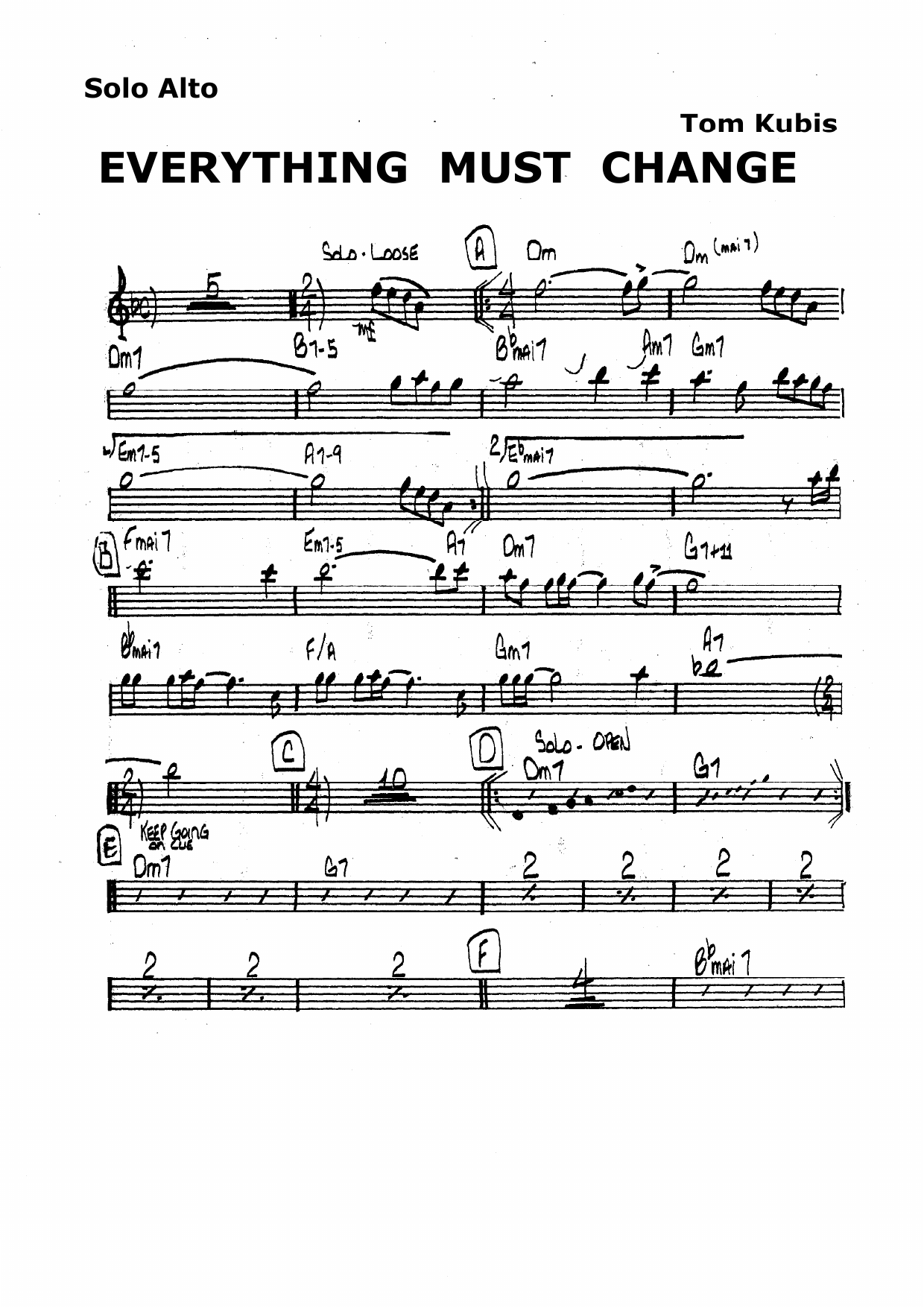
Everything Must Change (T.Kubis)
Composed by Bernard Ighner
Arranged by Tom Kubis
- Ensemble: Big Band
- Pages: 32
- Instruments (16): Solo Alto, Alto 2, Tenor 1, Tenor 2, Baritone, Trumpet 1, Trumpet 2, Trumpet 3, Trumpet 4, 'Bone 1, 'Bone 2, 'Bone 3, 'Bone 4, Piano, Bass, Drums
- Difficulty: medium
- Content: Individual Parts
- Format: PDF Download (Instant)
- Price: $24.99
Bernard Ighner’s timeless vocal masterpiece "Everything Must Change"—cemented in jazz history by legendary interpretations from Quincy Jones, Randy Crawford, and George Benson—stands as one of the most poignant philosophical reflections in the modern songbook. Originally emerging from the fertile crossover soul-jazz landscape of the mid-1970s, this composition bridges traditional jazz harmony with accessible, universally resonant lyrical themes. Its gentle, contemplative progression has allowed it to transcend its origins, evolving from a soulful vocal vehicle into a sophisticated instrumental canvas favored by master arrangers who appreciate its rich harmonic architecture and emotional depth. Tom Kubis’s masterful big band adaptation reimagines the soulful standard through a lush, contemporary jazz lens, transforming the introspective vocal original into a sweeping instrumental statement. Driven by a relaxed, flowing medium-groove feel rather than a rigid swing, the arrangement utilizes an expansive harmonic palette characterized by rich, extended chord voicings, subtle chromatic inner-voice movements, and gorgeous dynamic swells. The emotional trajectory shifts seamlessly from quiet, reflective intimacy to soaring, brass-heavy climaxes, evoking a profound sense of natural transition, growth, and optimism. Kubis avoids heavy-handed bombasts, opting instead for a sophisticated warmth that lets the underlying beauty of Ighner's melody breathe through intricate counterlines and expertly balanced ensemble textures. Throughout the chart, the melody is thoughtfully distributed across sections, highlighting the rich sonorities of the saxophones and flugelhorns before opening up into a soaring ensemble framework. A standout feature of this arrangement is a dedicated solo section—typically tailored for tenor saxophone or piano—which provides a spacious harmonic background for expressive improvisational exploration. Technically, the chart demands exceptional breath control, pristine intonation on tight chord clusters, and a mature sense of rubato-like phrasing within a steady groove. The saxes require nimble fingerwork for delicate background figures, while the brass section must execute nuanced dynamic control, utilizing warm, unforced tones rather than aggressive volume during the lower-dynamic plateaus. Advanced high school, collegiate, and professional big bands will find this arrangement an ideal vehicle for developing sophisticated ensemble listening skills, balance, and stylistic maturity. Because the chart relies heavily on lyrical phrasing, micro-dynamic control, and sophisticated blend rather than sheer velocity, it offers a refreshing change of pace for festival programs or concert settings. Directors will appreciate how the chart challenges sections to listen across the ensemble, ensuring that every inner voice contributes meaningfully to Kubis’s rich, cinematic reimagining of a modern classic. Navigating Tom Kubis’s chart requires a disciplined approach to time feel and balance; avoid rushing the medium groove, allowing the underlying subdivision to remain relaxed and resilient. The primary technical challenge lies in the execution of lush, extended harmonies where minor pitch discrepancies will immediately muddy the voicings—spend ample time in sectional rehearsals isolating chord clusters and tuning unisons, particularly within the saxophone and muted brass sections. Dynamic contrast is critical to the chart's emotional arc; ensure the ensemble respects the subtle piano and mezzo-piano markings early on so that the eventual dynamic peaks achieve maximum impact without forcing tone quality. Solos should be approached with a lyrical mindset, encouraging improvisers to quote the original melody's contour rather than simply running scale patterns over the changes. Conductor focus should center on smooth transitions between rubato-leaning ensemble phrases and the re-establishment of the strict groove. Q: What instruments and parts are included in this 16-instrument big band arrangement? A: The instrumentation features a standard 16-piece big band layout comprising Alto Saxophone 1 & 2, Tenor Saxophone 1 & 2, Baritone Saxophone, 4 Trumpets (with flugelhorn doublings encouraged), 4 Trombones, Piano, Guitar, Bass, and Drum Set. Q: What is the official difficulty level of this Tom Kubis arrangement? A: This chart is graded as advanced (Level 4–5), making it best suited for accomplished collegiate, high school honor jazz bands, and professional ensembles capable of handling dense harmonies and subtle stylistic nuances. Q: What is the historical background of the musical material used in this chart? A: The piece is based on Bernard Ighner’s 1974 soul-jazz standard, famously recorded by Quincy Jones, which blends sophisticated jazz harmony with the emotional directness of R&B and pop balladry. Q: What distinguishes Tom Kubis’s specific treatment from other big band arrangements of this standard? A: Kubis elevates the chart through his signature lush harmonic voicings, sophisticated inner-voice movement, and a cinematic approach to dynamics that transforms a vocal ballad into a nuanced instrumental tone poem. Q: What is the ideal performance tempo and approximate duration for this arrangement? A: The chart is set to a relaxed medium groove (around quarter note = 84-92 BPM), allowing the ensemble enough rhythmic space to phrase lyrically, with a standard performance duration of approximately 4 to 5 minutes.
Questions and answers
- What is included in the Everything Must Change (T.Kubis) PDF?
- The verified current file contains individual parts across 32 pages.
- How many instruments or parts are listed for Everything Must Change (T.Kubis)?
- The verified instrumentation list contains 16 entries for this Big Band arrangement.
- Who is credited for Everything Must Change (T.Kubis)?
- Composer: Bernard Ighner. Arranger: Tom Kubis.
- What difficulty is listed for Everything Must Change (T.Kubis)?
- The verified difficulty level is medium.
- Can I preview Everything Must Change (T.Kubis) before buying?
- Yes. The product page provides a preview generated from the current PDF file.
- How is Everything Must Change (T.Kubis) delivered?
- After successful payment, the digital PDF is made available for download. The displayed price is $24.99.
Musicians Also Search For
Everything Must Change Tom Kubis PDF • Everything Must Change Tom Kubis sheet music • Everything Must Change arranged by Tom Kubis • Tom Kubis big band charts • Tom Kubis jazz arrangements PDF • Everything Must Change Bernard Ighner sheet music • Everything Must Change Bernard Ighner big band arrangements • Bernard Ighner big band charts • Everything Must Change big band arrangements • Everything Must Change big band PDF download • Everything Must Change jazz sheet music • big band sheet music download • Everything Must Change individual parts download • Everything Must Change sheet music PDF • buy Everything Must Change sheet music • download Everything Must Change PDF • Everything Must Change jazz charts • best Tom Kubis big band arrangements • Bernard Ighner arranged by Tom Kubis • Everything Must Change printable sheet music • big band repertoire PDF