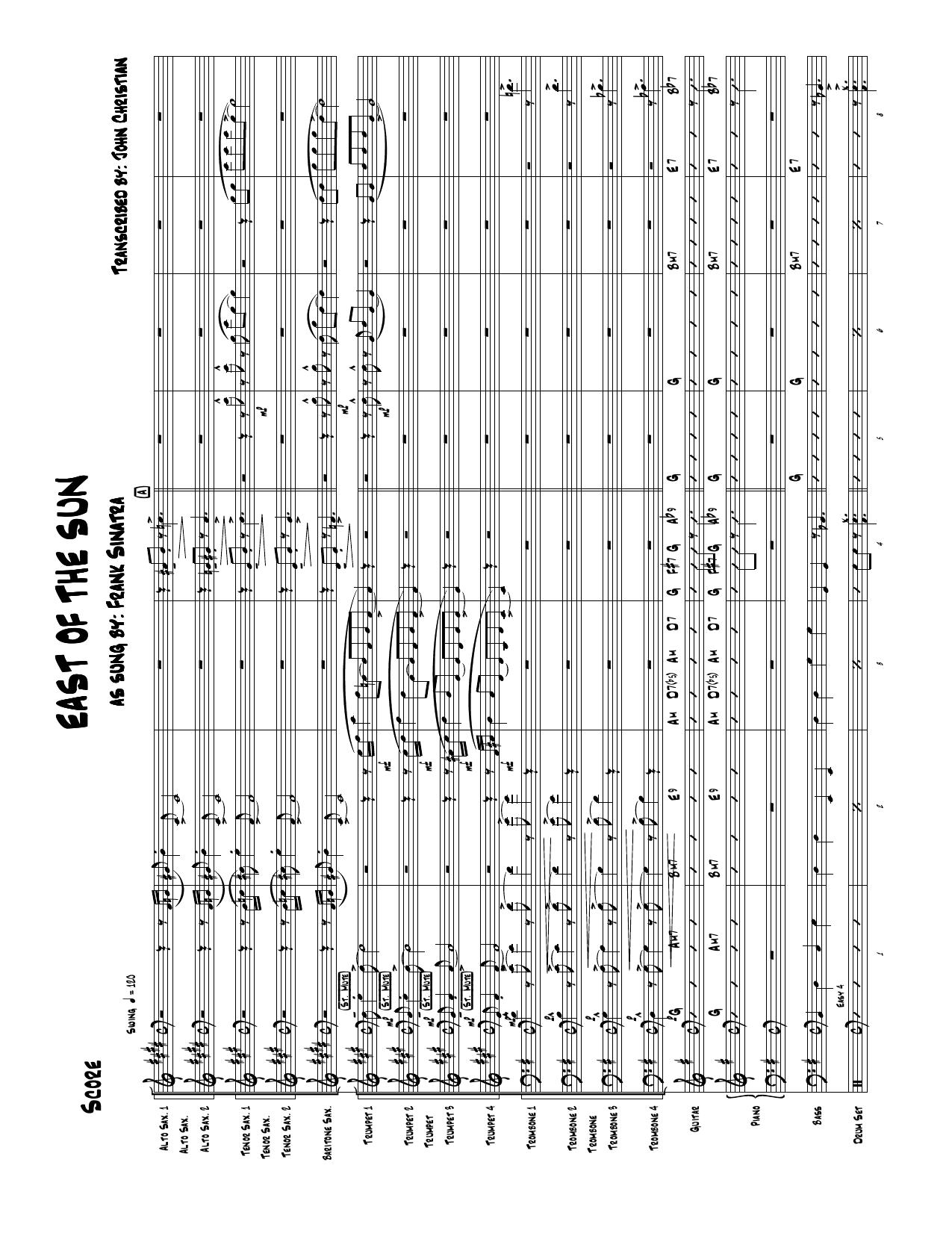
East Of The Sun (J.Christian) sheet music preview

East Of The Sun (J.Christian)

Composed by John Christian

Arranged by Frank Sinatra & Nelson Riddle

  • Ensemble: Big Band
  • Pages: 44
  • Instruments (17): Alto Sax. 1, Alto Sax. 2, Tenor Sax. 1, Tenor Sax. 2, Baritone Sax., Trumpet 1, Trumpet 2, Trumpet 3, Trumpet 4, Trombone 1, Trombone 2, Trombone 3, Trombone 4, Guitar, Piano, Bass, Drums
  • Difficulty: medium
  • Content: Individual Parts
  • Format: PDF Download (Instant)
  • Price: $24.99

Written by Brooks Bowman in 1934 while he was still an undergraduate at Princeton University, "East of the Sun (and West of the Moon)" swiftly transitioned from campus musical numbers into the permanent bedrock of the Great American Songbook. While early interpretations by artists like Billie Holiday and Stan Getz established its lyrical, romantic fluidity, the definitive mid-century vocal treatment arrived when Frank Sinatra recorded it for his classic 1961 Capitol album *Come Swing With Me!*. Nelson Riddle, Sinatra’s chief sonic architect during this golden era, reimagined the tune away from a traditional languid ballad into an effervescent, driving medium-up swing chart that radiates sophisticated optimism and breezy urban cool. Nelson Riddle’s arrangement is a masterclass in mid-century big band orchestration, characterized by sparkling upper-register woodwind counterlines, translucent brass voicings, and an infectious, forward-leaning 4/4 swing groove. The chart opens with an iconic, cascading brass figure that immediately establishes the buoyant, adventurous mood of the arrangement. Riddle avoids heavy, thick block chords in favor of transparent, sparkling textures—frequently pairing muted trumpets with a high-register alto saxophone or utilizing shimmering piano arpeggios to evoke the celestial imagery of the lyric. The harmonic language leverages sophisticated extended jazz chords, featuring clever chromatic passing tones and unexpected modulatory shifts that keep both the performers and the listener constantly engaged. Throughout the chart, the instrumental forces trade roles seamlessly, supporting the vocal line's rhythmic phrasing while interjecting sharp, witty counter-melodies. The tenor saxophone and trombone sections carry substantial weight in the background figures, providing a rich, warm cushion that complements the punchy brass stabs. While written explicitly to support a classic Sinatra-style vocal interpretation, the ensemble sections shine brilliantly on their own during the instrumental interludes, culminating in a compact, driving shout chorus that builds tension through dynamic contrast rather than sheer volume. The technical demands center primarily on stylistic precision: maintaining a feather-light, relaxed swing eighth-note feel at a brisk tempo, achieving absolute ensemble unison on syncopated figures, and balancing the delicate dynamic shifts between the muted brass and the rhythm section. Advanced high school, collegiate, and professional jazz ensembles will find this 44-page, 11-instrument arrangement an exceptional vehicle for developing stylistic authenticity, light swing articulation, and dynamic control. Because the arrangement relies heavily on nuance, spatial awareness, and stylistic cohesion rather than blistering tempos or extreme altissimo ranges, it serves as a premier educational tool for teaching the sophisticated art of vocal accompaniment and classic Capitol-era big band phrasing. Musicians and audiences alike will find the chart deeply rewarding for its sheer elegance, timeless melodic charm, and the sparkling brilliance of Riddle’s unmistakable arranging genius. The primary technical challenge in executing this Nelson Riddle arrangement lies in maintaining a relaxed, driving medium-up swing feel without rushing the tempo. The rhythm section must anchor the groove with a feather-light ride cymbal pattern and an insistent, walking acoustic bass line that breathes rather than hammers. Horn players should pay meticulous attention to articulation: short notes must be crisp and dry, while accented lines require a warm, vocal-like weight without heavy tongue-attacks. Pay close attention to the dynamic contrast between the muted brass background figures and the open ensemble punches; the accompaniment must never obscure the primary melody or vocal lead line. Rehearsal should begin slowly with the metronome clicking on beats two and four to lock in the syncopated ensemble figures before bringing the chart up to its intended performance tempo. Ensure the saxophones blend their scalar runs with a dry, focused tone, avoiding excessive vibrato to preserve the clean, modern mid-century aesthetic. Q: What instruments and parts are included in this 44-page arrangement? A: This arrangement is scored for an 11-instrument ensemble typical of classic studio big bands, featuring parts for Alto Saxophone, Tenor Saxophone, Trumpet, Trombone, Piano, and rhythm section components. Q: What is the difficulty level of this arrangement? A: This chart is best suited for advanced high school, collegiate, and professional jazz ensembles due to its heavy reliance on precise swing articulation, delicate dynamic balancing, and mature stylistic phrasing. Q: What is the historical context and musical style of this piece? A: Written by Brooks Bowman in 1934, this arrangement captures the sophisticated mid-century swing style popularized by Frank Sinatra and arranger Nelson Riddle during their landmark Capitol Records era in 1961. Q: What makes this specific Nelson Riddle arrangement unique? A: It transforms a traditional romantic standard into an effervescent, driving swing chart defined by sparkling upper-register woodwind lines, transparent brass voicings, and witty, sophisticated counter-melodies. Q: What is the recommended performance tempo and duration for this arrangement? A: The piece is set in a buoyant, medium-up 4/4 swing feel with a performance duration of approximately 3 to 4 minutes, depending on the ensemble's chosen tempo and solo extensions.

Questions and answers

What is included in the East Of The Sun (J.Christian) PDF?
The verified current file contains a conductor score and individual parts across 44 pages.
How many instruments or parts are listed for East Of The Sun (J.Christian)?
The verified instrumentation list contains 17 entries for this Big Band arrangement.
Who is credited for East Of The Sun (J.Christian)?
Composer: John Christian. Arranger: Frank Sinatra & Nelson Riddle.
What difficulty is listed for East Of The Sun (J.Christian)?
The verified difficulty level is medium.
Can I preview East Of The Sun (J.Christian) before buying?
Yes. The product page provides a preview generated from the current PDF file.
How is East Of The Sun (J.Christian) delivered?
After successful payment, the digital PDF is made available for download. The displayed price is $24.99.

Musicians Also Search For

East Of The Sun Frank Sinatra & Nelson Riddle PDFEast Of The Sun Frank Sinatra & Nelson Riddle sheet musicEast Of The Sun arranged by Frank Sinatra & Nelson RiddleFrank Sinatra & Nelson Riddle big band chartsFrank Sinatra & Nelson Riddle jazz arrangements PDFEast Of The Sun John Christian sheet musicEast Of The Sun John Christian big band arrangementsJohn Christian big band chartsEast Of The Sun big band arrangementsEast Of The Sun big band PDF downloadEast Of The Sun jazz sheet musicbig band sheet music downloadEast Of The Sun conductor score PDFEast Of The Sun individual parts downloadEast Of The Sun sheet music PDFbuy East Of The Sun sheet musicdownload East Of The Sun PDFEast Of The Sun jazz chartsbest Frank Sinatra & Nelson Riddle big band arrangementsJohn Christian arranged by Frank Sinatra & Nelson RiddleEast Of The Sun printable sheet musicbig band repertoire PDF

All arrangements by Frank Sinatra & Nelson Riddle All John Christian sheet music