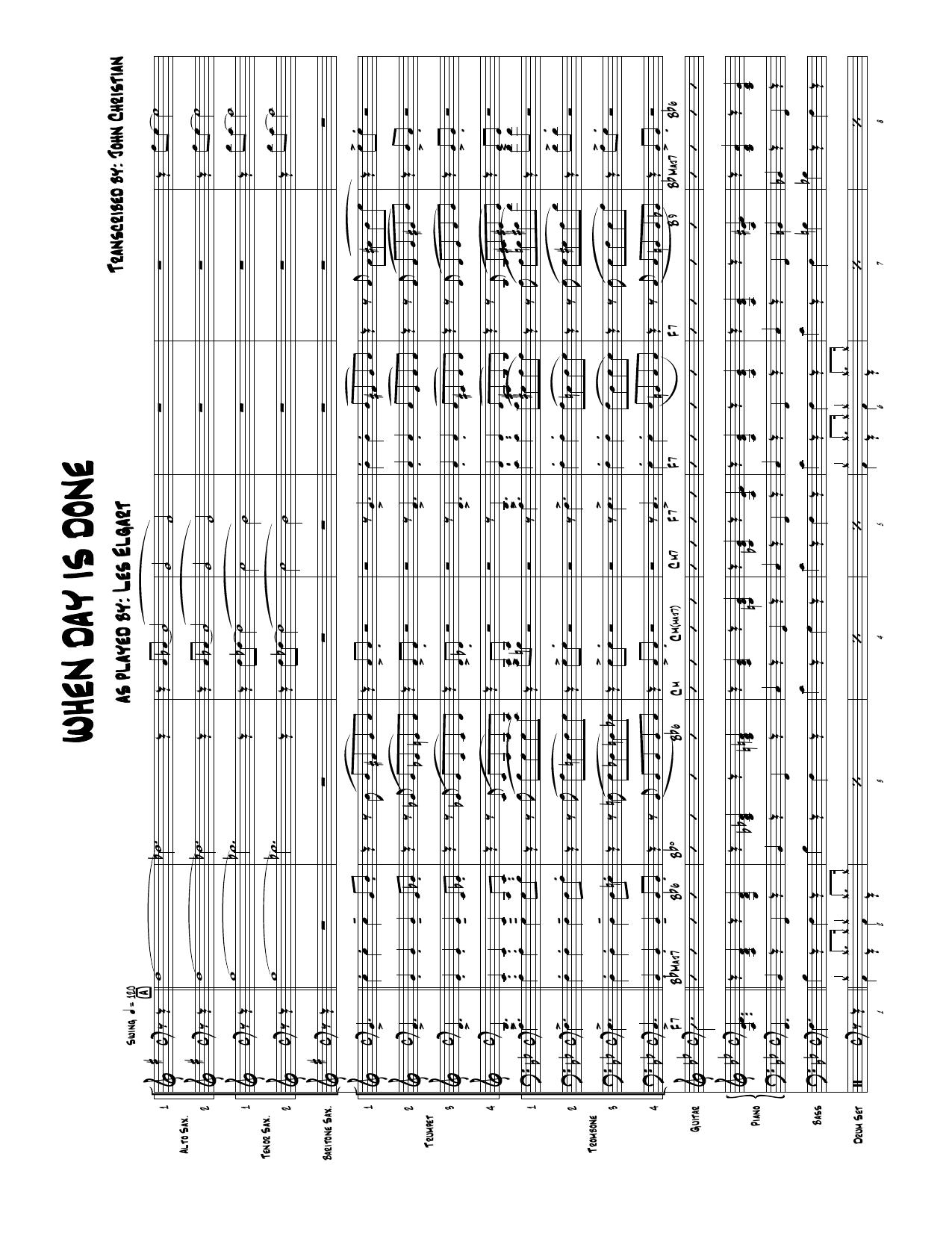
When Day Is Done (J.Christian)
Composed by John Christian
Arranged by J.Christian
- Ensemble: Big Band
- Pages: 25
- Instruments (17): 1st Alto Saxophone, 3rd Alto Saxophone, 2nd Tenor Saxophone, 4th Tenor Saxophone, Baritone Saxophone, 1st Trumpet, 2nd Trumpet, 3rd Trumpet, 4th Trumpet, 1st Trombone, 2nd Trombone, 3rd Trombone, 4th Trombone, Guitar, Piano, Bass, Drum Set
- Difficulty: medium
- Content: Individual Parts
- Format: PDF Download (Instant)
- Price: $24.99
"When Day Is Done," immortalized by composer Robert Katscher with English lyrics by B.G. DeSylva, has long occupied a cherished space in the standard jazz and cabaret repertoire, having been famously interpreted by luminaries such as Paul Whiteman, Django Reinhardt, and Benny Goodman. Rooted in the sophisticated harmonic landscape of the late 1920s European-American popular song tradition, the composition bridges early dance orchestra idioms with the burgeoning language of jazz improvisation. Its inherent melancholy and sweeping lyrical contours provide an ideal canvas for expansive big band orchestration, translating a timeless salon melody into a rich, texturally varied canvas for modern jazz ensembles. Conceived as a sophisticated medium-tempo swing chart, this arrangement by J.Christian balances nostalgic warmth with modern harmonic color. The prevailing mood is introspective yet rhythmically buoyant, driven by a relaxed, conversational swing feel in 4/4 time that encourages the ensemble to prioritize breath support, linear continuity, and subtle dynamic shading. Rather than relying on relentless high-energy bombast, the chart derives its emotional resonance from lush, impressionistic chord clusters, intricate counterpoint, and seamless transitions between sparse, exposed ensemble textures and full-throated, harmonically dense orchestrations. J.Christian approaches the material with a deep reverence for traditional big band architecture while infusing the score with contemporary reharmonizations and clever voice-leading. The arrangement opens with an evocative, rubato-tinged introduction before settling into a steady, persuasive groove. The saxophones—anchored by two altos, two tenors, and baritone—frequently carry the primary thematic weight, utilizing tight, cool-toned block voicings reminiscent of the classic West Coast school. A standout soli section showcases the reed choir in a delicate, interlocking harmonic dialogue, cleanly separated from brass counter-lines that add subtle tension without ever cluttering the texture. The chart builds organically toward a meticulously crafted shout chorus, avoiding cheap dynamic tricks in favor of a rising scalar trajectory and rich upper-structure triads in the trumpet and trombone sections. Designed with versatility and pedagogical value in mind, this 25-page, 17-instrument chart is ideally suited for advanced high school, collegiate, and accomplished community jazz orchestras. It offers ample opportunity for a featured soloist—ideally on tenor saxophone or trumpet—to stretch out over a standard AABA form, while demanding strong sectional cohesion, intonation control, and stylistic flexibility from the entire band. Performing groups will find deep satisfaction in navigating the subtle metric nuances, balancing the intricate inner voices, and mastering the sophisticated dynamic shifts that define J.Christian’s distinctive compositional voice. Success with this arrangement hinges on maintaining a relaxed, conversational medium-swing feel, avoiding any tendency to rush the tempo as the texture thickens. Conductors should emphasize a forward-moving quarter-note pulse in the rhythm section, where the bassist walks a clean, acoustic-style line and the drummer keeps the ride cymbal shimmering while feathering the bass drum. Pay close attention to articulation: all eighth-note lines should feature traditional jazz articulation, playing off-beats with appropriate weight and length while keeping back-beats (beats 2 and 4) crisp and defined. The brass section must exercise extreme care with dynamic balance during the lush chordal passages, ensuring that muted trumpet parts and open trombone pads blend seamlessly beneath the lead alto saxophone. During the saxophone soli, the section needs to lock in its internal balance and intonation, treating the passage like a chamber music excerpt. Subtle use of cup mutes in the trumpets will enhance the nocturnal, atmospheric mood of the head statements, while the shout chorus demands full-ensemble commitment without forced tone quality or shrill upper-register playing. Q: What instruments and parts are included in this big band arrangement? A: The 17-instrument orchestration includes a standard big band lineup: two alto saxophones, two tenor saxophones, baritone saxophone, standard brass sections, and a full rhythm section, spread across a comprehensive 25-page score and parts set. Q: What is the difficulty level of this chart? A: This arrangement is graded as advanced-intermediate to advanced, making it exceptionally well-suited for collegiate ensembles, advanced high school jazz bands, and skilled community big bands looking to stretch their expressive and harmonic capabilities. Q: What is the historical style and background of "When Day Is Done"? A: Rooted in the classic 1920s European cabaret and American dance orchestra traditions, this piece functions as a timeless jazz standard that bridges early swing idioms with sophisticated ballad and medium-tempo harmonic styling. Q: What makes J.Christian's arrangement unique compared to standard stock charts? A: J.Christian infuses the classic melody with contemporary reharmonizations, impressionistic chord voicings, a tightly crafted saxophone soli, and an organic, tension-building shout chorus that avoids clichéd big band tropes. Q: What is the recommended performance duration and tempo for this piece? A: The arrangement is set at a comfortable medium-swing tempo (approximately 116–124 BPM) and typically runs around 4 to 5 minutes in duration, depending on the length of the improvised solos taken during the middle chorus.
Questions and answers
- What is included in the When Day Is Done (J.Christian) PDF?
- The verified current file contains a conductor score and individual parts across 25 pages.
- How many instruments or parts are listed for When Day Is Done (J.Christian)?
- The verified instrumentation list contains 17 entries for this Big Band arrangement.
- Who is credited for When Day Is Done (J.Christian)?
- Composer: John Christian. Arranger: J.Christian.
- What difficulty is listed for When Day Is Done (J.Christian)?
- The verified difficulty level is medium.
- Can I preview When Day Is Done (J.Christian) before buying?
- Yes. The product page provides a preview generated from the current PDF file.
- How is When Day Is Done (J.Christian) delivered?
- After successful payment, the digital PDF is made available for download. The displayed price is $24.99.
Musicians Also Search For
When Day Is Done J.Christian PDF • When Day Is Done J.Christian sheet music • When Day Is Done arranged by J.Christian • J.Christian big band charts • J.Christian jazz arrangements PDF • When Day Is Done John Christian sheet music • When Day Is Done John Christian big band arrangements • John Christian big band charts • When Day Is Done big band arrangements • When Day Is Done big band PDF download • When Day Is Done jazz sheet music • big band sheet music download • When Day Is Done conductor score PDF • When Day Is Done individual parts download • When Day Is Done sheet music PDF • buy When Day Is Done sheet music • download When Day Is Done PDF • When Day Is Done jazz charts • best J.Christian big band arrangements • John Christian arranged by J.Christian • When Day Is Done printable sheet music • big band repertoire PDF