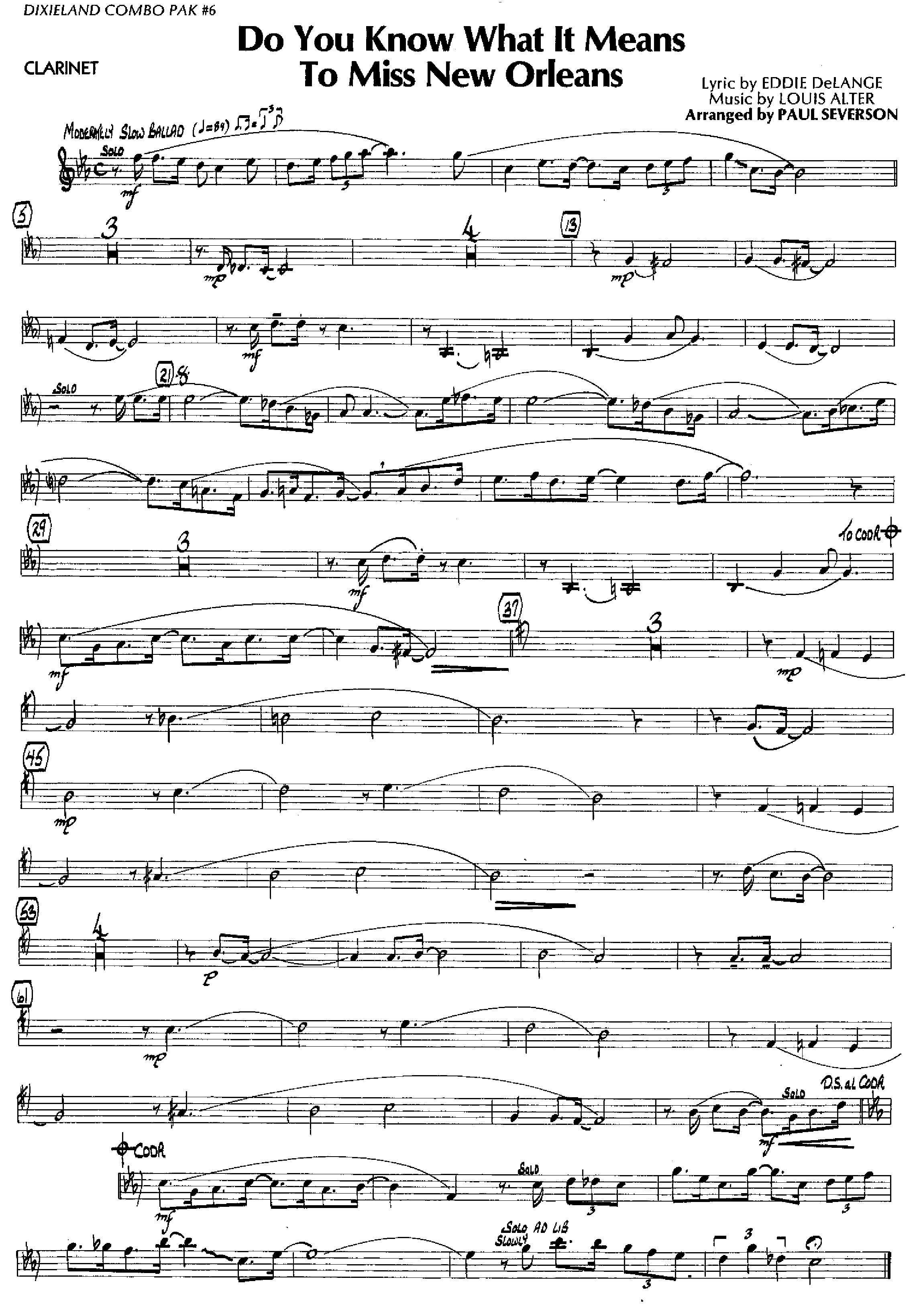
Do You Know What It Means to Miss New Orleans (Severson)
Composed by Louis Alter, Eddie DeLange
Arranged by Severson
- Ensemble: Dixieland Band
- Style: Jazz Standard
- Pages: 10
- Instruments (8): Clarinet, Tenor Sax, Trumpet, Trombone, Bass/Tuba, Drums, Guitar/Banjo, Piano/Conductor
- Difficulty: easy
- Content: Individual Parts
- Format: PDF Download (Instant)
- Price: $18.99
"Do You Know What It Means to Miss New Orleans" stands as an enduring testament to the city's unique cultural tapestry, a jazz standard that evokes a profound sense of longing and nostalgia. Penned by the talented duo of Louis Alter (music) and Eddie DeLange (lyrics) in 1939, the song emerged during a pivotal era for American popular music, just as the Golden Age of Hollywood was in full swing and jazz continued its evolution from its New Orleans roots. It gained iconic status through its inclusion in the 1947 film *New Orleans*, where it was famously performed by Louis Armstrong and Billie Holiday, cementing its place in the jazz canon. The piece is characterized by its melancholic yet tender melody, often performed as a slow to medium-tempo ballad, perfectly capturing the bittersweet essence of absence and affection for the Crescent City. Its harmonic structure, while accessible, offers rich opportunities for expressive interpretation, making it a favorite among vocalists and instrumentalists alike who wish to convey deep emotion. Severson's Dixieland band arrangement of "Do You Know What It Means to Miss New Orleans" masterfully channels the authentic spirit of early jazz, providing a vibrant and historically informed interpretation. Rather than a straightforward ballad, Severson reimagines the piece with a medium-swing, 4/4 Dixieland feel, injecting it with a buoyant energy that contrasts beautifully with the original's inherent wistfulness. The arrangement opens with a classic Dixieland ensemble statement, featuring the clarinet's soaring counter-melody above the trumpet's lead and the trombone's soulful smears. Severson's signature approach in this style emphasizes collective improvisation, though carefully notated to ensure clarity and stylistic integrity. Expect a rich tapestry of interwoven lines, characteristic of the New Orleans sound, with particular attention paid to authentic voicings that resonate with the era. The arrangement is in the key of F Major, a comfortable key for brass and woodwind players, allowing for expressive phrasing without undue technical strain. This arrangement offers a rewarding experience for musicians seeking to explore the foundational elements of jazz. The melody is initially carried by the trumpet, with subsequent choruses featuring a clarinet lead or a full ensemble soli, providing varied textural interest. Featured solo opportunities are thoughtfully integrated, with designated spaces for clarinet, trumpet, and trombone to improvise over the changes, encouraging individual expression within the Dixieland framework. Technical challenges primarily revolve around maintaining a cohesive ensemble sound amidst the polyphonic texture, ensuring proper blend and balance, and executing idiomatic Dixieland articulations such as falls, scoops, and growls. The arrangement culminates in a spirited shout chorus, bringing all voices together in a joyous, celebratory statement that encapsulates the enduring charm and vitality of New Orleans jazz. This piece is particularly well-suited for college and community Dixieland ensembles, as well as professional groups looking for an authentic and engaging rendition of a beloved standard, providing both educational value and audience appeal through its historical accuracy and spirited performance demands. This Dixieland arrangement of "Do You Know What It Means to Miss New Orleans" thrives on a relaxed, medium-swing feel at approximately quarter note = 120-130 BPM. Conductors should emphasize a light, buoyant rhythmic pulse, avoiding a heavy or overly rigid interpretation. Key technical challenges include achieving a balanced polyphonic texture, particularly in the ensemble sections where clarinet, trumpet, and trombone lines intertwine; careful listening and dynamic control are paramount. Encourage players to utilize idiomatic Dixieland techniques such as subtle scoops into notes, short falls at phrase endings, and plunger mute work for the trumpet and trombone where indicated, adding authentic color. Rehearsal time should be dedicated to blending the individual melodic lines, ensuring that each voice is heard clearly without overpowering the others, and practicing the collective improvisation sections to maintain stylistic consistency and energy. The key of F Major allows for comfortable execution, enabling musicians to focus on phrasing and stylistic nuance. Q: What instruments and parts are included in this arrangement? A: This arrangement for Dixieland band includes parts for Trumpet, Clarinet, Trombone, Piano, Bass, and Drums, providing a complete traditional Dixieland ensemble scoring. Q: What is the difficulty level of "Do You Know What It Means to Miss New Orleans (Severson)"? A: This arrangement is rated as medium difficulty, suitable for college and community Dixieland ensembles, requiring familiarity with jazz articulation and ensemble playing. Q: What musical style and historical context does this arrangement represent? A: This arrangement is a Dixieland interpretation of the classic jazz standard "Do You Know What It Means to Miss New Orleans," originally composed in 1939 and famously performed by Louis Armstrong and Billie Holiday. Q: What makes Severson's arrangement of this piece unique? A: Severson's arrangement uniquely transforms the original ballad into a medium-swing Dixieland piece, featuring authentic polyphonic textures, ensemble soli sections, and designated spaces for traditional Dixieland improvisation. Q: What is the suggested performance duration and tempo for this arrangement? A: The suggested tempo for this arrangement is a medium swing at approximately quarter note = 120-130 BPM, resulting in a performance duration of approximately 3 to 4 minutes, depending on the length of improvised solos.
Questions and answers
- What is included in the Do You Know What It Means to Miss New Orleans (Severson) PDF?
- The verified current file contains a conductor score and individual parts across 10 pages.
- How many instruments or parts are listed for Do You Know What It Means to Miss New Orleans (Severson)?
- The verified instrumentation list contains 8 entries for this Dixieland Band arrangement.
- Who is credited for Do You Know What It Means to Miss New Orleans (Severson)?
- Composer: Louis Alter, Eddie DeLange. Arranger: Severson.
- What difficulty is listed for Do You Know What It Means to Miss New Orleans (Severson)?
- The verified difficulty level is easy.
- What style is listed for Do You Know What It Means to Miss New Orleans (Severson)?
- The catalog lists the style as Jazz Standard.
- Can I preview Do You Know What It Means to Miss New Orleans (Severson) before buying?
- Yes. The product page provides a preview generated from the current PDF file.
- How is Do You Know What It Means to Miss New Orleans (Severson) delivered?
- After successful payment, the digital PDF is made available for download. The displayed price is $18.99.
Musicians Also Search For
Do You Know What It Means to Miss New Orleans Severson PDF • Do You Know What It Means to Miss New Orleans Severson sheet music • Do You Know What It Means to Miss New Orleans arranged by Severson • Severson dixieland band charts • Severson jazz arrangements PDF • Do You Know What It Means to Miss New Orleans Louis Alter, Eddie DeLange sheet music • Do You Know What It Means to Miss New Orleans Louis Alter, Eddie DeLange dixieland band arrangements • Louis Alter, Eddie DeLange dixieland band charts • Do You Know What It Means to Miss New Orleans dixieland band arrangements • Do You Know What It Means to Miss New Orleans dixieland band PDF download • Do You Know What It Means to Miss New Orleans jazz sheet music • dixieland band sheet music download • Do You Know What It Means to Miss New Orleans conductor score PDF • Do You Know What It Means to Miss New Orleans individual parts download • Do You Know What It Means to Miss New Orleans sheet music PDF • Do You Know What It Means to Miss New Orleans Jazz Standard charts • Jazz Standard dixieland band arrangements • buy Do You Know What It Means to Miss New Orleans sheet music • download Do You Know What It Means to Miss New Orleans PDF • Do You Know What It Means to Miss New Orleans jazz charts • best Severson dixieland band arrangements • Louis Alter, Eddie DeLange arranged by Severson • Do You Know What It Means to Miss New Orleans printable sheet music • dixieland band repertoire PDF