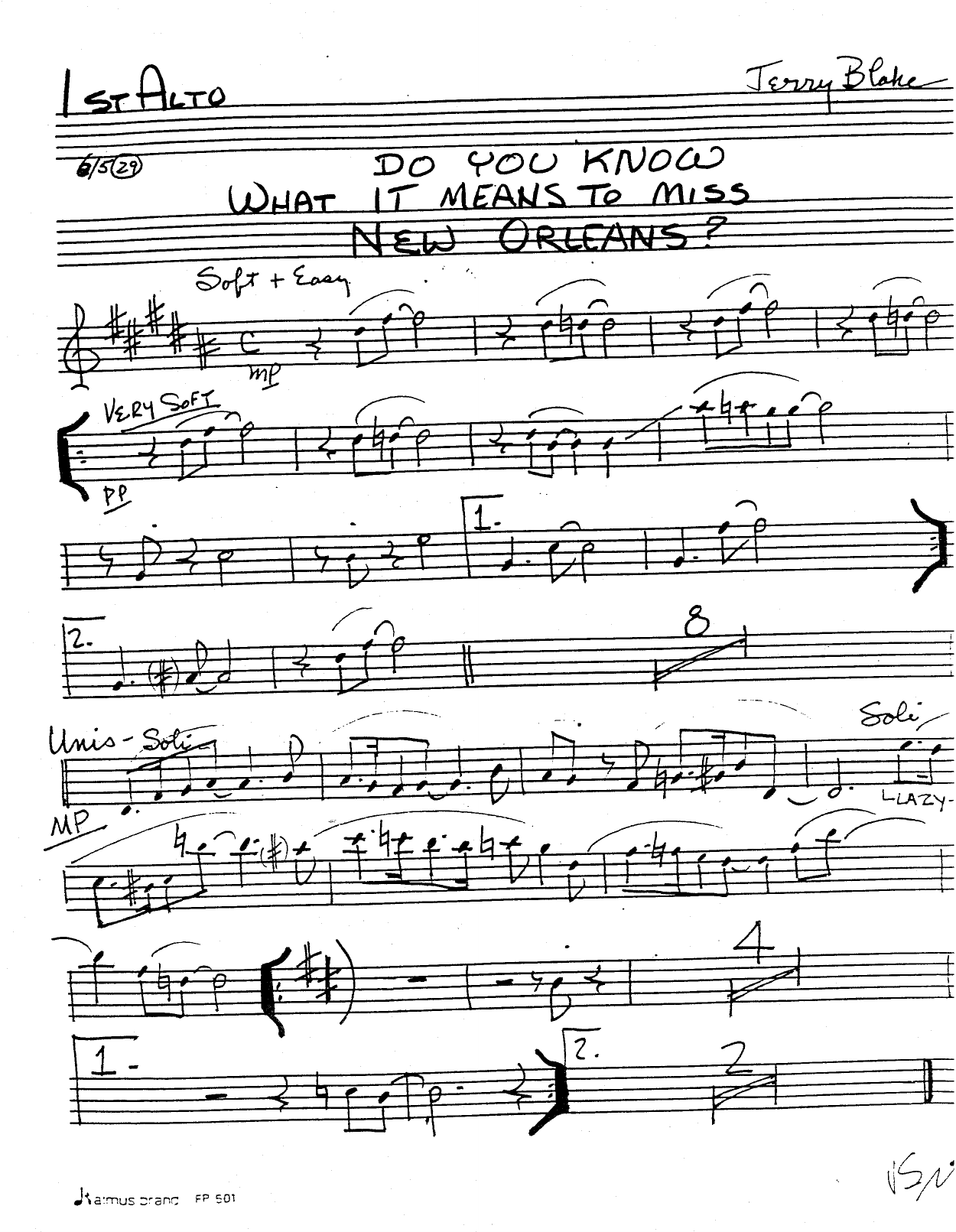
Do You Know What It Means To Miss New Orleans (T.Blake) sheet music preview

Do You Know What It Means To Miss New Orleans (T.Blake)

Composed by Louis Alter

Arranged by T.Blake

  • Ensemble: Big Band
  • Pages: 29
  • Instruments (15): 1st Alto Saxophone, 2nd Alto Saxophone, 1st Tenor Saxophone, 2nd Tenor Saxophone, Baritone Saxophone, 1st Trumpet, 2nd Trumpet, 3rd Trumpet, 1st Trombone, 2nd Trombone, 3rd Trombone, Guitar, Bass, Drums, Piano
  • Difficulty: medium
  • Content: Individual Parts
  • Format: PDF Download (Instant)
  • Price: $24.99

Evoking the humid, soulful atmosphere of the Louisiana Delta, "Do You Know What It Means to Miss New Orleans" stands as one of the definitive tributes to American music's spiritual birthplace. Introduced to the world in the 1947 United States motion picture *New Orleans*, starring Louis Armstrong and Billie Holiday, the composition quickly transcended its cinematic origins to become a permanent fixture of the traditional and mainstream jazz canon. Its enduring appeal lies in its poignant, nostalgic melody and its harmonious balance between melancholy reflection and the buoyant optimism inherent in traditional jazz and swing styling. Generations of jazz interpreters have returned to this tune to capture its distinct blend of urban blues and early New Orleans polyphony translated through a sophisticated lens. In this masterful big band adaptation by T.Blake, the composition is reimagined through a warm, expressive medium swing feel that honors its roots while utilizing modern harmonic coloration. Set in a comfortable, vocal-friendly key that translates brilliantly to instrumental ensemble performance, the arrangement balances rich, lush chord voicings in the brass with fluid, conversational counterlines in the reeds. The emotional trajectory shifts gracefully from introspective, velvety ballad-like openings into a relaxed, forward-driving swing groove. The harmonic language incorporates subtle chromatic extensions and passing chords that enrich the underlying blues structure without ever obscuring the nostalgic core of the original melody. T.Blake’s distinctive approach shines through the clever distribution of thematic material across the entire ensemble. The chart opens with a tender, rubato-flavored introduction before settling into an infectious, unhurried medium swing pulse. The saxophones carry the primary statement of the theme, supported by delicate, counter-melodic responses from muted trumpets and trombones. A tightly knit, harmonically rich sax soli highlights the middle section, showcasing the section's blend and intonation. Following an open solo section for featured improvisers—with provided changes for horn or piano—the arrangement builds organically into a vibrant, brass-driven shout chorus that captures the celebratory street-beat spirit of a second-line parade before winding down to a gentle, reflective coda. Advanced high school, collegiate, and professional community big bands will find this arrangement an exceptionally rewarding addition to their repertoire. While rhythmically accessible, the chart demands a high degree of stylistic maturity, particularly regarding swing subdivision, dynamic control, and blend within the reed and brass sections. Conductors will appreciate how the chart teaches the subtle art of playing behind a groove without rushing, making it an ideal vehicle for teaching stylistic versatility, ensemble cohesion, and expressive phrasing to developing jazz musicians. Achieving an authentic performance of this arrangement requires careful attention to the prescribed medium swing feel, avoiding any tendency to rush the tempo. The rhythm section must anchor the groove with a laid-back, infectious pulse; the ride cymbal should swing gracefully while the bass lays down a steady, walking foundation rooted in two-beat and four-beat feels. Brass players should utilize cup or basket mutes where indicated to achieve the authentic, warm vocal quality reminiscent of the 1940s big band era, reserving open horn playing for the dynamic peaks of the shout chorus. Rehearsals should initially focus on the internal balance of the sax soli, ensuring that the inner voices project clearly beneath the lead alto. Pay close attention to dynamic markings; the contrast between the hushed, intimate opening choruses and the soaring, full-ensemble climaxes is essential for delivering the narrative arc of the piece. Q: What instruments and parts are included in this big band arrangement? A: The arrangement is scored for a standard 15-instrument big band instrumentation, featuring Alto Saxophone 1, Alto Saxophone 2, Tenor Saxophone 1, Tenor Saxophone 2, Baritone Saxophone, plus standard brass and rhythm sections across a comprehensive 29-page manuscript. Q: What is the difficulty level of this chart? A: This arrangement is ideally suited for advanced high school, collegiate, and professional community big bands, requiring strong ensemble blend, stylistic maturity in medium swing, and section balance rather than extreme technical pyrotechnics. Q: What is the historical context and musical style of the piece? A: Originally written for the 1947 film *New Orleans* starring Louis Armstrong, this arrangement treats the tune as a classic medium swing standard, blending traditional New Orleans nostalgia with sophisticated big band harmony. Q: What makes T.Blake's arrangement unique? A: T.Blake distinguishes this treatment through lush, modern harmonic colorations, a conversational dialogue between the reeds and muted brass, a gorgeous saxophone soli, and a dynamic shout chorus that cleverly evokes a second-line feel. Q: What is the performance duration and tempo guidance? A: The arrangement is designed to be performed at a relaxed, unhurried medium swing tempo (approximately 112-120 BPM), resulting in a performance duration of roughly 4 to 5 minutes depending on the length of the open solo sections.

Questions and answers

What is included in the Do You Know What It Means To Miss New Orleans (T.Blake) PDF?
The verified current file contains individual parts across 29 pages.
How many instruments or parts are listed for Do You Know What It Means To Miss New Orleans (T.Blake)?
The verified instrumentation list contains 15 entries for this Big Band arrangement.
Who is credited for Do You Know What It Means To Miss New Orleans (T.Blake)?
Composer: Louis Alter. Arranger: T.Blake.
What difficulty is listed for Do You Know What It Means To Miss New Orleans (T.Blake)?
The verified difficulty level is medium.
Can I preview Do You Know What It Means To Miss New Orleans (T.Blake) before buying?
Yes. The product page provides a preview generated from the current PDF file.
How is Do You Know What It Means To Miss New Orleans (T.Blake) delivered?
After successful payment, the digital PDF is made available for download. The displayed price is $24.99.

Musicians Also Search For

Do You Know What It Means To Miss New Orleans T.Blake PDFDo You Know What It Means To Miss New Orleans T.Blake sheet musicDo You Know What It Means To Miss New Orleans arranged by T.BlakeT.Blake big band chartsT.Blake jazz arrangements PDFDo You Know What It Means To Miss New Orleans Louis Alter sheet musicDo You Know What It Means To Miss New Orleans Louis Alter big band arrangementsLouis Alter big band chartsDo You Know What It Means To Miss New Orleans big band arrangementsDo You Know What It Means To Miss New Orleans big band PDF downloadDo You Know What It Means To Miss New Orleans jazz sheet musicbig band sheet music downloadDo You Know What It Means To Miss New Orleans individual parts downloadDo You Know What It Means To Miss New Orleans sheet music PDFbuy Do You Know What It Means To Miss New Orleans sheet musicdownload Do You Know What It Means To Miss New Orleans PDFDo You Know What It Means To Miss New Orleans jazz chartsbest T.Blake big band arrangementsLouis Alter arranged by T.BlakeDo You Know What It Means To Miss New Orleans printable sheet musicbig band repertoire PDF

All arrangements by T.Blake All Louis Alter sheet music